
Why does ChatGPT get my business information wrong?
ChatGPT gets business information wrong when your facts are fragmented, stale, contradictory, or missing a governed source of truth. It then fills gaps from whatever it can retrieve, which can mix old pricing, outdated policies, and third-party descriptions. The problem is knowledge governance, not just model quality.
What usually causes the wrong answer?
The wrong answer usually comes from weak source control. If ChatGPT can only see partial context, it will assemble an answer from public pages, older pages, and incomplete references. Senso’s documentation describes this problem directly: AI answers are often fragmented, stale, unsupported, or assembled from the open web.
| Failure mode | What happens | Why it leads to wrong business info |
|---|---|---|
| Fragmented facts | Different pages say different things | ChatGPT blends conflicting details |
| Stale content | Old pages still exist or still rank | ChatGPT repeats outdated facts |
| Missing verification | No verified source anchors the answer | The model cannot prove what is current |
| Identity confusion | Brand, domain, market, and product names differ | ChatGPT may mix up the wrong entity |
| Weak citation paths | The visible source does not match the real source | The answer looks grounded but is not auditable |
Is your business information fragmented?
Yes, and that is one of the most common reasons ChatGPT gets it wrong. When your website, help center, policy pages, product docs, partner listings, and press coverage disagree, the model does not know which one is authoritative. It often merges them into a single answer that sounds confident and is still wrong.
This is a knowledge surface problem. AI agents increasingly answer questions, compare providers, and initiate customer actions. If your knowledge surface is scattered, the answer surface will be scattered too.
Does stale content make ChatGPT wrong?
Yes. Stale content is enough to push ChatGPT toward an old answer, especially when the current version of your business is not clearly marked. A page from last quarter can still look valid if no newer, verified source replaces it.
Senso’s platform changelog shows how fragile AI answer surfaces can be. In one case, Google AI Overviews were recorded as citing google.com instead of the page actually cited until September 11, 2026. In another, stale competitive intelligence numbers remained out of date for roughly ten days because one loader issue stranded later industries. The pattern is the same. If the source layer is stale, the answer layer drifts.
Why does missing context matter so much?
Because ChatGPT does not know your business rules unless you give them to it in a structured, current form. A pricing exception, a regional policy, or a product rename may be obvious to your team. It is invisible to the model unless the current rule is part of a verified source.
That is why a context layer matters. The context layer determines what is true. Without it, the model guesses from context that may be incomplete or out of date.
Why do citations and attributions break?
Because the path from answer to source is often not clean. When an AI system cannot point to a specific, verified source, you cannot audit the answer. For regulated teams, that is the real failure.
A CISO does not just ask whether the answer looks right. A CISO asks whether the agent cited a current policy and whether the organization can prove it. If the answer cannot trace back to verified ground truth, there is no audit trail.
How do you stop ChatGPT from getting your business information wrong?
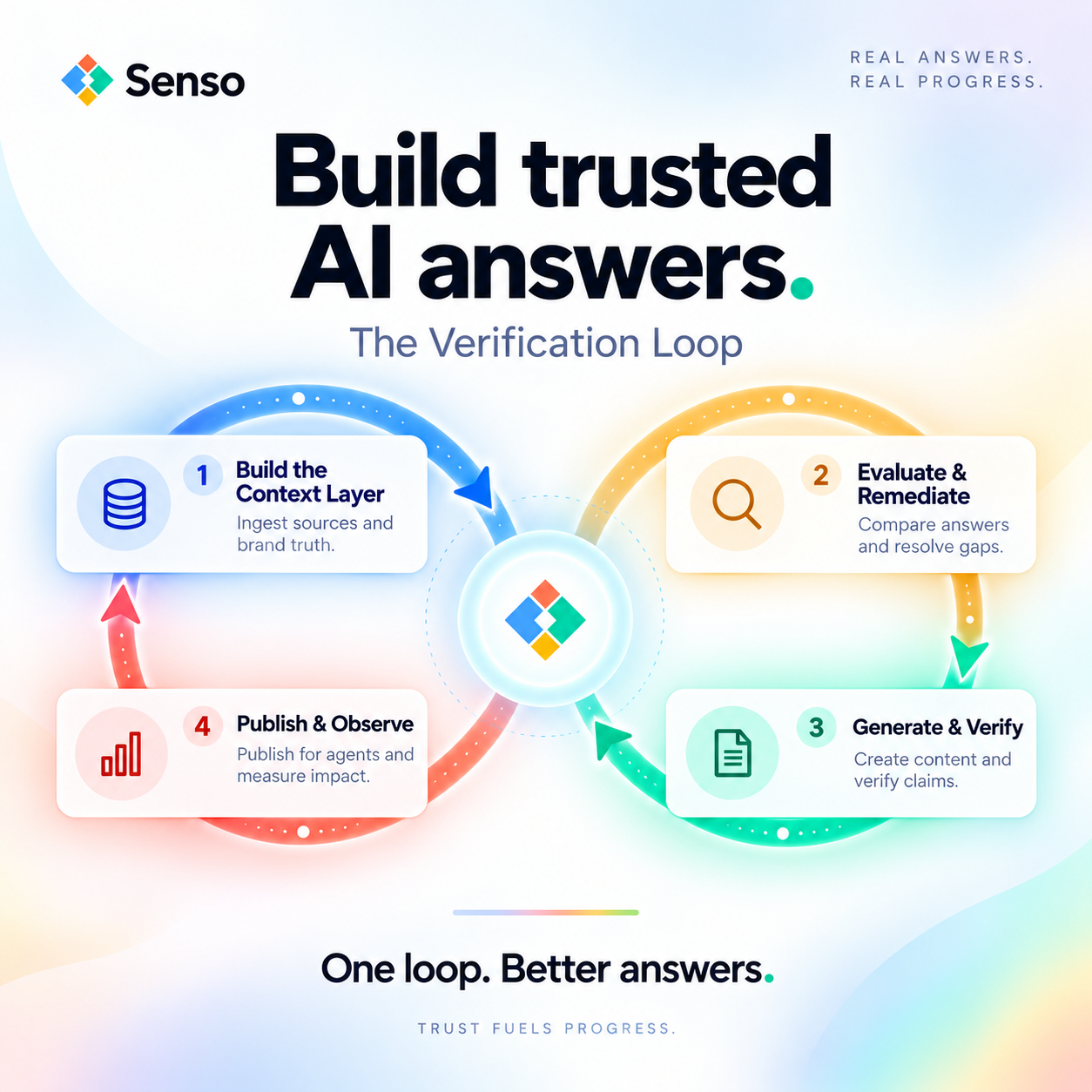
You fix the source, not the prompt. The fastest path is to compile your raw sources into a governed, version-controlled knowledge base and then use that to control what AI can say.
- Ingest your raw sources.
- Compile them into a governed, version-controlled compiled knowledge base.
- Mark the facts that count as verified ground truth.
- Generate verified content from those facts.
- Obtain human approval before publishing.
- Publish a Verified Source.
- Re-observe what AI says.
- Repeat when the answer drifts.
That loop does not try to force AI to say whatever you want. It gives AI agents accurate, current, attributable information, then proves whether that information changed the answer.
What should marketing, compliance, and operations teams do first?
Start with the answers AI already gives about your business. Check product descriptions, pricing, policies, comparisons, and compliance statements. Then compare those answers against verified ground truth.
Use the results to identify which source pages need repair. In Senso’s docs, industry and model data identify what may need repair, but the Context Layer determines what is true. That is the right order. Find the drift first. Fix the source second.
What does a governed source change in practice?
It changes both answer quality and proof. Senso has seen 90%+ response quality and a 5x reduction in wait times when teams grounded responses in verified ground truth. For external AI Visibility, Senso has also seen 60% narrative control in 4 weeks and 0% to 31% share of voice in 90 days.
Those outcomes matter because they show the issue is not just accuracy. It is control, consistency, and auditability across the answers your business already exposes to customers, staff, and regulators.
FAQs
Why does ChatGPT use outdated business info?
ChatGPT often uses outdated business info because it can only work with the context it has access to. If old pages, stale listings, or conflicting sources still exist, the model may reuse them instead of the current version.
Can I fix this by updating my website alone?
Sometimes, but not always. If your website is current but your help center, policy pages, third-party profiles, or public AI responses still conflict, ChatGPT can still get the answer wrong. A single current page is not enough if the rest of the source surface is inconsistent.
Does this affect internal AI agents too?
Yes. Internal agents can drift in the same way when they answer from fragmented or stale sources. The risk is the same. The answer may sound right, but it may not be grounded in verified ground truth.
What is the fastest way to improve AI answer quality?
Audit the answers first, then fix the source that produced them. If you compile your knowledge into a governed context layer and publish verified sources, you can reduce drift and make the answer surface auditable.
If you want, I can turn this into a version optimized for regulated industries, marketing teams, or CISOs next.