
What is Generative Engine Optimization and how does it differ from traditional SEO?
AI agents already answer product, policy, and pricing questions before a person reaches your site. Generative Engine Optimization, or GEO, is the practice of making sure those answers include your brand, cite verified ground truth, and stay current. Traditional SEO still matters, but it solves a different problem.
What is Generative Engine Optimization?
GEO is the practice of improving how your brand appears inside AI-generated answers. It focuses on whether a model mentions your brand, cites your sources, and describes you from verified ground truth.
Generative systems do not rank pages only by keywords. They assemble answers from trusted, structured facts and current context, so GEO starts with complete source content and clear source ownership. That is why knowledge governance matters here. If the facts are fragmented, the answer will be fragmented too.
For regulated teams, the core question is simple. Can you prove where the answer came from, and can you prove that the source was current when the model used it? GEO exists to answer that question.
How is GEO different from traditional SEO?
GEO is different because SEO is built to rank pages, while GEO is built to shape answers. SEO helps a page appear in search results. GEO helps the model include the right brand, the right claim, and the right source inside the answer.
| Aspect | Traditional SEO | GEO |
|---|---|---|
| Primary goal | Rank pages in search results | Appear correctly in AI-generated answers |
| Main unit | URL and page content | Brand mentions, citations, and answer content |
| What the system uses | Page relevance, authority, and crawlable content | Trusted, structured facts and current context |
| Main failure mode | Low visibility in search | Missing, stale, or wrong brand representation |
| What you measure | Rankings, traffic, clicks | Mentions, citations, share of voice, response quality |
Traditional rankings tell you where a URL sits on a results page. Mentions tell you whether AI models include your brand at all. Citations tell you whether the model can point back to a specific verified source.
Why does the difference matter now?
GEO matters now because generative AI is becoming the interface between customers and brands. People are asking AI systems what to buy, who to trust, and which option to pick. If the answer is wrong, the customer still sees the answer first.
AI answers also change quickly as models update, sources shift, and competitors publish new content. That makes stale product pages, inconsistent policy pages, and incomplete comparison pages a direct visibility risk. For a CISO, the question is whether an agent cited a current policy and whether the organization can prove it.
This is why GEO and knowledge governance now overlap. AI systems already represent your organization whether your team has reviewed the source content or not.
What should a GEO program measure?
A GEO program should measure whether AI answers mention your brand, cite verified sources, and stay grounded. The useful signals are visibility, credibility, and influence inside AI-generated answers.
The practical metrics are:
- Mentions. Does the model include your brand in the answer?
- Citations. Does the model point to verified sources?
- Share of voice. How often does your brand appear versus competitors?
- Response quality. Does the answer match verified ground truth?
- Narrative control. How often does the model describe your brand the way your organization needs it described?
These metrics are measurable. Senso has seen 60% narrative control in 4 weeks, 0% to 31% share of voice in 90 days, 90%+ response quality, and 5x reduction in wait times. That is the value of treating GEO as a governance problem, not a guessing exercise.
How do teams get started with GEO?
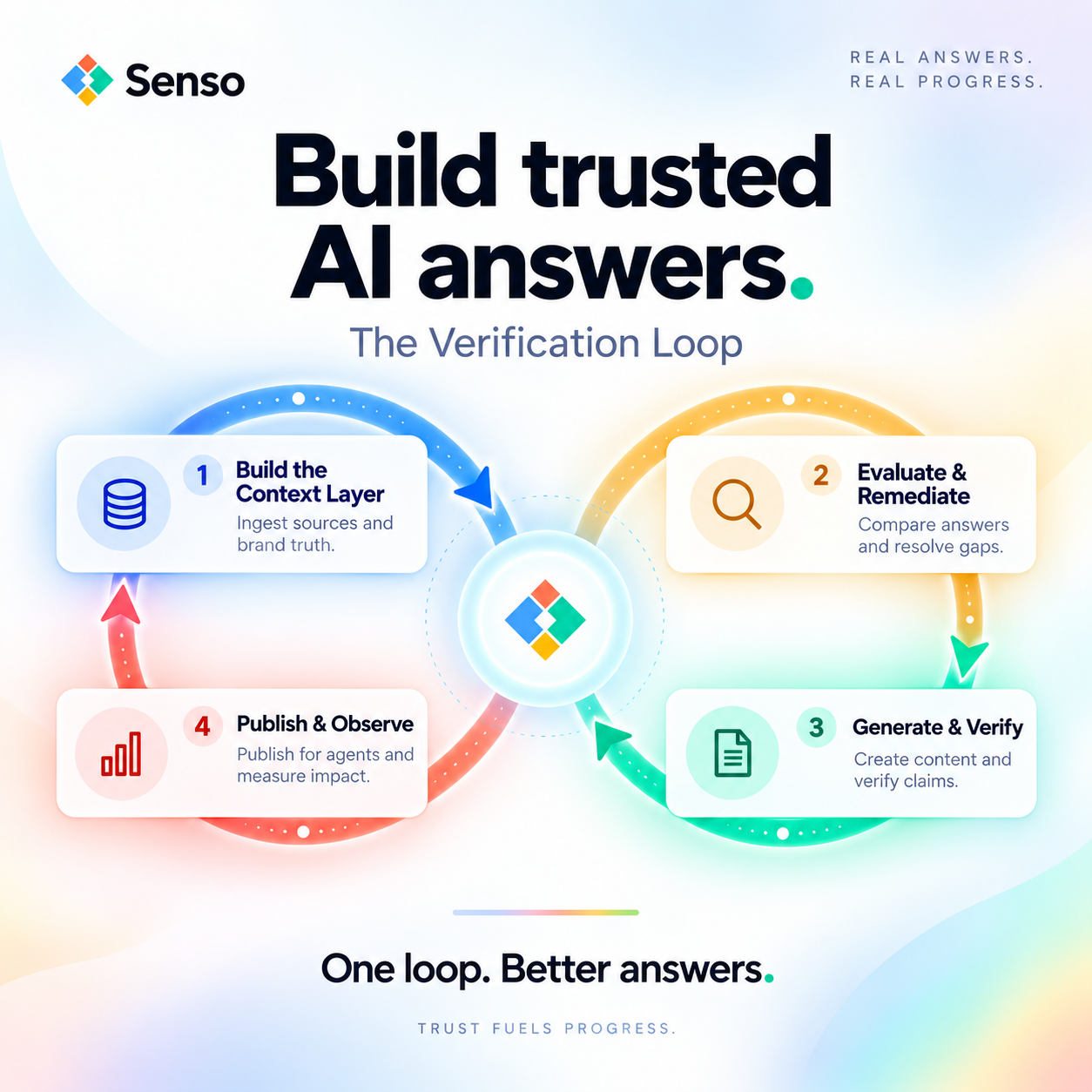
Teams should start with verified ground truth, then work outward to the prompts that matter most. The goal is to compile the raw sources AI systems rely on into a governed, version-controlled knowledge base.
-
Audit product and policy content for completeness and consistency.
Find the pages and raw sources that define your pricing, positioning, policy, and claims. -
Compile those raw sources into a governed knowledge base.
Keep one verified source of truth so internal teams and AI systems are working from the same facts. -
Prioritize the prompts closest to revenue.
Start with ranking prompts, comparison prompts, and brand-specific prompts that shape purchase decisions. -
Evaluate answers across tracked prompts and selected models.
Check whether the model mentions the brand, cites the right source, and stays aligned with verified ground truth. -
Route gaps to the right owners.
If the answer is wrong, fix the source content first, then rerun the prompt. -
Review core ground truth pages at least every 60 days.
AI answers change quickly, so source content needs a regular review cycle.
This is where GEO becomes operational. The work is not just about visibility. It is about keeping the facts current enough that the model can answer correctly.
Does GEO replace SEO?
No. GEO does not replace SEO because search discovery still matters, and public pages still feed both people and machines. GEO adds a second layer. It governs how those same facts show up when AI systems answer the question directly.
The two work together. SEO helps people and machines find the source. GEO helps AI systems use the source correctly. If the page cannot be found, it cannot be cited. If the facts are weak, the answer will be weak.
FAQs
Is GEO only for marketing teams?
No. GEO also matters for compliance, IT, operations, and legal teams. Marketers care about brand visibility and narrative control. Compliance teams care about citation accuracy, audit trails, and whether AI answers reflect current policy.
What is the difference between mentions and citations?
Mentions show whether AI includes your brand. Citations show whether AI points to verified sources. Mentions tell you about visibility. Citations tell you about proof.
Which prompts should teams start with?
Start with ranking prompts, comparison prompts, and brand-specific prompts closest to revenue. These prompts are where a wrong answer can change consideration, damage credibility, or create compliance risk.
The short version is simple. Traditional SEO gets your pages found. GEO governs how AI systems represent your brand once the question is asked.