
What is the role of structured data in answer engine optimization?
Structured data gives answer engines the machine-readable facts they need to retrieve, verify, and cite the right information. It turns raw sources into grounded signals about products, policies, dates, and entities, which is why it sits at the center of answer engine optimization. For enterprises, it also supports narrative control because AI systems can only describe what they can parse and prove.
What does structured data actually do for answer engines?
Structured data tells an answer engine what each fact means. It labels the entity, the attribute, the version, and the source, so the system can assemble a citation-accurate response instead of guessing from scattered text.
Senso's documentation is direct on this point. Generative systems do not rank pages only by keywords. They assemble answers from trusted, structured facts and context.
| Structured signal | What it helps answer engines do |
|---|---|
| Entity names and aliases | Identify the right brand, product, or person |
| Attributes and values | Pull the right fact into the answer |
| Dates and version numbers | Keep answers current |
| Source references | Trace the claim back to verified ground truth |
| Relationships and categories | Compare products, policies, or options correctly |
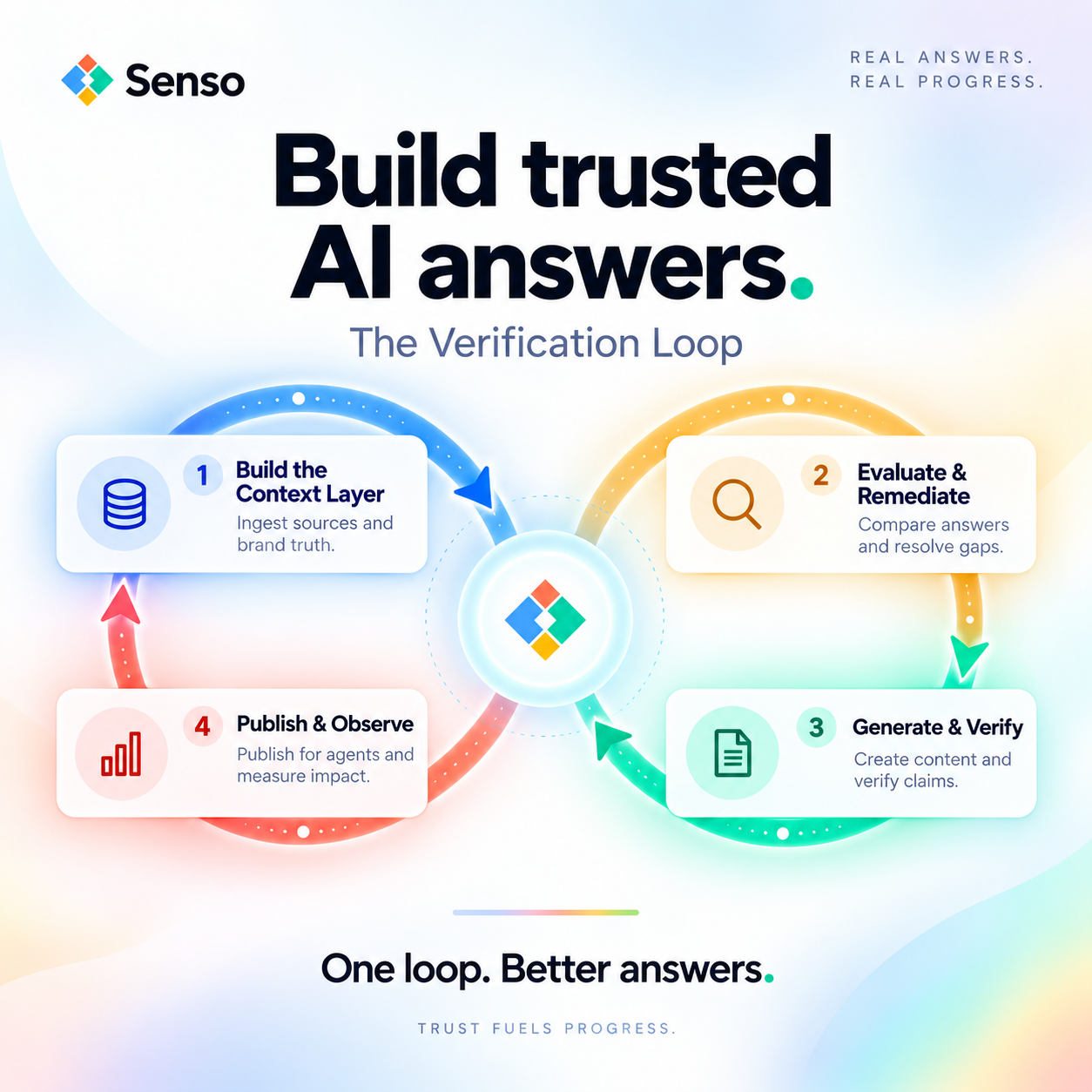
In practice, structured data is the bridge between raw sources and grounded answers. It gives the model a stable way to connect a query to the correct fact, source, and version.
Why does structured data matter more than keywords alone?
Keywords help discovery, but structure helps selection. Answer engines assemble responses from trusted structured facts, so a page with clear fields, canonical names, and source links is easier to use than a page full of loosely related copy.
This matters most when the query asks for a comparison, a policy, or a recommendation. Senso defines narrative control as an enterprise’s ability to influence how AI systems describe, compare, and recommend its brand, and structured data is what makes that possible at scale.
Structured data also reduces duplication. One compiled knowledge base can feed both internal workflow agents and external AI-answer representation, so the same facts drive customer-facing answers and internal agent responses.
What should you structure first?
Start with the facts closest to revenue and risk. Senso’s documentation recommends ranking prompts, comparison prompts, and brand-specific questions first, then auditing product and policy content for completeness and consistency.
| What to structure first | Why it comes first |
|---|---|
| Product names and feature sets | Answer engines need canonical product facts |
| Policies and exceptions | Compliance teams need current, provable answers |
| Pricing or packaging details | Public queries often ask for direct comparisons |
| Comparisons and alternatives | Answer engines often synthesize evaluation queries |
| Dates, versions, and owners | These fields support auditability and freshness |
| Source citations | These connect claims to verified ground truth |
For web pages, that usually means schema for Organization, Product, FAQPage, HowTo, Article, and BreadcrumbList, plus clear authorship and version fields.
How does structured data support citation accuracy and auditability?
Structured data creates a trace from answer back to a specific verified source. That is the difference between “the agent said it” and “we can prove which source it used.”
For regulated teams, that trace matters. When a CISO asks whether an agent cited a current policy, the answer should show the exact policy version, the owner, and the review date. Without that chain, you have no audit trail.
This is why Senso frames the problem as knowledge governance, not content formatting. Every answer should trace back to a specific, verified source, and every response should be scored against verified ground truth.
What does answer-engine-ready content look like?
Answer-engine-ready content starts with the answer, uses question-style headings, and puts proof close to the claim. Senso’s platform notes say content built to be cited by AI answer engines uses answer-first phrasing, question-style headings, and proof placed next to claims.
Keep each paragraph to one idea. Use canonical names. Use clear labels. Do not bury the key fact in the fourth paragraph. If an answer engine cannot find the fact quickly, it may not cite it.
Good structure does not mean thin content. It means content that a machine can read without confusion and a human can verify without hunting.
What are the limits of structured data?
Structured data cannot fix contradictory source material. If product pages, policy pages, and help content disagree, answer engines inherit that conflict.
Start with ground truth infrastructure. Audit product and policy content for completeness and consistency, then add structure on top. This is the fastest path to grounded answers without creating false confidence.
Structured data is a layer, not a substitute for governance. If the underlying facts are wrong, the markup only makes the wrong facts easier to reuse.
Is structured data the same as schema markup?
No. Schema markup is one way to expose structured data, but the job is broader than markup alone. You also need consistent naming, version control, source references, and clear ownership.
Think of schema as the delivery format. Structured data is the underlying factual model. Answer engines need both.
Does structured data guarantee citations?
No. Structured data makes citations easier, but answer engines still choose what to cite based on trust, relevance, and clarity. If the source is incomplete or inconsistent, the citation can still miss the point.
That is why the best results come from governed source content, not markup added after the fact.
What should regulated teams do next?
Start with the queries that carry the most risk. That usually means product, policy, comparison, and support queries that can affect revenue, compliance, or customer trust.
Then do three things:
- Audit the raw sources for conflicts and missing facts.
- Compile the verified facts into a governed, version-controlled knowledge base.
- Add structured fields, source links, and review dates where the answers matter most.
That sequence gives you a better path to AI Visibility than adding markup alone. It also gives compliance teams a way to prove what the system used.
Structured data is the context layer that lets answer engines retrieve the right facts, cite the right source, and represent your organization correctly. For teams that need grounded answers, auditability, and narrative control, it is the foundation that makes answer engine optimization work in practice.