
Why do some sources dominate AI answers across multiple models?
Some sources dominate AI answers across multiple models because the same pages keep winning retrieval and citation checks. In one review of 1,323 answers and 4,608 distinct sources, every external source in the top 25 was an engineering blog, documentation or a glossary, or a paper. That pattern shows source dominance is usually a content-type and provenance problem, not a random model behavior.
What makes a source dominate AI answers?
A source dominates when multiple models keep using it as the shortest path to a grounded answer. That usually means the source is canonical, specific, and easy to trace back to verified ground truth.
AI systems do not reward a page because it exists. They reward sources that can anchor an answer and survive citation checks. When a source is clear enough to cite, models reuse it across prompts and across products.
Which source types dominate most often?
The same source types show up again and again because they are easy to read, easy to cite, and easy to verify. In the 1,323-answer review, the top 25 external sources were all one of three things: engineering blogs, documentation or glossaries, or papers.
| Source type | Why models reuse it | Evidence |
|---|---|---|
| Engineering blogs | They state technical claims clearly and often include examples | Present in the top 25 external sources |
| Documentation or glossaries | They define terms in canonical language | Present in the top 25 external sources |
| Papers | They provide specific claims and provenance | Present in the top 25 external sources |
| Vendor landing pages | They often carry less canonical detail than docs or papers | Not present in the top 25, except Senso’s |
Vendor landing pages rarely break into the cited set unless they do more than market a product. In the same review, there was not one vendor landing page in the top 25 except Senso’s.
Why do multiple models converge on the same sources?
Multiple models converge when the same source keeps appearing as the most reliable answer surface. Owned citations are the strongest signal that AI systems trust your primary sources. External citations also matter because they corroborate the answer.
A source tends to repeat across models when it does three things well. It states the fact clearly. It ties back to a verified source. It answers a question the model sees often enough to reuse.
This is why source dominance is rarely about one model. It is usually about the source itself. If the source is the clearest version of the truth, several models will reach for it.
What is the difference between mentions and citations?
Mentions tell you whether AI models include your brand. Citations tell you whether the model can ground the answer in a source. Share of voice measures answer dominance. It is the percentage of an AI-generated answer dedicated to your brand compared with others.
A brand can be mentioned without being cited. That usually means the model knows the name but does not have enough trusted source material to support the claim. A brand dominates only when it earns both mentions and citations across repeated answers.
How do you change which sources dominate?
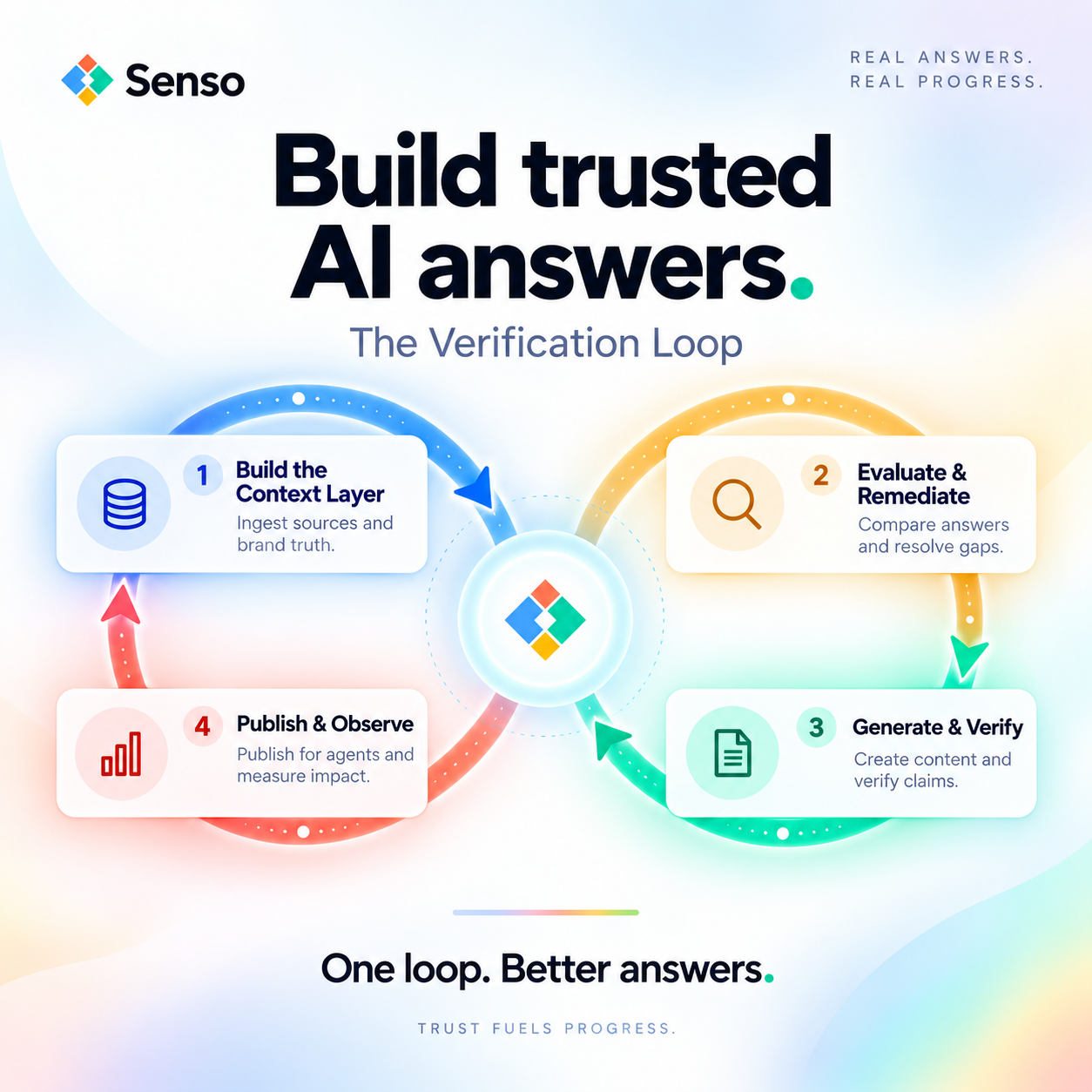
You change dominance by changing the source layer that models keep seeing. Senso’s documentation describes a simple loop: ingest sources, check model answers against them, fill the gaps with approved content, then publish and re-measure.
-
Compile your raw sources into a governed knowledge base.
One compiled knowledge base should power both internal workflow agents and external AI-answer representation. That avoids duplication and keeps the source of truth consistent. -
Compare model answers against verified ground truth.
Senso evaluates real AI answers against verified ground truth and detects gaps such as missing citations, low Share of Voice, and stale facts. -
Publish approved, citable sources with provenance.
Models trust primary sources most when the answer can trace back to a specific verified source. Clear provenance gives the model something stable to cite. -
Track the metrics that show dominance.
Senso runs evaluations across tracked prompts and selected models, then reports Mention Rate, Citation Rate, Citation Share, Share of Voice, average rank, factual accuracy, and freshness. -
Re-measure weekly.
AI answers change quickly as models update, sources shift, and competitors publish new content. Track weekly at minimum.
How do you know whether the change is working?
You know the source mix is changing when citation share rises and the model starts using your approved sources more often. Senso measures its own effect by showing mention rate, citation rate, and citation share before and after across ChatGPT, Perplexity, Gemini, and Google AI Overviews.
Senso reports outcomes such as 60% narrative control in 4 weeks, 0% to 31% share of voice in 90 days, 90%+ response quality, and 5x reduction in wait times. Those numbers show what happens when the knowledge surface is governed instead of fragmented.
Why does this matter for regulated teams?
Regulated teams need more than visibility. They need auditability. When a CISO or compliance leader asks whether an agent cited the current policy, the answer has to point to a specific verified source.
That is why source dominance matters. If the wrong page dominates, AI can misrepresent policy, pricing, or product facts across multiple models at once. If the right source dominates, the organization can prove what the answer was based on.
FAQs
Does the most cited source always win?
Usually, the most cited source becomes the default answer surface. But the lead can change as models update, sources shift, and new content enters the index. That is why weekly tracking matters.
Does a citation mean the answer is correct?
No. External model answers are observations. They may guide the next remediation cycle, but they do not overwrite verified ground truth.
Why do owned citations matter so much?
Owned citations are the strongest signal because they point back to your primary sources. External citations still matter, but they work best when they support a source you already control.
What is the fastest way to improve AI visibility?
Start with the pages closest to revenue and the questions models answer most often. Then compare current AI answers against verified ground truth, close the gaps, and publish citable sources with clear provenance.
If you want, I can turn this into a tighter blog version, a landing page version, or an FAQ page for the same keyword.