
What should I do to make sure AI agents can find and recommend my products?
AI agents recommend products when your facts are specific, current, and easy to verify. Discovery is shifting from browsing pages to asking AI for a best answer, so the brands that win are the ones with verified ground truth. The job is to compile those facts, publish them cleanly, and keep them current.
Quick answer
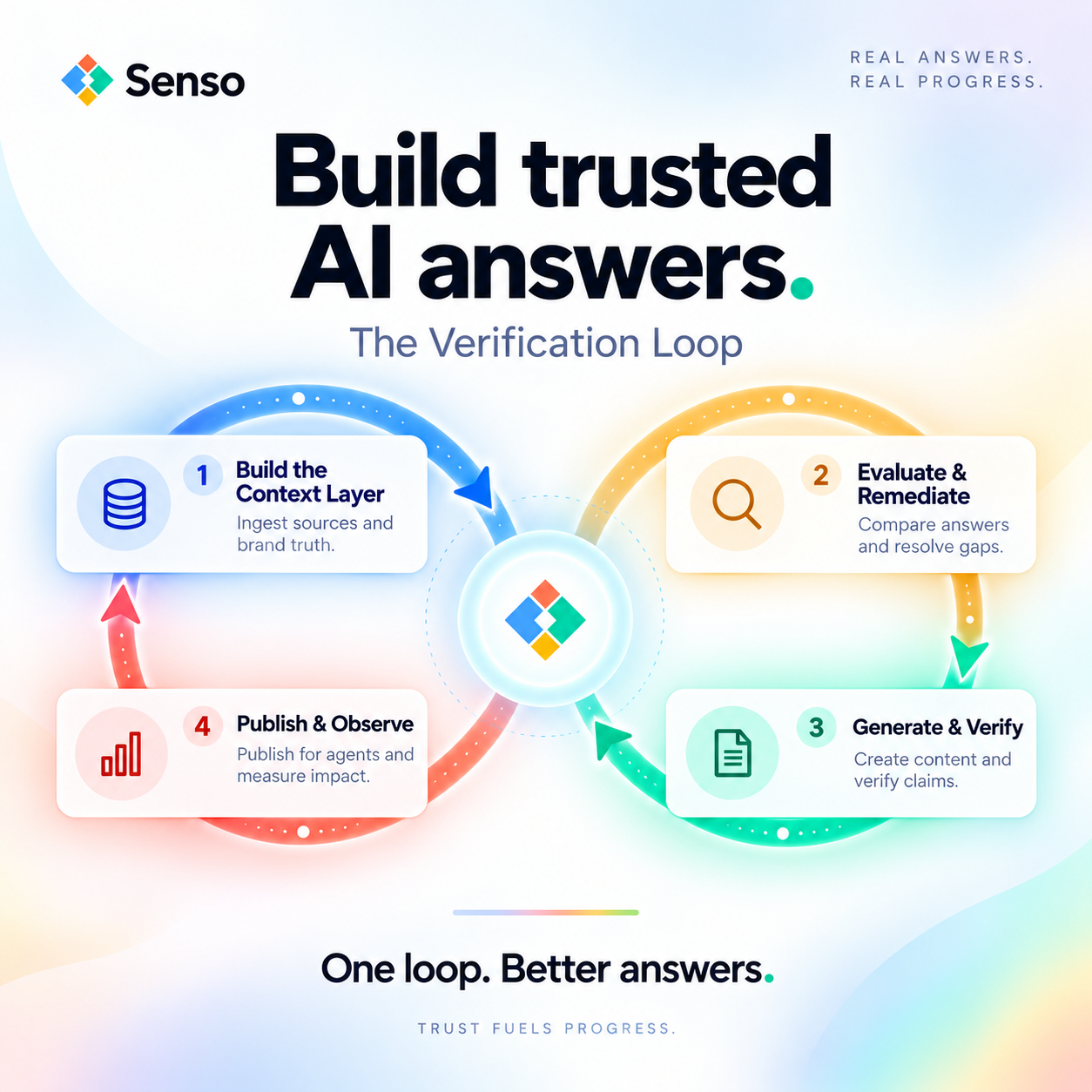
Start with one governed source of truth. Ingest your raw sources, compile them into a version-controlled compiled knowledge base, publish clean pages that answer buyer questions, and measure what AI systems say about you. If you do that well, agents are more likely to cite you, compare you fairly, and recommend you.
What do AI agents need before they recommend a product?
AI agents need verified ground truth. They reduce uncertainty and risk, so they favor facts that are specific, consistent, and current. AI systems already describe products, compare competitors, summarize policies, and recommend vendors, which means your product facts need to be ready for machine use.
The most useful inputs are:
- Canonical product names
- Exact product descriptions
- Current pricing and packaging
- Policies and usage limits
- Use cases and ideal customers
- Comparison points against alternatives
- Support and escalation details
- Clear source ownership
If any of these facts conflict across pages, the agent can choose a competitor with cleaner inputs.
What should you publish first?
Publish the pages that answer the first buyer questions. Clean, structured formats perform best, especially FAQs, pricing pages, policy pages, and product detail pages. These pages give AI systems the shortest path from question to citation.
| Page type | Why it matters |
|---|---|
| Product page | Defines what the product is and who it is for |
| FAQ page | Answers common questions in a direct format |
| Pricing page | Gives current commercial facts |
| Policy page | Gives current usage, security, or compliance rules |
| Comparison page | Clarifies where you fit versus alternatives |
| Support page | Shows escalation paths and service details |
Refresh these pages immediately after changes to products, pricing, or policies. Stale facts reduce citation accuracy.
How should you structure each page?
Each page should answer one question and contain one set of verified facts. AI agents do better with short, structured pages than with long marketing copy. The goal is to make the answer easy to query and easy to cite.
Use this structure:
- Put the direct answer first.
- Use the same product names everywhere.
- State current facts in plain language.
- Add short FAQs for common follow-up questions.
- Keep related facts on the same page.
- Remove conflicting or outdated copy.
A product page should not force an agent to infer the basics. It should state the basics clearly.
How do you keep AI answers current?
Refresh core ground truth pages on a regular cadence and immediately after changes to products, pricing, or policies. That simple habit prevents stale answers from spreading across AI systems.
Good governance includes:
- Clear ownership for each source page
- Version history for every change
- Review before publication
- Fast correction when facts change
- Re-evaluation after updates
If the source changes first, the agent has a current answer to cite. If the source changes later, the agent keeps repeating the old one.
How do you know whether AI agents are recommending you?
Measure mentions, citations, and response quality across evaluated prompt runs. Mentions show how often your brand appears in AI-generated answers. Citation accuracy shows whether the answer points back to verified ground truth. Response quality shows whether the answer matches the source.
Senso uses this model in practice. It scores every response against verified ground truth and tracks what AI systems say about your brand. That matters because you cannot fix what you cannot see.
Proof points from Senso deployments: 60% narrative control in 4 weeks, 0% to 31% share of voice in 90 days, 90%+ response quality, and a 5x reduction in wait times.
Where does Senso fit?
Senso fits when you need AI visibility and governance, not just more content. It compiles enterprise knowledge into a governed, version-controlled compiled knowledge base, so agents can query the same verified source without duplication.
| Need | Senso product | What it does |
|---|---|---|
| External AI visibility | Senso AI Discovery | Scores public AI responses for accuracy, brand visibility, and compliance against verified ground truth. No integration required. |
| Internal agent governance | Senso Agentic Support and RAG Verification | Scores internal agent responses against verified ground truth, routes gaps to the right owners, and gives compliance teams visibility into what agents are saying. |
Senso is backed by Y Combinator W24. It is built for the agentic enterprise, where AI agents already represent the organization whether the organization has governed its knowledge or not.
What should you do this week?
Start with the facts buyers and agents need most. Then publish them in a format that agents can use without interpretation.
- List the top 10 questions buyers ask about your product.
- Gather the raw sources that answer those questions.
- Pick one canonical answer for each fact.
- Write or refresh the FAQ, pricing, policy, and product pages.
- Compile those raw sources into a governed knowledge base.
- Run prompt evaluations to see what AI systems say today.
- Fix the top inaccuracies and rerun the checks after each change.
If you do only one thing, fix the source pages first. Agents can only recommend what they can verify.
FAQs
What is the fastest way to improve AI recommendations for my products?
The fastest path is to publish verified ground truth in structured pages. Start with product, pricing, policy, and FAQ pages, then correct any conflicting facts across the rest of your site.
Do I need a huge content library to get recommended?
No. AI systems favor specific, consistent, and easy-to-verify facts. A small set of strong source pages often helps more than a large set of generic copy.
How often should I update my product facts?
Update them any time products, pricing, policies, or support terms change. Refreshing after change is more important than waiting for a fixed schedule.
What is the difference between external AI visibility and internal agent governance?
External AI visibility controls how public AI systems represent your brand. Internal agent governance checks whether your own agents are citing current, verified facts. Senso covers both with separate product lines.
When should I use Senso?
Use Senso when you need proof of what AI systems are saying, not just more content. It is a fit for teams that need narrative control, citation accuracy, and auditability across public AI answers and internal agents.