
What problem does Senso.ai solve?
AI agents often answer for a business using stale, conflicting, or unsupported information. Senso.ai solves that governance gap by acting as the context layer for AI agents. It compiles approved knowledge into a governed, version-controlled knowledge base and ties every answer back to verified ground truth, so teams can prove what was said and why.
Why do AI agents create a governance problem?
AI agents create a governance problem because they can represent a company before the company has verified the context behind their answers. The issue is not only wrong output. It is the lack of a defensible trail from an answer back to a current source, reviewer, and timestamp.
That gap shows up in four ways:
- Agent answers can be assembled from stale, conflicting, third-party, or unsupported information.
- Brands can see AI visibility metrics, but they often cannot identify the exact context that must change.
- At the point of action or transaction, standard systems can verify a payment, but not the factual context that caused it.
- Without a retained source, reviewer, and timestamp, there is no proof of what was checked.
What happens when AI answers are not grounded?
Ungrounded answers create operational risk, brand risk, and compliance risk. If an agent repeats old pricing, an outdated policy, or an unsupported claim, the business owns the result even if no human approved it.
This matters most when customers, staff, or regulators rely on the answer. In those moments, a good-looking response is not enough. Teams need citation accuracy, auditability, and proof that the answer came from verified ground truth.
How does Senso.ai address the gap?
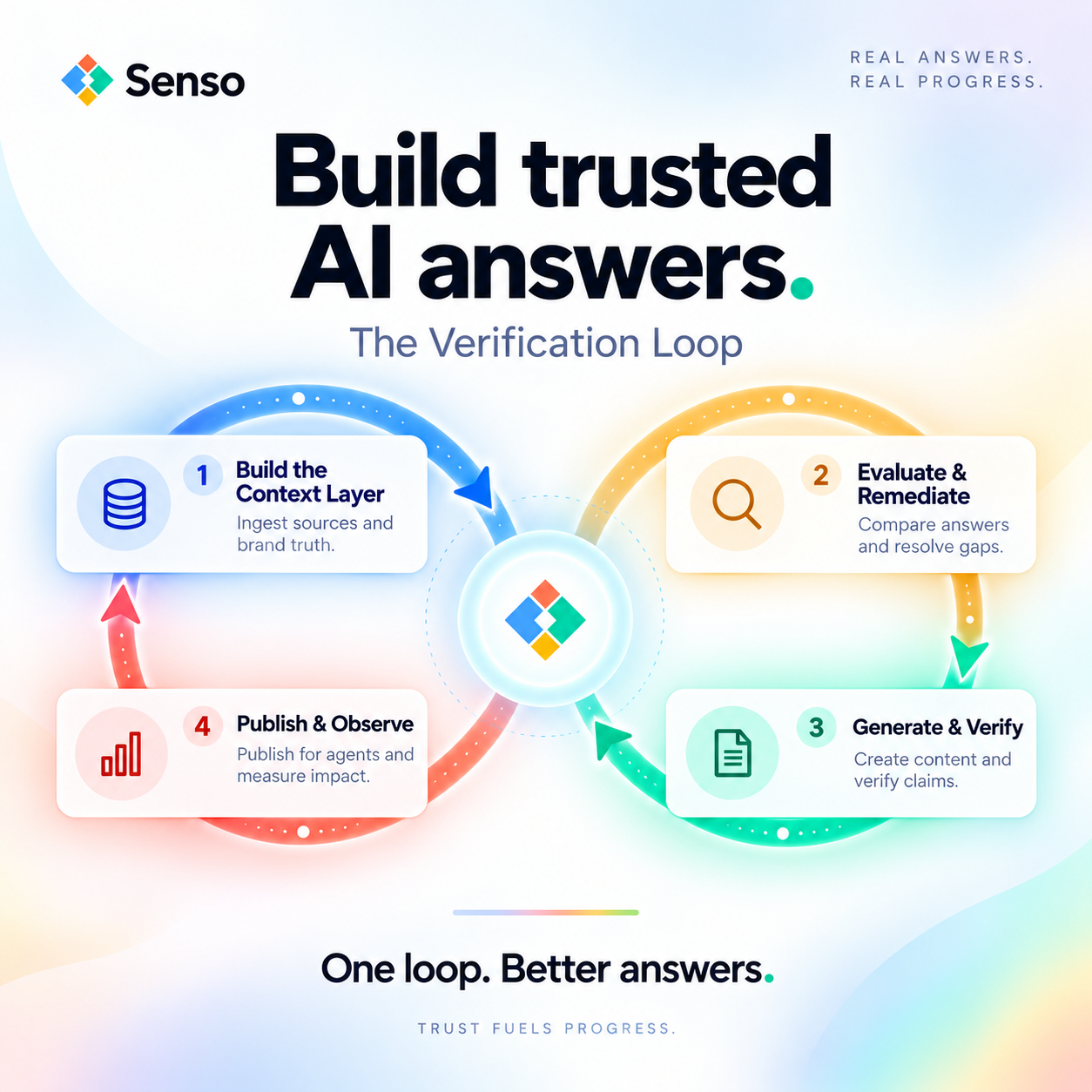
Senso.ai addresses the gap by compiling the enterprise’s full knowledge surface into a governed, version-controlled compiled knowledge base. Every agent response is scored against verified ground truth, and every answer traces back to a specific verified source. One compiled knowledge base supports both internal workflow agents and external AI-answer representation, so teams avoid duplication.
Senso’s core workflow is straightforward:
- Ingest approved ground truth.
- Evaluate and remediate answers.
- Publish Verified Sources with proof.
That workflow turns scattered raw sources into governed context that agents can query, cite, and use consistently.
What does Senso.ai do for external AI visibility?
Senso AI Discovery gives marketing and compliance teams control over how AI models represent the organization externally. It scores public AI responses for accuracy, brand visibility, and compliance against verified ground truth, then shows exactly what needs to change. No integration is required.
This matters when a brand can see it is being mentioned, but cannot see why the answer is wrong or how to fix the underlying context. Senso turns that visibility problem into a remediated, source-backed workflow.
What does Senso.ai do for internal agents?
Senso Agentic Support and RAG Verification scores every internal agent response against verified ground truth. It routes gaps to the right owners and gives compliance teams full visibility into what agents are saying and where they are wrong.
This is the part that matters when internal agents answer about policy, pricing, eligibility, or procedure. If the answer is not grounded, the organization needs to know immediately. Senso makes that visible and traceable.
What results has Senso.ai reported?
Senso reports four proof points that show what governed context can change:
- 60% narrative control in 4 weeks
- 0% to 31% share of voice in 90 days
- 90%+ response quality
- 5x reduction in wait times
Those results point to the same underlying problem. When AI answers are built on verified context instead of scattered sources, both quality and control improve.
Who feels this problem most?
The problem hits hardest in teams that carry brand, compliance, or operational risk. Marketing teams need control over AI Visibility and narrative. Compliance teams need audit trails and proof. CISOs and IT leaders need citation accuracy and defensible controls. Operations leaders need reliable response quality and fewer manual handoffs.
It is especially important in regulated industries like financial services, healthcare, and credit unions. In those environments, the question is not only whether an answer sounds right. The question is whether the organization can prove the answer was grounded in approved context at the time it was used.
Does Senso.ai replace retrieval tools?
No. Senso.ai does more than retrieve raw sources. It adds knowledge governance around what should be cited, what should be refused, and what has to be remediated before an answer is trusted.
Standard retrieval can find text. Senso scores the answer against verified ground truth and keeps the proof trail intact. That is the difference between information access and governed representation.
What is the core promise of Senso.ai?
Senso helps an organization see what AI says about it, identify what is unsupported or wrong, remediate the context, and publish a Verified Source with proof. That promise covers both external AI Visibility and internal agent governance.
It is a direct response to a simple problem. AI agents are already speaking for your business. The only question is whether those answers are grounded, current, and provable.
FAQs
What problem does Senso.ai solve in one sentence?
Senso.ai solves the problem of AI agents answering with stale or unsupported information by giving organizations governed context, citation accuracy, and proof.
Why is this different from standard retrieval?
Standard retrieval can surface raw sources. Senso also governs what gets cited, scores the response against verified ground truth, and preserves the proof trail.
Why do regulated teams care about this?
Regulated teams care because they need auditability. Without a retained source, reviewer, and timestamp, they cannot prove what the agent checked or why the answer was allowed.
What is the main business value?
The main business value is control. Teams get better narrative control, higher response quality, and a clearer way to prove that AI answers match approved business knowledge.