
What makes Senso’s GEO platform unique?
AI agents are already the interface to your business. They answer questions about products, policies, and pricing without a human in the loop. Senso’s GEO platform is unique because it does more than measure visibility. It verifies the context behind those answers, compiles raw sources into a governed, version-controlled knowledge base, and ties every response to verified ground truth and a specific source.
That matters because standard retrieval tools do not answer the CISO question: did the agent cite a current policy, and can the organization prove it? Senso closes that gap with receipts, audit trails, and version control. Senso is backed by Y Combinator (W24).
What problem does Senso solve?
Senso solves the gap between AI answers and provable knowledge. Most enterprises already have agents answering for them, but the knowledge behind those answers is fragmented, unstructured, and hard to audit.
Cloudflare reports that automated agents and bots now generate more than half of all web requests. That makes answer quality, provenance, and compliance part of daily operations, not a future concern.
What makes Senso different from a standard GEO tool?
Senso does not stop at measurement. It connects AI Visibility to knowledge governance, so teams can see what AI said, why it said it, and what approved context should replace the gap.
| Capability | Typical GEO tool | Senso |
|---|---|---|
| Primary job | Measure visibility in AI answers | Measure visibility and verify context behind the answer |
| Evidence | Surface-level reporting | Every answer traces back to a specific verified source |
| Workflow | Flag gaps | Show exactly what needs to change or be published |
| Governance | Limited auditability | Receipts and audit trails |
| Knowledge model | Separate systems for different use cases | One compiled knowledge base for internal agents and external AI-answer representation |
Senso is not just a monitor. It is the operating loop that turns an observed answer gap into approved, citable context and a retrievable receipt.
How does Senso work?
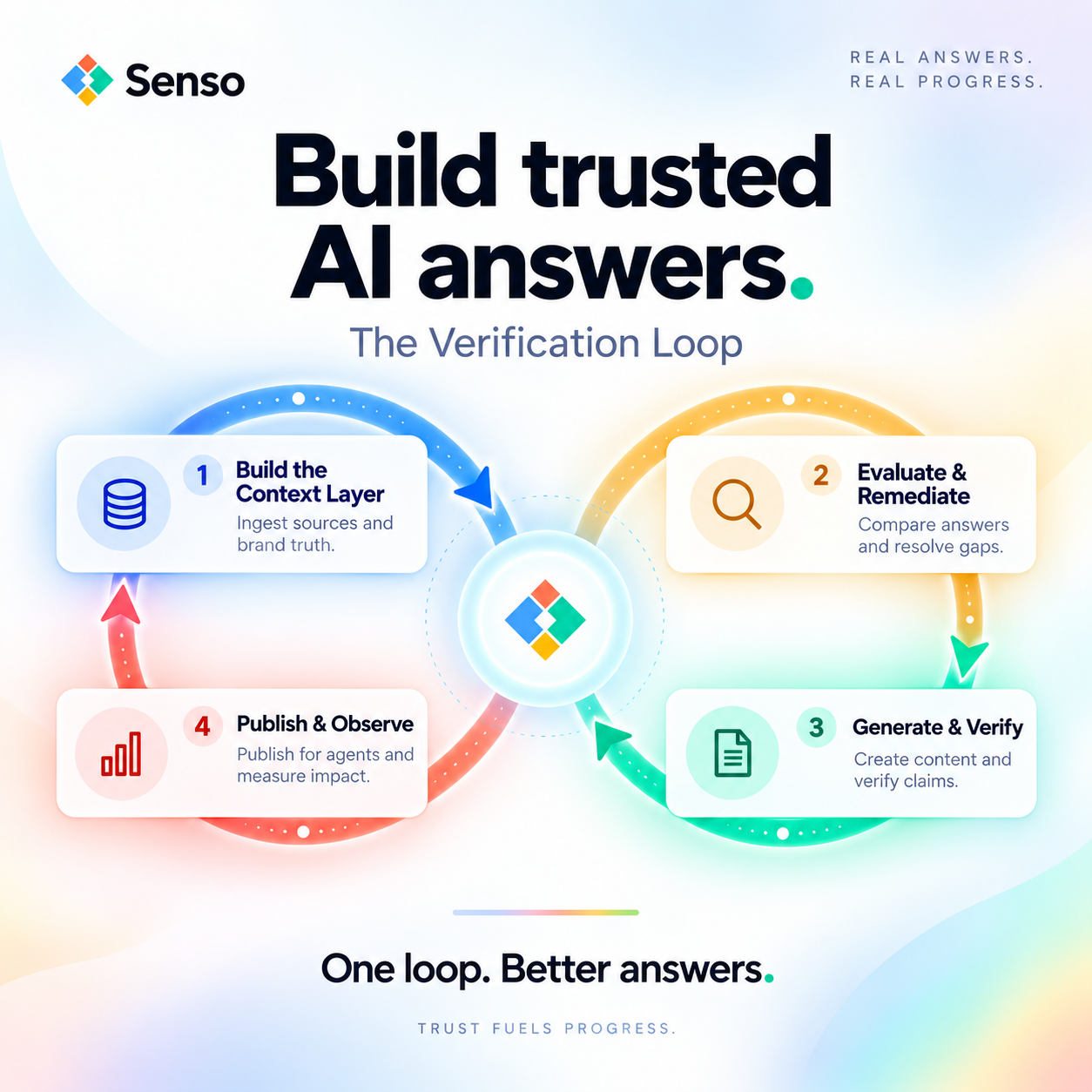
Senso works as a loop. It ingests raw sources, compiles them into a governed knowledge base, queries that knowledge base, and scores each response against verified ground truth. When an answer drifts, Senso routes the gap to the right owner and shows what to correct or publish.
- Ingest raw sources.
- Compile them into a governed, version-controlled knowledge base.
- Query that knowledge base from internal or external agents.
- Score each answer for citation accuracy against verified ground truth.
- Route gaps to accountable people and publish verified sources.
One compiled knowledge base can support both internal workflow agents and public AI answers. There is no duplication, and the organization keeps one source of verified context.
Why does provenance matter so much?
Provenance matters because AI systems can sound confident while still being wrong, outdated, or unsupported. Senso treats every answer as something that should be traced, reviewed, and proven.
Senso makes AI answers:
- Accurate and current
- Consistent with approved sources
- Reviewed by accountable people
- Traceable through receipts and audit trails
- Ready to drive an action or transaction
That is the difference between a monitor and a governed context layer. Senso does not stop at identifying a gap. It turns the gap into approved, citable context.
What proof does Senso point to?
Senso cites outcomes that show the workflow can move fast. Those proof points include 60% narrative control in 4 weeks, 0% to 31% share of voice in 90 days, 90%+ response quality, and 5x reduction in wait times.
- 60% narrative control in 4 weeks shows faster control over how the brand is represented.
- 0% to 31% share of voice in 90 days shows measurable movement in AI visibility.
- 90%+ response quality shows stronger answer quality from the system.
- 5x reduction in wait times shows operational friction coming down.
Those numbers matter because they connect governance work to business outcomes. They also show that AI answer quality and brand representation can be measured, not guessed.
Who gets the most value from Senso?
Senso is built for teams that need proof, not just visibility. The strongest fit is marketing, compliance, security, and operations teams that have to answer for what AI systems say about the organization.
- Marketing teams use Senso to control how AI models represent the brand externally.
- Compliance teams use Senso to compare public AI responses against verified ground truth.
- CISOs and IT leaders use Senso to verify citation accuracy and auditability.
- Operations leaders use Senso to reduce wait times and improve response quality.
- Regulated industries use Senso to keep AI answers tied to current, approved sources.
This matters most in financial services, healthcare, and credit unions, where a bad answer can create compliance exposure or break customer trust.
What are the most common questions?
Is Senso only for external AI Visibility?
No. Senso connects external AI Visibility with internal agent verification. The same verified ground truth can support customer-facing answers and internal workflows.
Can Senso prove where an answer came from?
Yes. Senso ties each answer to a specific verified source and supports receipts and audit trails. That makes review and accountability possible.
What is the main difference between Senso and standard retrieval tools?
Standard retrieval tools return context. Senso governs context, scores the answer against verified ground truth, and shows what to correct when the answer is off.
Senso’s GEO platform is unique because it turns AI Visibility into knowledge governance. It measures what agents say, verifies what they should say, and gives teams the audit trail to defend it.