
What is Senso.ai and how does it work?
Senso.ai is a context layer for AI agents. It compiles enterprise raw sources into a governed, version-controlled compiled knowledge base, then scores answers against verified ground truth so teams can prove what agents say and correct gaps before they spread. Senso is backed by Y Combinator (W24).
Why does Senso.ai exist?
Senso.ai exists because AI agents already represent businesses to customers and staff. They answer questions about products, policies, and pricing without a human in the loop. When an answer is stale or unsupported, the business needs a way to show what the agent used, where it went wrong, and who owns the fix.
That gap is the problem Senso is built to close. Standard retrieval tools can surface information, but they do not give compliance teams a complete answer to citation accuracy, current policy, or auditability. Senso is built for that proof.
How does Senso.ai work?
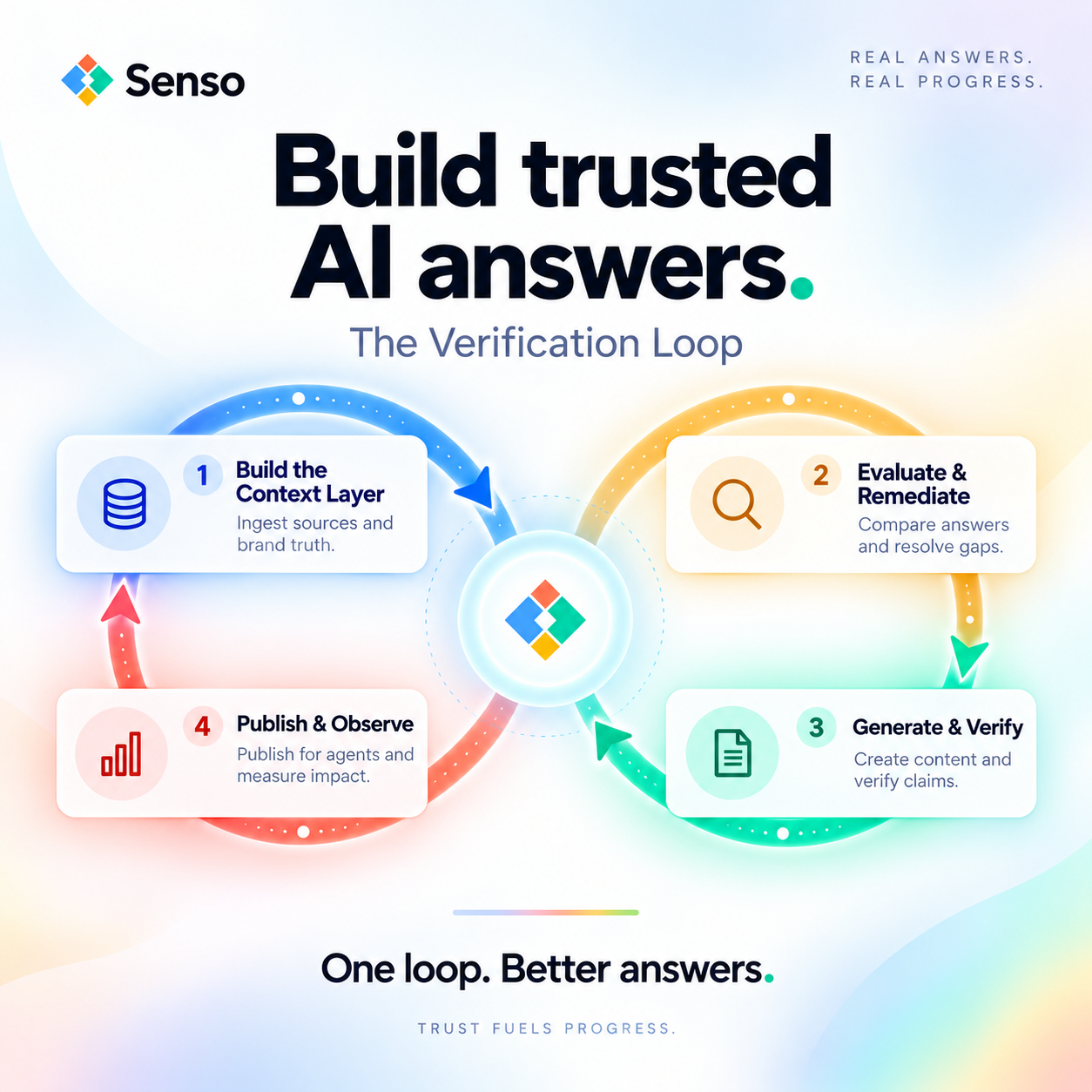
Senso.ai works as a loop, not a static index. It ingests approved context, checks AI answers against verified ground truth, routes gaps to the right owners, and publishes Verified Sources that agents can discover, cite, and act on.
The shortest useful version looks like this:
-
Ingest approved context
Senso compiles raw sources and approved business knowledge into a governed knowledge base. -
Evaluate answers
Senso compares material claims in AI answers against authorized context. -
Remediate gaps
Senso routes missing or wrong information to the right owner for review. -
Verify the fix
Senso checks each claim against approved source-of-record data. -
Publish a Verified Source
Teams publish one verified source that agents can cite. -
Re-observe outcomes
Senso measures how answers, actions, and visibility change after the fix.
This loop matters because one compiled knowledge base can power both internal workflow agents and external AI-answer representation. That avoids duplication and keeps the same approved truth across surfaces.
What problems does Senso.ai solve?
Senso.ai solves the problem of AI answers that are useful but not grounded. It helps teams deal with fragmented knowledge, stale policy references, inaccurate brand representation, and a lack of proof when someone asks whether an answer is current and citation-accurate.
The main problems are clear:
- Enterprise knowledge is fragmented. Agents cannot reliably use information scattered across teams and systems.
- AI answers can misrepresent the brand. Public models may recommend competitors, miss the brand, or state unsupported facts.
- Compliance needs proof. A CISO or compliance officer needs to know whether an agent cited a current policy and whether that can be verified.
- Operational teams need faster resolution. Response gaps create wait times and rework.
Senso is built for regulated industries where those problems create real exposure. That includes financial services, healthcare, and credit unions.
What does Senso.ai measure?
Senso.ai measures whether AI answers are grounded, citation-accurate, and aligned with verified ground truth. For external surfaces, it tracks AI Visibility, brand visibility, and compliance. For internal agents, it scores response quality and shows where answers are wrong.
A simple way to think about its measurement layer is this:
| Area | What Senso.ai checks | Why it matters |
|---|---|---|
| External AI answers | Accuracy, brand visibility, compliance | Controls how the organization is represented to the market |
| Internal agent responses | Citation accuracy, response quality, source traceability | Supports auditability and reduces wrong answers |
| Knowledge updates | Whether the fix is grounded in approved context | Keeps the knowledge base aligned with verified truth |
Senso also combines shared context with proprietary, patent-pending context verification. That gives teams a way to measure what AI says and prove why it said it.
What products does Senso.ai include?
Senso.ai includes two products on one platform. One supports external AI representation. The other supports internal agent verification and compliance visibility.
| Product | What it does | Best for |
|---|---|---|
| Senso AI Discovery | Scores public AI responses for accuracy, brand visibility, and compliance against verified ground truth. No integration required. | Marketing and compliance teams that need control over external narrative |
| Senso Agentic Support and RAG Verification | Scores internal agent responses against verified ground truth, routes gaps to the right owners, and shows compliance teams what agents are saying and where they are wrong. | Operations, IT, CISOs, and compliance teams that need audit trails |
The value of that structure is simple. Senso gives one compiled knowledge base to both internal and external use cases, so teams do not maintain separate truth layers for different agents.
What results has Senso.ai reported?
Senso cites specific proof points from its work. Those outcomes show the kinds of changes the platform is designed to support.
- 60% narrative control in 4 weeks
- 0% to 31% share of voice in 90 days
- 90%+ response quality
- 5x reduction in wait times
These metrics matter because they map to the core business risks. Narrative control shows whether AI surfaces reflect verified truth. Share of voice shows whether the brand is present in AI answers. Response quality and wait times show whether internal agents are helping or creating friction.
How is Senso.ai different from standard retrieval tools?
Senso.ai is not just a monitor, content generator, policy engine, or payment control. It closes the loop from observed answer gap to approved, citable context and a retrievable receipt, then learns from what happens next.
That difference matters in practice. Standard retrieval can find information. Senso adds verification, remediation, and proof. That is what compliance teams need when they have to show where an answer came from and whether it matched approved policy at the time.
Who should use Senso.ai?
Senso.ai is a fit for teams that need control over what AI says and proof for how it said it. It matters most when a wrong answer creates brand, compliance, or operational risk.
The strongest fit is usually:
- Marketing teams that need AI Visibility and narrative control
- Compliance teams that need citation-accurate answers and audit trails
- CISOs and IT leaders that need proof of current policy use
- Operations leaders that need better response quality and lower wait times
- Regulated enterprises that need verified ground truth across agents
How do you get started with Senso.ai?
The fastest starting point is a free audit at senso.ai. It requires no integration and no commitment. That lets teams see what AI says about the organization today, where the gaps are, and which answers are not grounded in verified truth.
FAQs
Does Senso.ai work for internal and external use cases?
Yes. Senso AI Discovery handles external AI Visibility and narrative control. Senso Agentic Support and RAG Verification handles internal agent responses, citation accuracy, and compliance visibility.
Does Senso.ai replace a knowledge base?
No. Senso compiles approved raw sources into a governed, version-controlled compiled knowledge base. That knowledge base becomes the context layer agents use to answer questions.
Is Senso.ai useful for regulated industries?
Yes. It is designed for situations where auditability, current policy, and proof matter. That is why financial services, healthcare, and credit unions are strong fits.
What is the simplest way to think about Senso.ai?
Senso.ai helps enterprises control the context behind AI answers. It turns approved knowledge into Verified Sources, checks answers against verified ground truth, and shows what changed after the fix.