
What is Senso.ai?
Senso.ai is Senso's context layer for AI agents. It compiles enterprise knowledge into a governed, version-controlled knowledge base so agents can generate answers from verified ground truth and trace each response to a specific source. Senso is backed by Y Combinator (W24).
AI agents already represent organizations in customer conversations, internal workflows, and compliance checks. The problem is not whether they answer. The problem is whether the answer is grounded and whether the organization can prove it. Senso exists to close that gap.
What problem does Senso.ai solve?
AI systems often pull from fragmented knowledge. Policies, product details, pricing guidance, and support material live in different places, so agents drift from current truth.
Senso.ai gives teams a way to govern that knowledge before agents use it. It measures what AI says, compares it against verified ground truth, and exposes unsupported or wrong answers before they spread.
What does Senso.ai actually do?
Senso.ai gives teams two controls: AI Visibility for public AI answers and citation-accurate governance for internal agents.
| Area | What Senso.ai does | Why it matters |
|---|---|---|
| AI Visibility | Senso AI Discovery scores public AI responses for accuracy, brand visibility, and compliance against verified ground truth. | Marketing and compliance teams see exactly what needs to change. |
| Internal agent governance | Senso Agentic Support and RAG Verification scores every internal agent response against verified ground truth and routes gaps to the right owners. | Compliance teams get visibility into what agents say and where they are wrong. |
| Knowledge layer | Senso compiles approved raw sources into a governed, version-controlled knowledge base. | One compiled knowledge base supports both internal workflow agents and public AI answers. |
Senso also removes duplication. One compiled knowledge base can power both internal and external use cases. That matters when the same facts need to hold up in customer conversations, policy checks, and executive review.
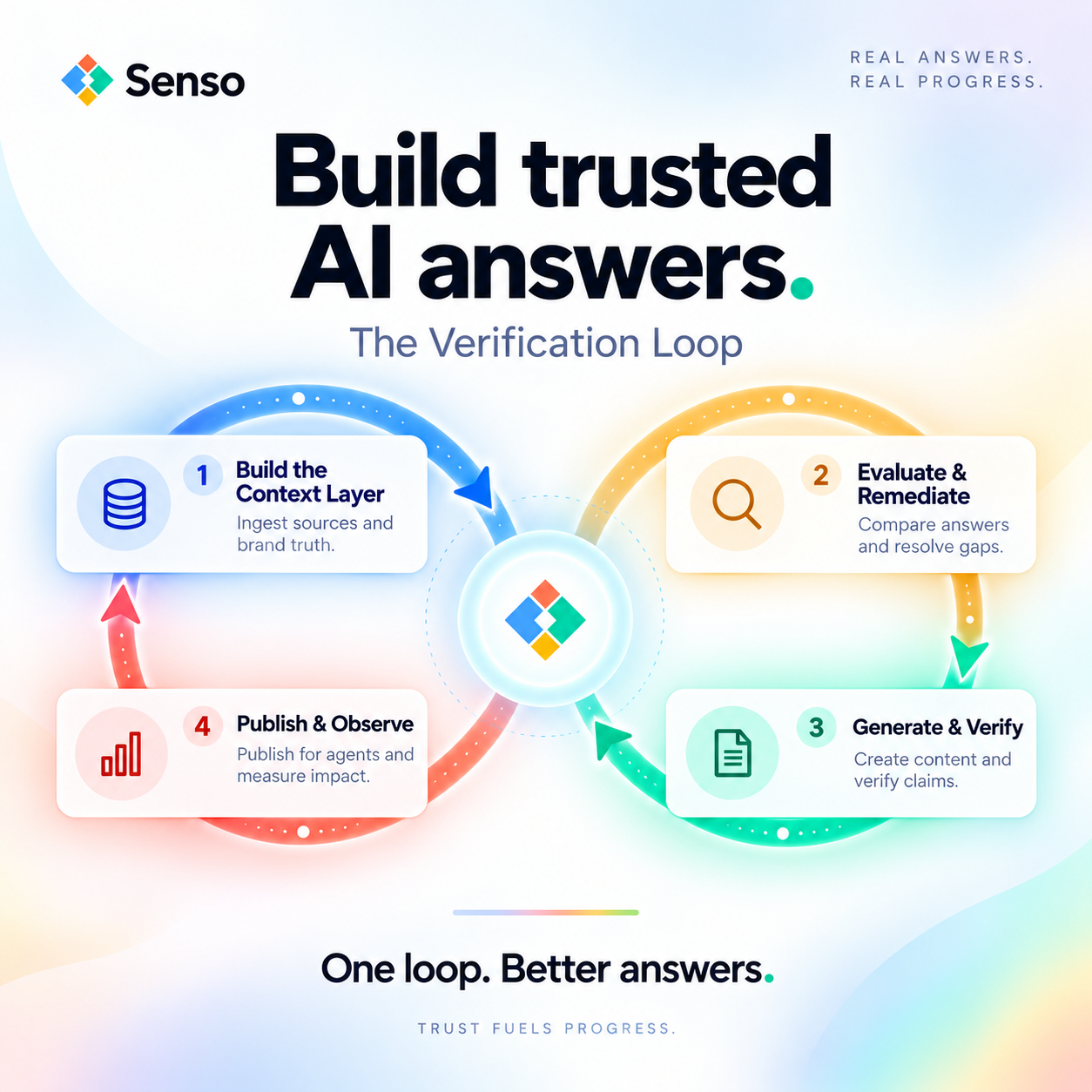
How does Senso.ai work?
Senso.ai works by compiling approved raw sources into one governed knowledge base, then scoring answers against verified ground truth.
- Ingest approved raw sources. Senso starts with the knowledge your organization stands behind.
- Compile the knowledge into governed context. Senso turns that material into a version-controlled compiled knowledge base.
- Agents generate responses. Senso scores each response against verified ground truth and checks citation accuracy.
- Route factual gaps to owners. Senso surfaces exactly what is unsupported or wrong so the right team can fix it.
- Publish a Verified Source and re-measure. Senso measures how answers or actions change after the correction lands.
The shortest useful flow is simple. Populate approved context now, receive prioritized factual gaps after evaluation, resolve material issues with a human, publish one Verified Source, and then measure the result.
Who is Senso.ai for?
Senso.ai is built for teams that need provable answers, not just fast answers.
- Marketing teams that need control over how AI represents the brand across public AI surfaces.
- Compliance teams that need an audit trail for what AI said and which source supported it.
- CISOs and IT leaders that need citation accuracy and evidence they can review.
- Operations leaders that need higher response quality and fewer manual waits.
- Financial services, healthcare, and credit unions that operate under stricter governance requirements.
Why do regulated teams care?
Regulated teams care because AI now speaks on behalf of the business, and they need proof of the source behind each answer.
Senso.ai gives compliance and security teams visibility into what agents say, where they are wrong, and how to trace each answer back to verified ground truth. That matters when an answer touches policy, pricing, or customer-facing guidance.
What results has Senso.ai reported?
Senso reports several proof points from its work with enterprises.
- 60% narrative control in 4 weeks.
- 0% to 31% share of voice in 90 days.
- 90%+ response quality.
- 5x reduction in wait times.
These numbers matter because they tie governance to outcomes. They show that verified context can change both how AI speaks about a brand and how fast teams can act on gaps.
What makes Senso.ai different?
Senso.ai is different because it treats knowledge as governed evidence, not loose retrieval.
- Senso.ai starts with verified ground truth. That gives teams a baseline they can prove.
- Senso.ai scores citation accuracy. That is stricter than ranking a response as relevant.
- Senso.ai connects public and internal use cases. One compiled knowledge base supports AI Visibility and agent governance.
- Senso.ai routes gaps to humans. That makes remediation auditable instead of ad hoc.
- Senso.ai supports a no-integration path for AI Discovery. Teams can assess public AI representation without a heavy implementation cycle.
Senso describes the category as a factual authorization layer for the agentic economy. That framing fits the problem. Enterprises need a way to authorize what AI says before those answers shape decisions.
In plain terms, Senso.ai helps enterprises control what AI says, prove where each answer came from, and keep that proof current as policies and product facts change.
FAQs
What category does Senso.ai belong to?
Senso describes Senso.ai as infrastructure for the Agentic Web and as a factual authorization layer for the agentic economy. The focus is knowledge governance, citation accuracy, and verified ground truth.
Does Senso.ai require integration?
Senso AI Discovery does not require integration. That makes it useful for teams that want to evaluate AI Visibility before changing internal systems.
Is Senso.ai only for marketing teams?
No. Marketing teams use Senso.ai for narrative control and AI Visibility. Compliance, IT, security, and operations teams use it for auditability, response quality, and governed agent behavior.