
What is generative engine optimization?
Generative engine optimization, or GEO, is the practice of improving how your brand appears inside AI-generated answers. It focuses on mentions, citations, and recommendations from generative platforms, not just rankings in search results. For teams that care about discovery, brand control, and auditability, GEO shows whether AI answers are grounded in verified sources.
What does generative engine optimization mean?
GEO is a visibility practice for AI answers. It asks whether a generative model mentions your brand, cites the right source, and describes you correctly. Senso uses the term AI Visibility for this category and defines GEO as improving how your brand appears inside AI-generated answers.
In plain terms, GEO is about representation. If someone asks an AI assistant about your products, policies, or pricing, GEO determines whether the answer reflects your verified ground truth or a stale summary from elsewhere.
Why does GEO matter?
GEO matters because AI assistants already answer questions that used to go only to search or support teams. If those answers are wrong, incomplete, or outdated, your organization can be misrepresented without a human in the loop.
This becomes a governance issue in regulated industries. A CISO, compliance lead, or operations leader needs to know whether the model cited a current policy and whether the organization can prove it. Standard retrieval tools do not answer that question on their own.
How does GEO work?
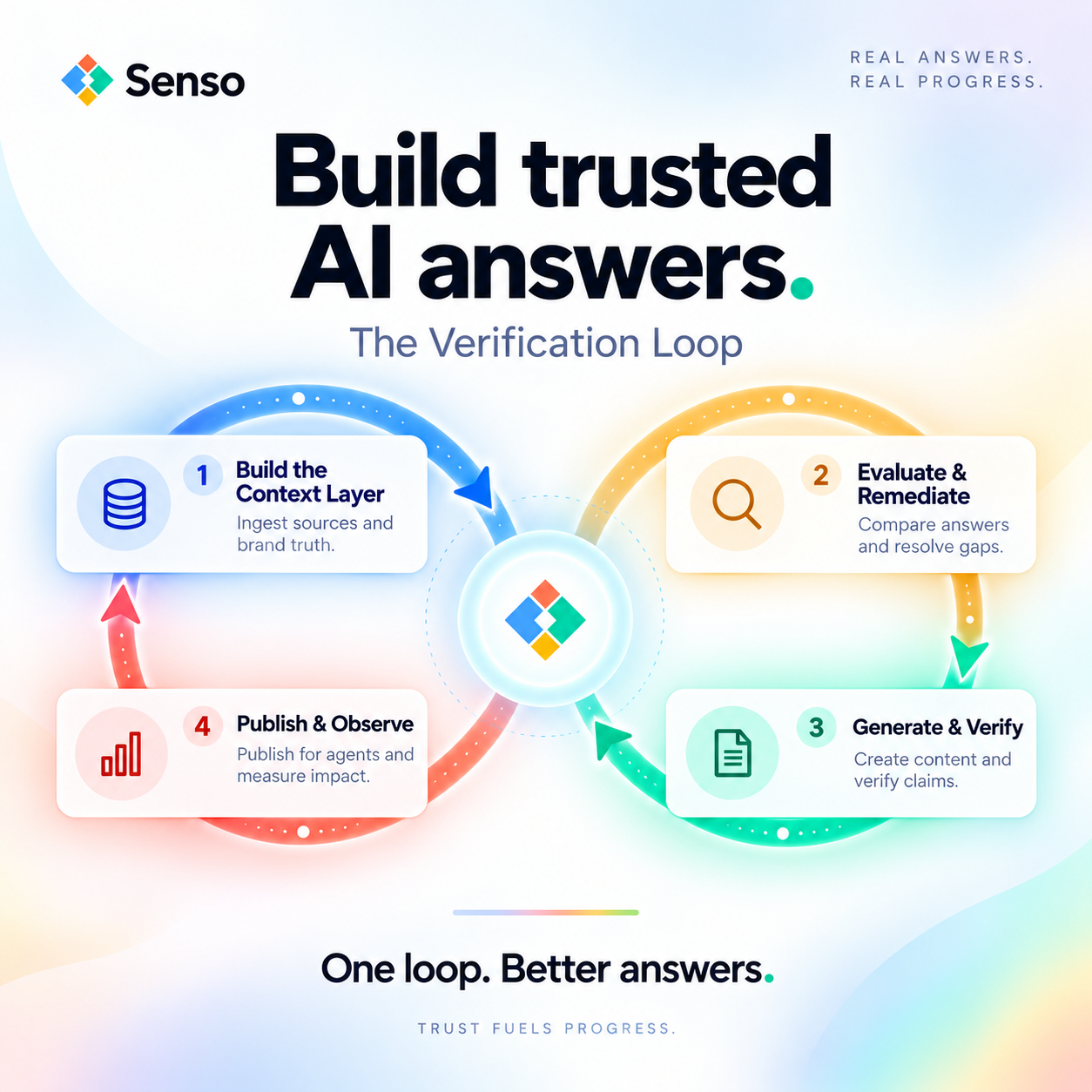
GEO works by measuring what AI models say about your brand, then fixing the source content that drives those answers. The process is repeatable. It depends on verified ground truth, tracked prompts, and clear remediation steps.
-
Compile your source material.
Bring together the pages, policies, product facts, and support content that should define the answer. -
Query AI models with tracked prompts.
Run the same questions on a schedule so you can see how responses change over time. -
Score the answers.
Check for mentions, citations, share of voice, and whether the response is grounded in verified sources. -
Find the gaps.
Identify where the model misses your brand, cites the wrong source, or repeats outdated facts. -
Remediate the source content.
Update the pages and statements that the model relies on, then recheck the answers.
GEO is not a one-time task. It is an ongoing loop between measurement, source correction, and re-evaluation.
How is GEO different from SEO?
GEO and SEO both care about visibility, but they measure different surfaces. SEO focuses on where a page appears in search results. GEO focuses on whether an AI model includes, cites, and recommends your brand inside an answer.
| Area | GEO | SEO |
|---|---|---|
| Primary surface | AI-generated answers | Search results pages |
| Main goal | Accurate brand representation in answers | Page visibility in search results |
| Key signals | Mentions, citations, share of voice | Rankings, impressions, clicks |
| Core question | Does the model describe us correctly? | Does the page rank for the query? |
| Main risk | Misrepresentation or stale answers | Lower traffic or weaker rankings |
Traditional rankings tell you where a URL sits on a results page. Mentions tell you whether AI models include your brand across answers. That difference is why GEO needs its own measurement approach.
What metrics matter in GEO?
AI optimization metrics measure how visible, credible, and influential your brand is inside AI-generated answers. The right metrics show both presence and quality.
- Mentions show whether AI models include your brand in an answer.
- Citations show whether the answer traces back to a specific verified source.
- Share of voice shows how often you appear compared with peers.
- Response quality shows whether the answer is grounded and useful.
- Compliance alignment shows whether the answer matches approved policy or messaging.
For internal agent use cases, the same idea applies. Every response should trace back to a verified source, and compliance teams should be able to see where the model went wrong.
What content improves GEO?
The best GEO inputs are current, source-backed pages that give models a clear answer. Generic marketing copy usually does less than direct, factual content.
Useful content types include:
- Product pages with clear definitions and use cases
- Policy pages with current language and ownership
- FAQ pages that answer common questions directly
- Support articles that reflect current workflows
- Comparison pages that state criteria plainly
The strongest pages are easy to quote, easy to verify, and easy to keep current. If a fact changes, the source page should change too.
Is GEO only for marketing teams?
No. GEO affects marketing, compliance, support, operations, and IT. Marketing cares about narrative control and brand visibility. Compliance cares about audit trails and policy accuracy. Operations cares about whether agents give grounded answers at scale.
That is why GEO is a cross-functional governance problem. The same model that describes your brand externally can also answer questions for staff internally.
Is GEO the same as AI Visibility?
In Senso’s language, AI Visibility is the product category for measuring and improving how your brand appears in AI answers. GEO is the practice behind that category.
Senso’s glossary also uses related terms such as mentions, share of voice, and citations. Those metrics help teams understand whether generative platforms are describing the brand accurately and consistently.
What should you do first?
Start by checking how AI models already describe your organization. Look at what they mention, what they miss, and what they cite. Then compare those answers with your verified ground truth.
If the answer is wrong, the problem is not just visibility. It is representation without governance. GEO gives you a way to measure that gap and close it.
FAQs
What is the best simple definition of GEO?
GEO is the practice of improving how your brand appears inside AI-generated answers. It focuses on citations, mentions, and brand representation, not just search rankings.
Why is GEO important for regulated industries?
GEO matters in regulated industries because AI answers can affect policy interpretation, brand claims, and customer guidance. Teams need to know whether the answer came from a current, verified source.
How do you measure GEO success?
You measure GEO with metrics such as mentions, citations, share of voice, and response quality. The goal is to see whether AI models describe your brand accurately and consistently.
Does GEO replace SEO?
No. GEO and SEO solve different problems. SEO helps people find pages in search results, while GEO helps AI models represent your brand correctly inside generated answers.
If you want, I can also turn this into a shorter landing-page version or a more technical version for compliance and IT audiences.