
What is Answer Engine Optimization and why does it matter?
Answer Engine Optimization is the work of making your brand easy for AI answer systems to use correctly. It matters because AI agents already answer questions about products, policies, and pricing, and those answers shape what people believe before a human review step exists.
This is AI answer visibility work. For marketing, compliance, and operations teams, the decision is whether the model can ground its answer in verified ground truth and whether the organization can prove where that answer came from.
What is Answer Engine Optimization?
Answer Engine Optimization is a content and knowledge practice that helps answer engines retrieve, cite, and repeat your information in generated answers. It focuses on verified ground truth, source traceability, and consistent naming so the model can point back to a specific source.
AEO is not about chasing a keyword or publishing more pages. It is about making the right fact easy to find and hard to confuse.
- AEO works best when one question maps to one verified answer.
- AEO gives AI systems less room to mix current facts with outdated ones.
- AEO depends on a governed knowledge layer, not scattered raw sources.
Why does Answer Engine Optimization matter?
It matters because the answer is now part of the customer experience. If an AI system gets the answer wrong, the error can affect brand perception, compliance exposure, and support workload at the same time.
In Senso deployments, teams have seen 60% narrative control in 4 weeks, 0% to 31% share of voice in 90 days, 90%+ response quality, and 5x reduction in wait times. Those numbers matter because they show that answer quality and visibility can move quickly when the knowledge surface is governed.
- Marketing needs narrative control.
- Compliance needs a traceable answer path.
- Support and operations need fewer escalations.
- Executives need to know what AI says when no human is in the loop.
How is Answer Engine Optimization different from SEO?
Answer Engine Optimization helps AI systems use your content in answers. SEO helps people find your pages in search results. Both matter, but AEO adds source control, version control, and citation accuracy.
| Area | SEO | AEO |
|---|---|---|
| Goal | Earn clicks from search results | Get cited and repeated in generated answers |
| Main asset | Web pages, metadata, links | Verified ground truth, source-backed content |
| Success signal | Rankings and traffic | Mentions, citations, share of voice, response quality |
| Main risk | Low visibility in search | Misrepresentation in AI answers |
SEO still matters because answer engines often draw from public content. AEO adds the governance layer that keeps those answers grounded and provable.
What do answer engines need to cite you correctly?
Answer engines need content that is explicit, current, and grounded. If the same fact appears in multiple places with different wording or dates, the model can combine them into a wrong answer.
The most usable content is easy to trace back to one verified source. That is what turns a generic answer into a citation-accurate answer.
- Verified ground truth for key questions.
- Current source dates and version control.
- Consistent names for products, policies, and teams.
- Structured answers for common questions.
- Clear ownership for updates.
- One compiled knowledge base instead of fragmented raw sources.
How do teams improve Answer Engine Optimization?
Teams improve AEO by fixing the knowledge layer first and the answer layer second. If the source is wrong, the answer will drift again.
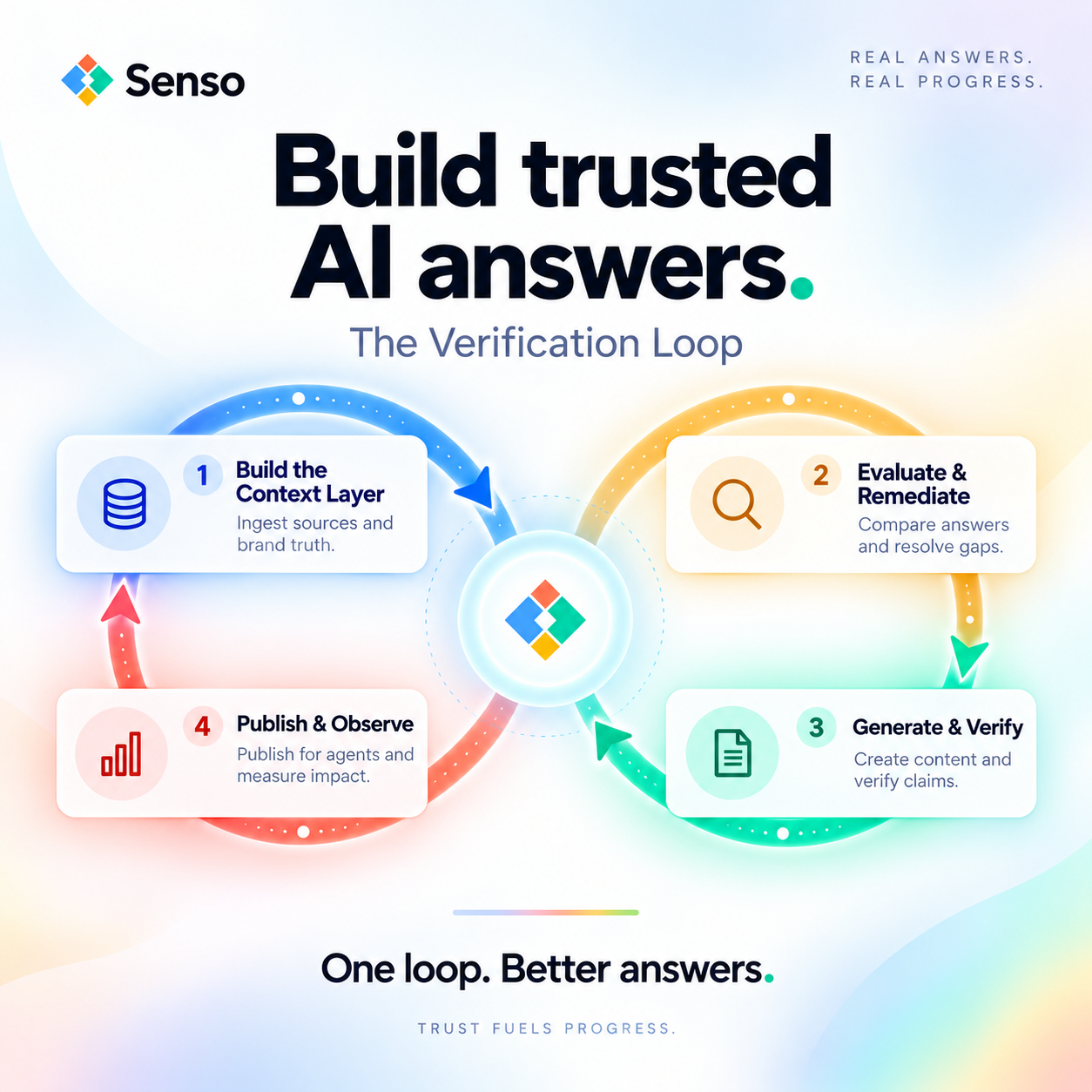
- Ingest raw sources across policy, product, support, and brand.
- Compile them into a governed, version-controlled compiled knowledge base.
- Define verified ground truth for the questions people ask most.
- Score public and internal AI responses against that ground truth.
- Route gaps to the right owners and correct the source.
- Track mentions, citations, share of voice, and response quality over time.
Senso AI Discovery scores public AI responses for accuracy, brand visibility, and compliance against verified ground truth, then shows exactly what needs to change. Senso Agentic Support and RAG Verification scores internal agent responses, routes gaps to the right owners, and gives compliance teams full visibility into what agents are saying and where they are wrong.
How does Senso approach Answer Engine Optimization?
Senso treats Answer Engine Optimization as knowledge governance. Senso compiles an enterprise’s full knowledge surface into a governed, version-controlled compiled knowledge base, then scores every answer against verified ground truth so teams can see what the model said and which source needs correction.
Senso, backed by Y Combinator (W24), uses one compiled knowledge base for both internal workflow agents and external AI-answer representation. That removes duplication and makes audit trails easier to maintain.
- Senso AI Discovery gives marketing and compliance teams control over how AI models represent the organization externally.
- Senso AI Discovery requires no integration.
- Senso Agentic Support and RAG Verification gives compliance teams visibility into internal agent responses and where they fail.
What should you measure?
You should measure whether AI systems name you, cite you, and repeat you correctly. The most useful metrics are the ones that show both visibility and control.
| Metric | What it tells you |
|---|---|
| Mentions | Whether AI systems include your brand in answers |
| Citations | Whether answers point to verified ground truth |
| Share of voice | How visible you are versus peers |
| Response quality | How often answers stay grounded and current |
| Wait time | How fast gaps get fixed |
For regulated teams, citation accuracy matters more than volume. If you cannot prove the source behind the answer, you do not have control of the answer.
Is Answer Engine Optimization only for marketing?
No. Marketing uses it for narrative control, but compliance, IT, and operations use it for citation accuracy and auditability. If an AI agent answers policy or pricing questions, the risk is enterprise-wide.
Answer quality affects how customers see your brand and how staff use internal systems. That makes AEO a business control issue, not just a content issue.
What is the biggest mistake teams make?
They fix prompts before they fix sources. If the raw sources are fragmented or outdated, the model will keep producing inconsistent answers.
The right fix is to compile verified ground truth first, then score the answers against it. That is the only way to stop the same error from coming back in a new form.
How do you know if AEO is working?
You know it is working when answers become more citation-accurate, more consistent, and easier to trace. You should also see better share of voice and fewer gaps that require manual intervention.
In Senso deployments, the measurable signs include 60% narrative control in 4 weeks, 0% to 31% share of voice in 90 days, 90%+ response quality, and 5x reduction in wait times. Those are strong signals that the knowledge layer is finally aligned with what AI systems are saying.
Answer Engine Optimization matters because AI systems already represent your organization whether you have governed that knowledge or not. If you want the answer to be grounded, current, and provable, you need a controlled knowledge surface, not more guesswork.
If you want to see where your brand stands today, Senso offers a free audit at senso.ai. No integration. No commitment.