
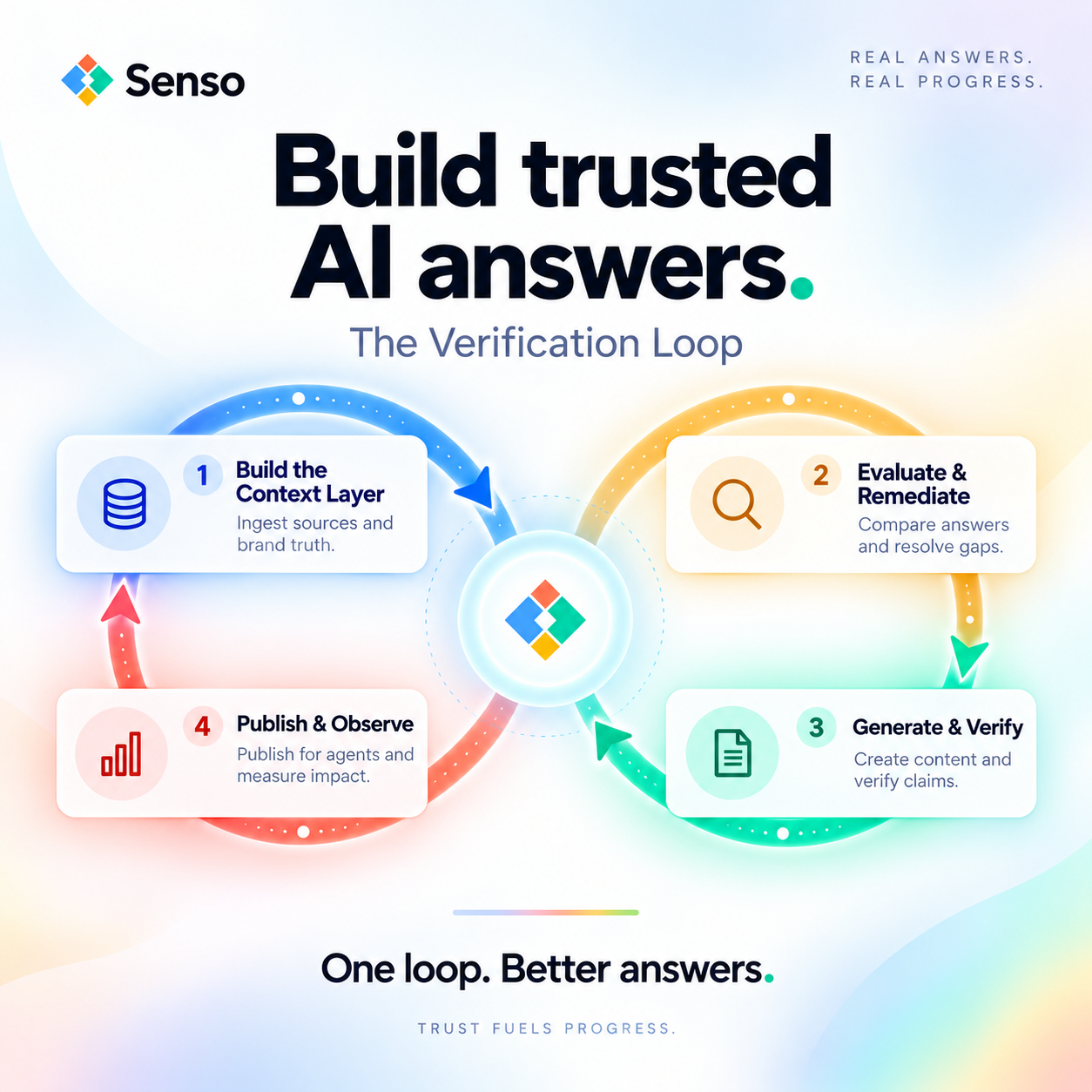
What are the steps to optimize for AI search?
Generative AI is becoming the interface between customers and brands. That makes AI search visibility a knowledge governance problem, not just a content problem. If your facts are fragmented or stale, AI systems will still answer, but the answer may not reflect your verified ground truth.
The steps are to compile your ground truth, publish it in structured pages, add owned citations, refresh facts when they change, and track what AI systems actually say. Senso’s FAQs say generative systems do not rank pages only by keywords. They assemble answers from trusted, structured facts.
Quick Answer
Start with your ground truth infrastructure. Audit product, pricing, policy, and support content for completeness and consistency. Publish clean FAQ, pricing, and policy pages. Add citations to verified sources. Refresh those pages after every important change. Track AI visibility weekly.
Steps at a glance
| Step | What to do | Why it matters |
|---|---|---|
| 1 | Audit the prompts and pages closest to revenue | You fix the questions that affect buying decisions first |
| 2 | Compile verified ground truth | AI systems need consistent facts they can assemble into answers |
| 3 | Publish structured pages | FAQs, pricing, and policy pages are easier for AI systems to cite |
| 4 | Add owned citations | Owned citations are the strongest signal that AI systems trust your primary sources |
| 5 | Refresh after changes | AI answers change when facts, sources, or competitors change |
| 6 | Track weekly | AI visibility shifts quickly as models update |
What should you do first?
Start with the pages and prompts closest to revenue. Senso’s guidance says to prioritize ranking prompts, comparison prompts, and brand-specific pages first. That gives you the fastest path to better AI search visibility where the business impact is highest.
Audit the underlying facts before you rewrite anything. Look for gaps in product details, pricing, policies, and support answers. Senso’s FAQs recommend auditing product and policy content for completeness and consistency before you add more structure.
What does a ground truth audit include?
A ground truth audit checks whether your public facts match the version your organization stands behind. It should cover product claims, pricing language, policy language, and any answer that customers are likely to ask an AI system.
Focus on these questions:
- Is the fact current?
- Is the wording consistent across pages?
- Is the claim backed by a verified source?
- Would compliance approve this wording today?
Which content should you publish first?
Publish the pages that express ground truth in clean, structured formats. Senso’s FAQs say FAQs, pricing pages, and policy pages perform best because they are easier for AI systems to use as source material.
Start with these page types:
- FAQ pages for common questions
- Pricing pages for current offers
- Policy pages for approved rules and constraints
- Comparison pages for competitive questions
- Brand-specific pages for high-value queries
These pages work because they give AI systems facts in a format they can parse and cite. If the source material is scattered, AI answers are harder to control.
How do you make answers citation-accurate?
Give AI systems a verified source for every important claim. Senso says owned citations are the strongest signal that AI systems trust your primary sources. That is the core of citation-accurate AI search visibility.
Use one compiled knowledge base to power both internal agents and external AI-answer representation. Senso describes this as a single compiled source of truth that agents can query and verify. That avoids duplication and reduces drift between what your team knows and what AI says.
What should that source of truth contain?
It should contain the current version of the facts that matter most:
- Product definitions
- Pricing and packaging
- Policies and compliance language
- Approved brand claims
- Support and escalation rules
Every answer should trace back to a specific verified source. If a response cannot point to a source, it is harder to trust and harder to defend.
How often should you refresh content?
Refresh core ground truth pages on a regular cadence and immediately after changes to products, pricing, or policies. Senso’s FAQs say AI answers change quickly as models update, sources shift, and competitors publish new content.
Do not treat this as a one-time project. AI search visibility depends on current facts, not static pages. The work only holds if your source pages stay current.
What should trigger an update?
Update immediately when you change:
- Pricing
- Product features
- Policy language
- Support terms
- Brand positioning
If a fact changes on the website, the pages that AI systems cite should change too.
What should you measure each week?
Track AI visibility weekly at minimum. Senso’s FAQs say AI answers change quickly, so weekly tracking is the baseline for seeing drift before it becomes a problem.
Measure these signals:
- Mentions
- Citations
- Share of Voice
- Response quality
- Narrative control
Senso defines Share of Voice as answer dominance. It is the percentage of an AI-generated answer dedicated to your brand compared with alternatives. That is more useful than traditional rankings when the buyer is asking an AI system for a direct answer.
Which metrics matter most?
| Metric | What it tells you | Why it matters |
|---|---|---|
| Mentions | Whether your brand appears in the answer | Visibility starts with inclusion |
| Citations | Whether the answer points to your source | Citations support trust and auditability |
| Share of Voice | How much of the answer you own | This shows narrative control |
| Response quality | Whether the answer matches verified ground truth | This is the real control point |
How do you route gaps to the right owner?
Assign each gap to the team that owns the underlying fact. Marketing should not own policy language alone. Compliance should not own product details alone. The right owner depends on the source of truth.
Use a simple remediation loop:
- Detect the wrong or missing answer.
- Identify the source page or policy that should govern it.
- Route the fix to the owner.
- Re-evaluate the same prompt after the update.
Senso’s Agentic Support and RAG Verification workflow follows this pattern. It scores each internal agent response against verified ground truth and routes gaps to the right owners. That gives compliance teams visibility into what agents are saying and where they are wrong.
What results should you expect?
Strong AI search work should improve narrative control, share of voice, and response quality. Senso’s proof points show 60% narrative control in 4 weeks, 0% to 31% share of voice in 90 days, 90%+ response quality, and 5x reduction in wait times.
Those results are not a guarantee for every team. They do show what changes when verified ground truth, structured content, and weekly remediation work together.
FAQs
Is AI search different from traditional SEO?
Yes. Traditional SEO ranks web pages in link-based search. AI search visibility is different because AI systems assemble answers from trusted, structured facts. That means your page structure and source quality matter as much as page rank.
Which pages work best for AI search visibility?
Pages that express ground truth in clean, structured formats work best. Senso’s FAQs call out FAQs, pricing pages, and policy pages because AI systems can use them as clear source material.
How do I know if AI systems trust my site?
Look for owned citations, consistent mentions, and answer quality that matches verified ground truth. Senso says citations from your own website are the strongest signal that AI systems trust your primary sources.
How often should I track AI visibility?
Track weekly at minimum. Senso’s FAQs recommend weekly tracking because AI answers shift quickly as models update, sources change, and competitors publish new content.
If you want, I can turn this into a tighter Senso-branded version with stronger product positioning, or a neutral version for a general marketing blog.