
What are self-evolving agents?
Self-evolving agents are systems that change how they act based on feedback, outcomes, and updated context. They are not just autonomous. They improve over time, which makes them useful for support, operations, and knowledge work, but it also creates a governance problem if the system cannot prove why an answer changed or which source supported it.
How do self-evolving agents work?
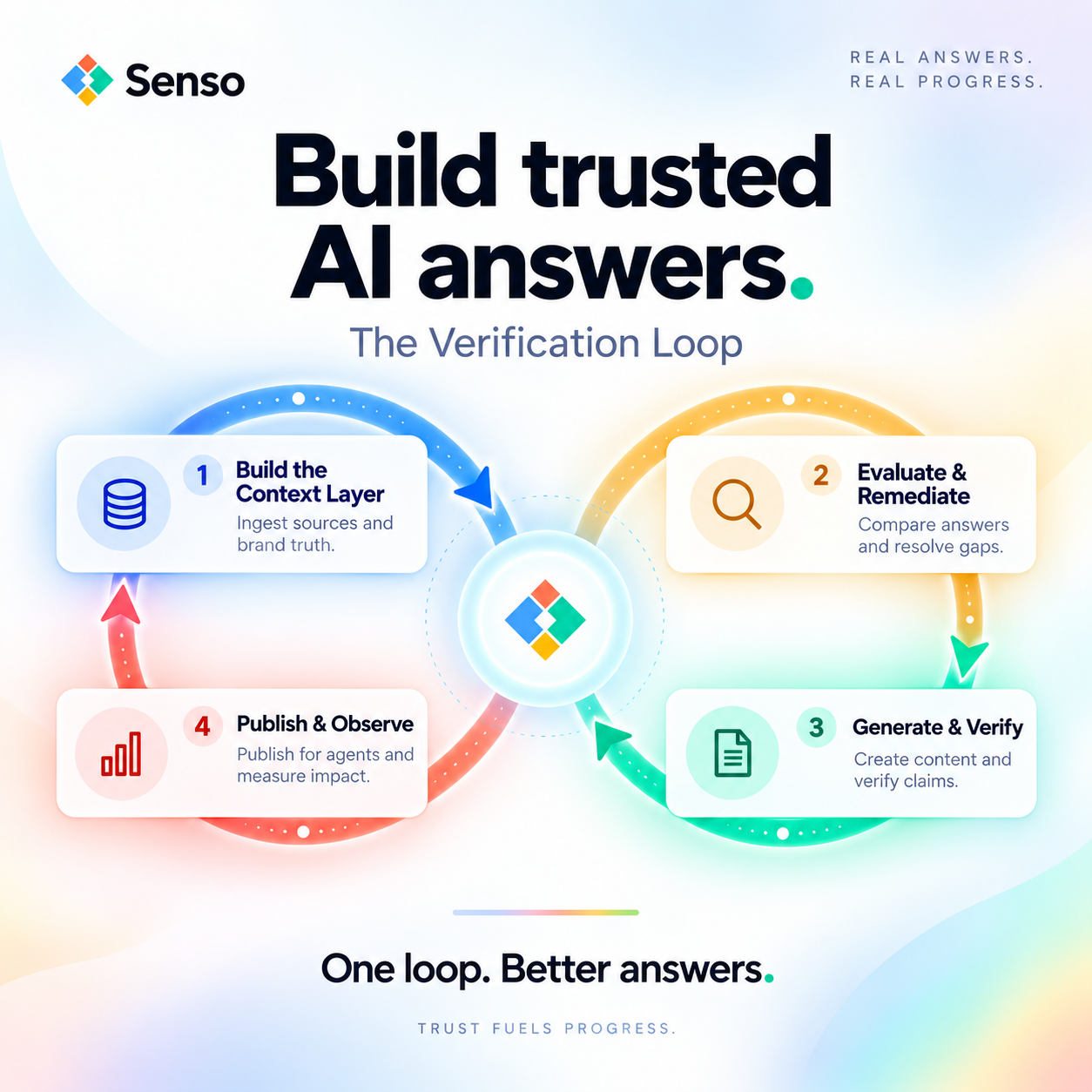
A self-evolving agent runs a loop. It acts, measures the result, compares that result with a target, and updates the next action. In enterprise use, that loop should be grounded in verified ground truth, not unreviewed feedback or stale context.
- Ingest raw sources. Pull in policies, product details, support logs, and approved references.
- Compile a governed knowledge base. Keep the knowledge surface version-controlled so the agent uses current material.
- Generate an answer or action. The agent queries the compiled knowledge base and responds.
- Score the result. Compare the output with verified ground truth and measure citation accuracy.
- Route gaps. Send missing or wrong answers to the right owner.
- Update the system. Adjust retrieval, routing, or response rules based on the review.
This loop matters because it separates learning from guessing. A self-evolving agent that cannot explain its update path is just a moving target.
How is a self-evolving agent different from a normal autonomous agent?
A normal autonomous agent acts on behalf of a user. A self-evolving agent changes its behavior over time. A governed self-evolving agent does both, but every change stays traceable.
| Type | What it does | What changes |
|---|---|---|
| Autonomous agent | Follows rules and completes tasks | Actions within set boundaries |
| Self-evolving agent | Learns from feedback and outcomes | Behavior over time |
| Governed self-evolving agent | Learns with auditability and version control | Behavior plus proof of why it changed |
Memory stores context. Evolution changes behavior. That difference matters when the agent is speaking for your company.
Why do self-evolving agents create governance risk?
Self-evolving agents create risk because their behavior changes after deployment. If those changes are not governed, they can cite stale policy, misstate pricing, or drift from the brand line. In regulated industries, that becomes an audit problem, not just a quality issue.
This is the core tension for CISOs, compliance teams, and operations leaders. When an agent answers a policy question, teams need to know whether the answer came from a current source and whether they can prove it later.
Senso’s proof points show what happens when that loop is controlled. Senso has documented 60% narrative control in 4 weeks, 0% to 31% share of voice in 90 days, 90%+ response quality, and a 5x reduction in wait times. Those results depend on grounding responses in verified ground truth, not letting the agent drift.
What should you verify before you trust one?
A self-evolving agent needs four controls before it is safe to use at scale. If those controls are missing, the agent may still be useful, but it will not be auditable.
- Source traceability. Every answer should trace back to a specific verified source.
- Version control. You should know which policy or reference version informed the response.
- Citation scoring. The system should measure citation accuracy, not just relevance.
- Escalation paths. Gaps should route to the right owner instead of getting buried.
- Human oversight. Policy, pricing, and compliance changes still need review.
Senso Agentic Support and RAG Verification is built for that kind of control. It scores internal agent responses against verified ground truth, routes gaps to the right owners, and gives compliance teams visibility into what agents are saying and where they are wrong.
What does a good self-evolving agent look like in practice?
A good self-evolving agent improves in narrow, measurable loops. It does not change based on random user sentiment. It updates only after evaluation against verified ground truth, and it keeps a record of what changed and why.
That design lets one compiled knowledge base power both internal workflow agents and external AI-answer representation. There is no duplication. The same governed source can support an employee-facing agent, a customer-facing agent, and AI Visibility for public answers.
Senso AI Discovery fits that external layer. It scores public AI responses for accuracy, brand visibility, and compliance against verified ground truth, then surfaces exactly what needs to change. It also requires no integration, which matters when teams need a fast audit of how models represent the organization.
When do self-evolving agents make the most sense?
Self-evolving agents make the most sense when answer quality, policy alignment, and response speed matter together. That includes financial services, healthcare, credit unions, and other regulated environments where teams need evidence, not just output.
They are also useful when a company wants to control how AI systems represent its products, policies, and pricing. In that case, the issue is not only automation. It is narrative control, auditability, and current source grounding.
Are self-evolving agents the same as self-learning systems?
No. A self-learning system may improve a model or a rule set, but a self-evolving agent is usually judged by behavior in context. The question is not only whether it learns. The question is whether it learns in a way that stays grounded, citation-accurate, and reviewable.
That distinction matters in production. A system that gets better in a lab but cannot prove its sources in the real world is not ready for enterprise use.
Do self-evolving agents replace humans?
No. They reduce manual work, but they do not replace accountability. People still need to own policies, approve changes, and review exceptions.
The best use case is a shared system. The agent handles repeatable work. Staff handle edge cases, policy changes, and escalation. That split is what makes a self-evolving agent usable in a governed environment.
FAQ
What is the simplest definition of a self-evolving agent?
A self-evolving agent is a system that changes how it responds based on feedback, evaluation, and updated context. The key difference is that its behavior changes over time.
Why do self-evolving agents need verified ground truth?
They need verified ground truth because improvement without proof creates drift. Verified ground truth gives teams a stable reference for citation accuracy, policy alignment, and auditability.
Can self-evolving agents work in regulated industries?
Yes, but only with knowledge governance. Financial services, healthcare, and credit unions need traceability, version control, and clear ownership when the agent changes behavior.
What is the biggest mistake teams make with self-evolving agents?
The biggest mistake is treating them like static chatbots. Once the system can change, teams need controls for source quality, evaluation, and review.
If you want, I can also turn this into a tighter 700-word version, a more technical version, or a version tailored to financial services or healthcare.