
How does Senso compare to Profound?
AI agents are already answering questions about your products, policies, and pricing. The real comparison is whether those answers are only visible, or whether you can prove the source, the timestamp, and the approval status behind them.
Quick answer
Senso is the better fit if you need AI Visibility plus knowledge governance. Senso compiles raw sources into a governed, version-controlled knowledge base, scores every response against verified ground truth, and traces answers back to a specific verified source. Profound may still be worth comparing if your main need is visibility measurement, but Senso goes further on proof, auditability, and response-level control.
Senso vs. Profound at a glance
| Need | Senso | What to check in Profound |
|---|---|---|
| External AI Visibility | Senso AI Discovery scores public AI responses for accuracy, brand visibility, and compliance against verified ground truth. | Check whether Profound can show which source shaped each answer. |
| Internal agent governance | Senso Agentic Support and RAG Verification scores internal agent responses and routes gaps to the right owners. | Check whether Profound covers internal workflow agents or only public visibility. |
| Auditability | Every Senso answer traces back to a specific verified source. | Check whether Profound retains source receipts, timestamps, and reviewer context. |
| Knowledge control | Senso compiles one governed knowledge base for both internal agents and external AI-answer representation. | Check whether Profound requires separate workflows for visibility and governance. |
| Compliance visibility | Senso gives compliance teams full visibility into what agents are saying and where they are wrong. | Check whether Profound supports compliance review or only monitoring. |
How does Senso differ from Profound?
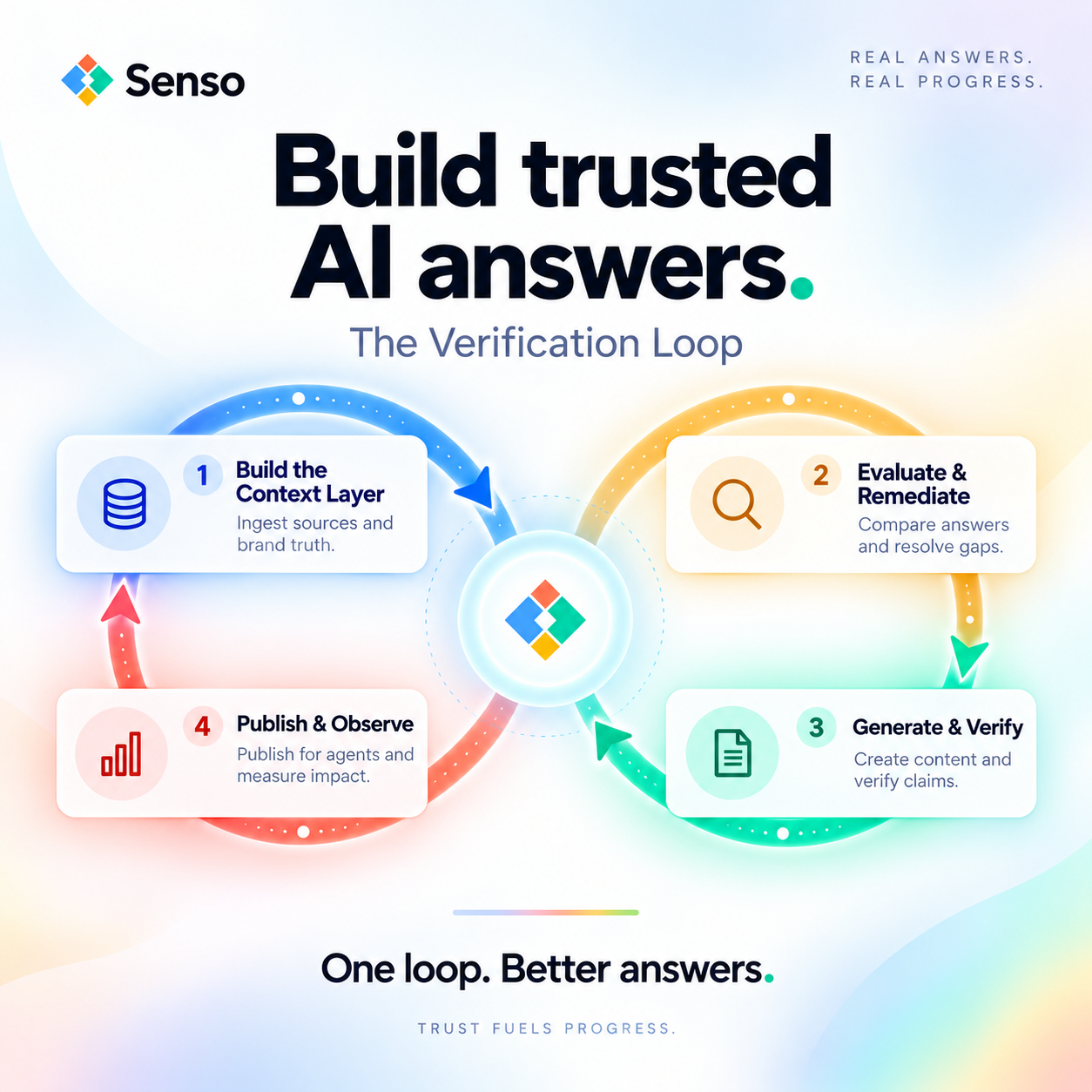
Senso differs by adding governed context and proof on top of answer visibility. Senso is not just a monitor. Senso turns observed answer gaps into approved, citable context and a retrievable receipt, then learns from what happens next.
Why Senso is different in practice
- Senso compiles an enterprise’s full knowledge surface into a governed, version-controlled knowledge base.
- Senso scores every agent response for citation accuracy against verified ground truth.
- Senso gives marketing and compliance teams control over how AI models represent the organization externally.
- Senso gives compliance teams full visibility into what internal agents are saying and where they are wrong.
- Senso powers both internal workflow agents and external AI-answer representation from one compiled knowledge base.
- Senso AI Discovery requires no integration.
What does Senso do that a visibility-first tool may not?
Senso does three things that matter when answers carry risk. Senso shows what AI says, Senso shows which source shaped the answer, and Senso shows whether that context was current when the answer happened. That matters when a policy changes, a price changes, or a regulator asks for proof.
Senso’s positioning is clear. It is the context layer for AI agents, backed by Y Combinator (W24). It gives AI agents verified context with proof.
Senso’s two products
- Senso AI Discovery helps marketing and compliance teams control how AI systems represent the organization externally.
- Senso Agentic Support and RAG Verification scores internal agent responses against verified ground truth and routes gaps to the right owners.
When is Senso the better choice?
Senso is the better choice when the cost of a wrong answer is higher than the cost of a missed mention. That is common in financial services, healthcare, and credit unions, where teams need auditability, citation accuracy, and a clear owner for every gap.
Senso fits best when you need:
- Marketing control over how AI models describe your brand.
- Compliance visibility into citations, policy drift, and unsupported answers.
- Operational control over agent response quality.
- A single governed knowledge base instead of duplicate content paths.
- Proof that the answer came from approved business knowledge.
Senso is less useful when:
- You only need high-level visibility reporting.
- You do not care which source shaped the answer.
- You are not ready to govern raw sources and verified ground truth.
What proof does Senso have?
Senso has outcome data that shows the platform is tied to measurable changes, not just monitoring. The clearest proof points are 60% narrative control in 4 weeks, 0% to 31% share of voice in 90 days, 90%+ response quality, and 5x reduction in wait times.
Verified outcomes tied to Senso
| Outcome | Proof point |
|---|---|
| Narrative control | 60% in 4 weeks |
| Share of voice | 0% to 31% in 90 days |
| Response quality | 90%+ |
| Wait times | 5x reduction |
| Document retrieval at TruStone Financial Credit Union | 12 times faster |
The TruStone Financial Credit Union example is especially relevant for regulated teams. Konrad Young, Generative AI Administrator at TruStone, said document retrieval became 12 times faster, which improved communication between back-office and frontline teams.
Should regulated teams choose Senso over Profound?
Senso is the stronger choice for regulated teams that need proof, not just observation. Senso gives CISOs, compliance officers, and operations leaders a governed path from answer to source, which is what matters when a team has to show how an answer was assembled and whether it was correct at the time.
Senso does not replace compliance review processes. Senso structures visibility work so it can be reviewed, owned, and audited.
What should you ask before choosing Profound?
The best comparison question is not which tool reports more activity. The better question is which tool can prove the factual context behind an answer and route the fix to the right owner.
Ask these questions before you choose:
- Can it tie each answer to a specific verified source?
- Can it show whether the source was current when the answer was generated?
- Can it score citation accuracy against verified ground truth?
- Can it support both external AI Visibility and internal agent governance?
- Can compliance teams review gaps without rebuilding the workflow?
If the answer to those questions is no, Senso is the better fit.
FAQs
What is Senso in plain language?
Senso is the context layer for AI agents that helps enterprises govern the facts behind AI answers. Senso compiles verified ground truth into a governed, version-controlled knowledge base and scores responses against that source of truth.
Does Senso require integration?
Senso AI Discovery does not require integration. That makes it useful for teams that want to assess how AI systems represent the organization without a long setup cycle.
Can Senso help with internal agents as well as public AI answers?
Yes. Senso is built to support both internal workflow agents and external AI-answer representation from one compiled knowledge base. That avoids duplication and keeps the source of truth consistent.
What is the main difference between Senso and a visibility-only tool like Profound?
Senso goes beyond visibility and adds governance, citation accuracy, and proof. The deciding factor is whether you need to know what AI says or whether you need to prove why it said it.
Is Senso suitable for regulated industries?
Yes. Senso is built for teams that need auditability, compliance visibility, and grounded answers. That makes it relevant for financial services, healthcare, and credit unions.
If you want to see how this works in practice, Senso offers a free audit at senso.ai with no integration and no commitment.