
How does Senso.ai make sure the information about my business is accurate?
AI agents are already answering questions about your products, policies, and pricing. Senso.ai acts as the context layer for AI agents and keeps those answers aligned with verified ground truth by compiling approved raw sources into a governed knowledge base and checking each response against a specific verified source. When a claim is unsupported or outdated, Senso.ai flags it, routes it to the right owner, and records the fix in a receipt. That is knowledge governance for the agentic enterprise.
What does Senso.ai treat as ground truth?
Senso.ai treats approved raw sources as the source of record. It ingests brand guidance, product catalogs, policies, and other authoritative materials, then compiles them into one version-controlled knowledge base. That knowledge base powers both internal workflow agents and external AI visibility, so your team does not have to maintain two separate systems.
- Senso.ai keeps the source, version, reviewer, and publication history attached to the claim.
- Senso.ai organizes knowledge by topic, product, audience, and funnel stage.
- Senso.ai uses verified ground truth, not a loose retrieval result.
How does the verification loop work?
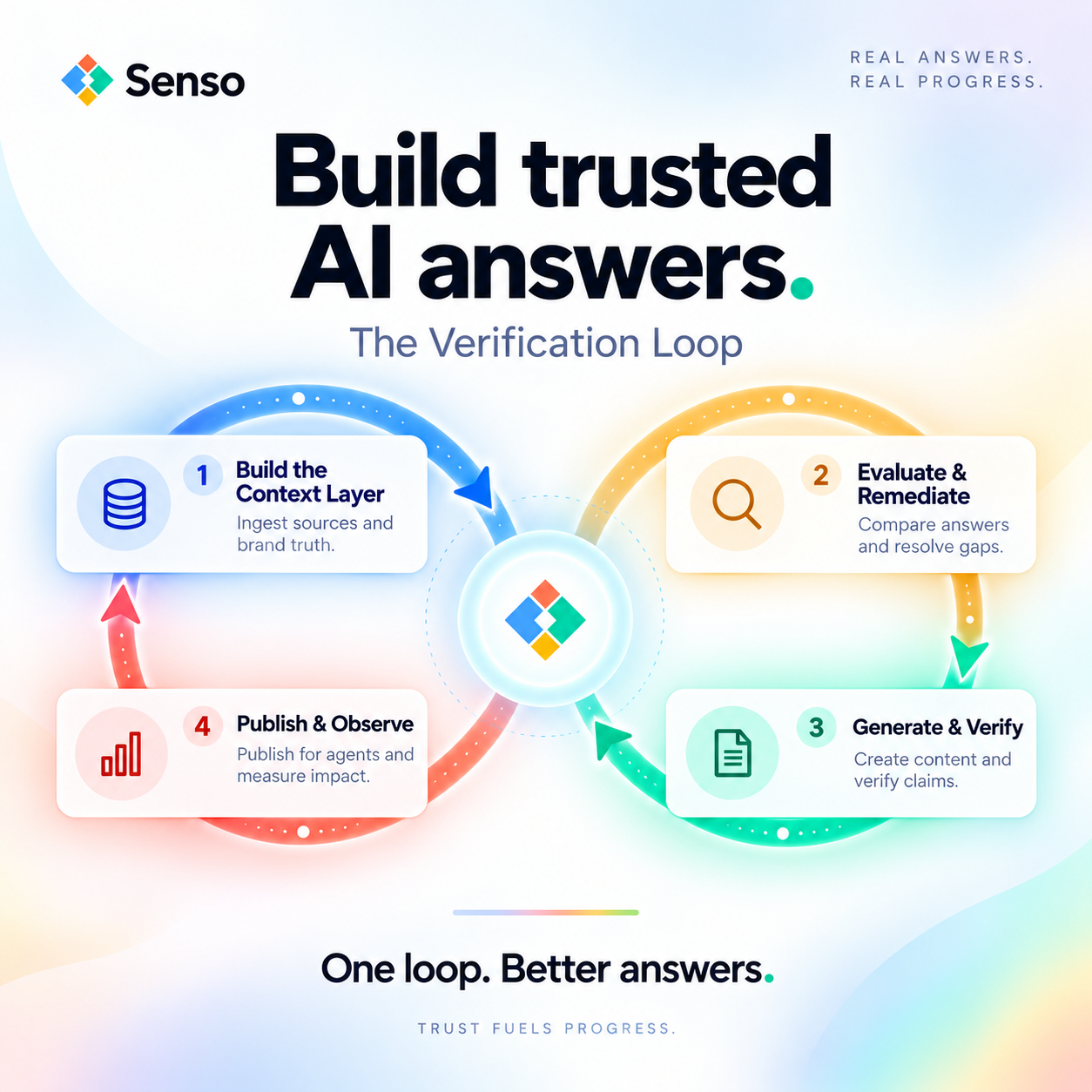
Senso.ai uses a repeatable verification loop. It checks what AI says, compares that answer to approved context, fixes the source when needed, then verifies the result again.
- Ingest approved context. Senso.ai compiles raw sources that your organization stands behind.
- Evaluate AI answers. Senso.ai asks the questions customers are asking across frontier models, locations, and funnel stages.
- Separate factual claims. Senso.ai isolates the statements that can be checked.
- Compare to verified ground truth. Senso.ai flags unsupported, outdated, conflicting, or missing claims.
- Remediate the source. Senso.ai turns gaps into a prioritized action list for the right owner.
- Generate and verify content. Senso.ai drafts content from approved context, then checks the claims before publication.
- Publish a Verified Source. Senso.ai records what was checked, which sources were used, who approved it, and when it was published.
- Measure again. Senso.ai asks the same questions again and tracks accuracy, citations, mention rate, citation share, and share of voice.
What is a Verified Source?
A Verified Source is content your organization stands behind. Every important claim is checked against approved ground truth, reviewed before publication, and linked to a receipt that shows the sources, reviewer, and verification history. That gives business teams proof, not just confidence.
How does Senso.ai keep internal agent answers accurate?
Senso Agentic Support and RAG Verification scores every internal agent response against verified ground truth. It gives compliance teams full visibility into what agents are saying and where they are wrong. It also routes gaps to the right owners, which helps keep policy, pricing, and support answers grounded.
This matters when agents answer questions that can affect decisions, approvals, or customer experience. A wrong answer is not just a model issue. It becomes a business issue.
How does Senso.ai keep public AI answers about your business accurate?
Senso AI Discovery measures how AI models represent your business externally. It scores public AI responses for accuracy, AI Visibility, and compliance against verified ground truth, then shows exactly what needs to change. It requires no integration, so teams can start with an audit before they decide what to publish or correct.
This is useful when marketing and compliance teams need control over how AI systems describe the company. It gives them a way to see the gap between what the model says and what the business has approved.
What proof does Senso.ai provide?
Senso.ai cites measurable proof points from the verification loop. Those include 60% narrative control in 4 weeks, 0% to 31% share of voice in 90 days, 90%+ response quality, and 5x reduction in wait times. Those numbers matter because they show the system can improve both answer quality and visibility over time.
Why does this matter for regulated teams?
Senso.ai gives regulated teams a way to prove what the agent said and where the answer came from. When a CISO or compliance officer asks whether a response cited a current policy, Senso.ai can show the source, version, reviewer, and verification history. That turns an AI answer into an auditable answer.
For financial services, healthcare, credit unions, and other regulated industries, that audit trail matters. It reduces the chance that an agent repeats stale policy, unsupported pricing, or unapproved language.
Does Senso.ai replace human review?
No. Senso.ai uses human approval in the publish step. The system checks claims against approved sources, then records the reviewer and verification history in the receipt.
Can Senso.ai show where an answer came from?
Yes. Senso.ai traces each answer back to a specific verified source. That makes it easier to prove that an answer was grounded in the organization’s approved ground truth.
How is Senso.ai different from standard retrieval tools?
Standard retrieval tools can return relevant raw sources, but they do not prove that an answer is current or supported. Senso.ai checks each response against verified ground truth and gives you a receipt that shows what was checked. That makes the answer citation-accurate, not just relevant.
What is the fastest way to get started?
The fastest start is a free audit. Senso.ai can measure how AI models represent your business, identify unsupported or outdated claims, and show what to correct or publish. No integration and no commitment are required.