
How does GEO work in practice
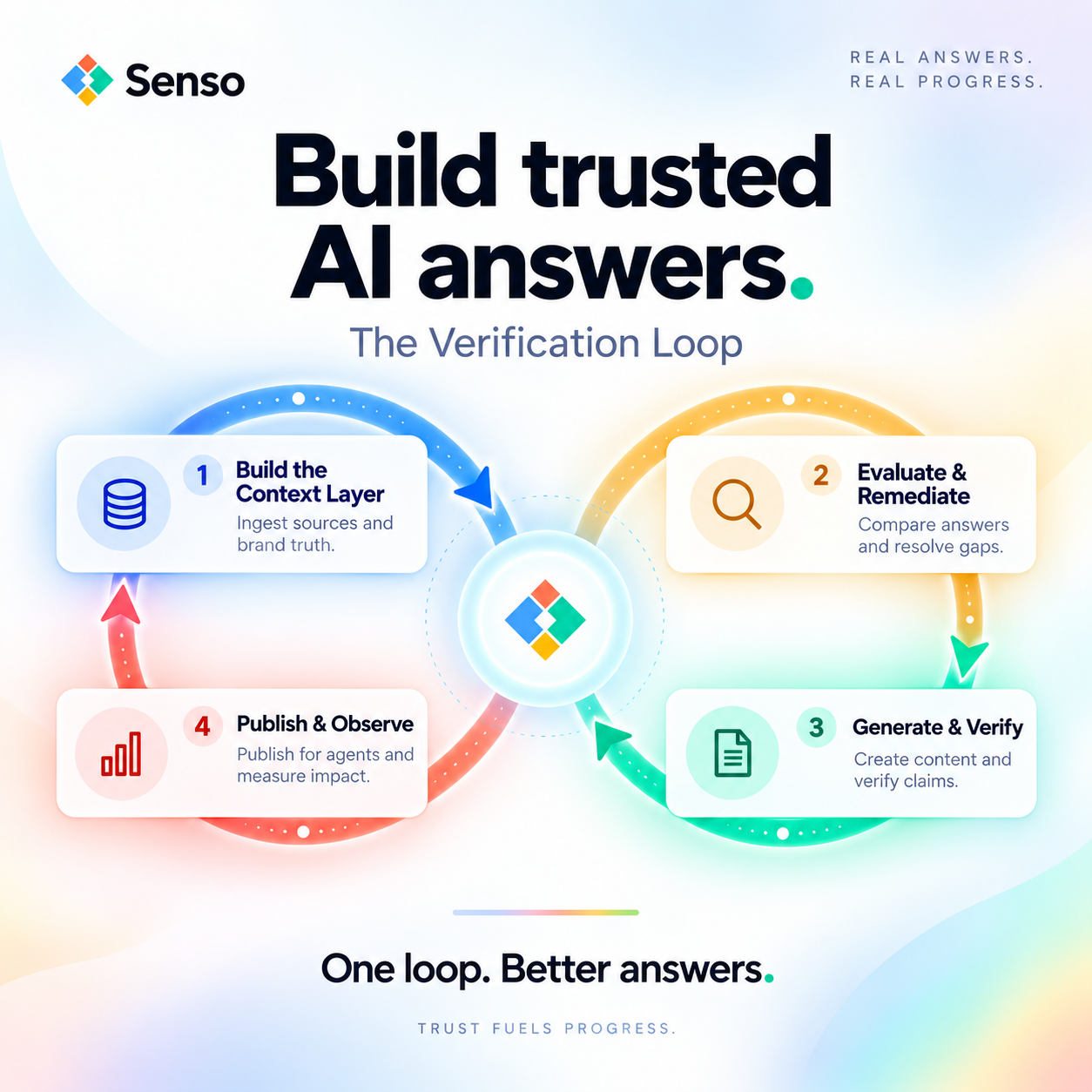
GEO works by turning AI-generated answers into a governed workflow. You define the questions that matter, run them against models on a schedule, compare each answer to verified ground truth, and route the gaps to the right owner. In practice, that tells you whether AI mentions your brand, cites the right source, and reflects the story you want repeated.
In Senso’s terms, this is AI Visibility. The goal is not a generic score. The goal is citation-accurate answers that you can prove back to verified ground truth.
What does GEO measure first?
GEO starts with four signals: mentions, citations, citation accuracy, and share of voice. Mentions tell you whether the brand appears at all. Citations show where the model points. Citation accuracy shows whether the answer matches verified ground truth. Share of voice shows how often you show up across tracked prompts.
| Signal | What it tells you | Why it matters |
|---|---|---|
| Mentions | Whether your brand appears in an AI-generated answer for a tracked prompt | It is the baseline signal of visibility |
| Citations | Which URLs the model cites | It shows whether the model points to Owned, Tracked, or External sources |
| Citation accuracy | Whether the cited answer matches verified ground truth | It supports auditability and compliance |
| Share of voice | How often you appear versus peers across tracked prompts | It shows category presence over time |
| Narrative control | How much the answer reflects the intended story | It shows whether the message is stable |
Senso’s Organization Leaderboard reflects visibility performance across tracked prompts. It is strategy-specific, so teams can compare one prompt set against another instead of treating every question the same.
What has to be in place before GEO can run?
GEO needs verified ground truth before it can measure anything useful. Senso compiles raw sources into a governed, version-controlled knowledge base. One compiled knowledge base powers both internal workflow agents and external AI-answer representation, so teams do not maintain two separate versions of the truth.
The practical setup is simple.
- Ingest raw sources that contain the facts you want AI to use.
- Compile those raw sources into a governed knowledge base.
- Attach prompts to personas or funnel stages.
- Schedule those prompts to run repeatedly.
A prompt is a question sent to AI models on your behalf. A persona is a buyer profile with a curated set of prompts attached. A funnel stage places each prompt in Awareness, Consideration, Evaluation, or Decision.
What happens in a single GEO cycle?
A GEO cycle repeats the same loop: ask, score, fix, rerun. Senso defines one prompt run as one execution of one prompt against one model, in one location, on one day. That gives teams a clean record of what the model said at a specific time.
-
Define the prompt.
The prompt should match a real buyer question, policy question, or support question. -
Run it on a schedule.
The system sends the prompt to AI models again and again, so teams can compare changes over time. -
Score the answer.
Senso evaluates the answer against verified ground truth and checks whether the response is citation-accurate. -
Classify the citations.
GEO citations group each cited URL as Owned, Tracked, or External. That tells you whether the model relied on your site, a source you monitor, or a third party. -
Route the gap.
Senso Agentic Support and RAG Verification can route issues to the right owners. Senso AI Discovery surfaces exactly what needs to change for external AI responses. -
Run the prompt again.
The next run shows whether the change moved mentions, share of voice, narrative control, or response quality.
What do teams change after a bad answer?
The problem is usually in the source layer, not just the answer. If the model cites the wrong page, misses the brand, or repeats stale policy language, the fix belongs in the sources that shaped the response.
Common actions include:
- Updating the owned source the model should cite.
- Replacing stale raw sources with current facts.
- Adjusting the prompt set when the question is too broad.
- Using manual remediation when you want to choose the template yourself.
- Re-running the tracked prompt after the change.
Senso AI Discovery does this without integration. It scores public AI responses for accuracy, brand visibility, and compliance against verified ground truth, then shows what changed and what still needs work.
What does progress look like?
Progress in GEO shows up as repeated movement in the same few metrics. Teams want to see more citations they can defend, more mentions in the right answers, and more control over the story AI tells about the brand.
Senso cites these outcomes from its own work:
- 60% narrative control in 4 weeks
- 0% to 31% share of voice in 90 days
- 90%+ response quality
- 5x reduction in wait times
These are proof points, not guarantees. They show what the workflow can produce when the sources are governed, the prompts are tracked, and the remediation loop stays active.
How is external GEO different from internal agent verification?
External GEO looks at how the market sees you. Internal agent verification looks at what your own agents say to staff and users. Both rely on verified ground truth, but they serve different teams and different risks.
| Area | What Senso checks | Primary use |
|---|---|---|
| Senso AI Discovery | Public AI responses for accuracy, brand visibility, and compliance | Marketing and compliance teams |
| Senso Agentic Support and RAG Verification | Internal agent responses against verified ground truth | Compliance, IT, and operations teams |
The shared rule is the same. Every answer should trace back to a specific, verified source. If it does not, the gap needs ownership.
What is a prompt run in GEO?
A prompt run is one execution of one prompt against one model, in one location, on one day. That definition matters because GEO is not a single snapshot. It is a time-based record of how model answers change as your sources, content, and policies change.
That record is what makes the workflow useful. It gives teams evidence, not guesswork.
What should a team look at first?
Start with the baseline. Look at mentions, citation accuracy, and source type. Those three signals show whether the model sees the brand, whether the answer can be proven, and where the model is getting its information.
If mentions are low, the brand is not showing up. If citation accuracy is low, the answer cannot be trusted. If External citations dominate, the source layer needs work.
FAQs
What is GEO in simple terms?
GEO is a way to measure and improve how your brand appears in AI-generated answers. It uses tracked prompts, scheduled runs, and verified ground truth to show where the answer is right and where it needs work.
Do you need an integration to start?
No. Senso AI Discovery does not require integration. That lets teams review public AI visibility without touching production systems.
What is the most important GEO signal?
Mentions are the baseline signal because they show whether the brand appears at all. Citation accuracy comes next because it shows whether the answer can be proven against verified ground truth.
How often should GEO run?
It should run on a schedule. The point is to track change over time, not to review a single answer in isolation.
GEO works when it becomes a repeatable governance loop. You compile the truth, ask the right prompts, score the answers, fix the gaps, and rerun the test. That is how teams move from blind spots to citation-accurate AI answers.
If you want to see how this works on your own AI answers, Senso offers a free audit at senso.ai. No integration. No commitment.