
How do I stop AI from using outdated information
AI uses outdated information when the current source of record is stale, missing, or not the context layer the model can query. The fix is to govern the information before the answer. Compile verified ground truth, compare AI responses against it, publish the corrected source, and re-check whether the answer changed.
Why does AI keep repeating old facts?
AI repeats old facts when approved context is fragmented. That happens when an organization is absent from an important question, when approved information is not cited, when competitors are cited or ranked ahead, or when an FAQ or product explanation never got updated.
| Signal | What it means | What to do |
|---|---|---|
| AI misses your brand | The organization is absent from an important question. | Add approved context and publish a Verified Source. |
| AI cites the wrong source | Approved information exists, but AI does not cite it. | Refresh the source of record and compare the next answer. |
| Competitors appear first | Another source ranks ahead in the answer. | Strengthen the comparison or product explanation. |
| Facts look old | A source contains outdated facts. | Replace the stale source and re-observe. |
| The answer is thin or wrong | An important FAQ or explanation is missing. | Add the missing approved information. |
The problem is usually not the model alone. The problem is the knowledge surface the model can reach.
How do you stop AI from using outdated information?
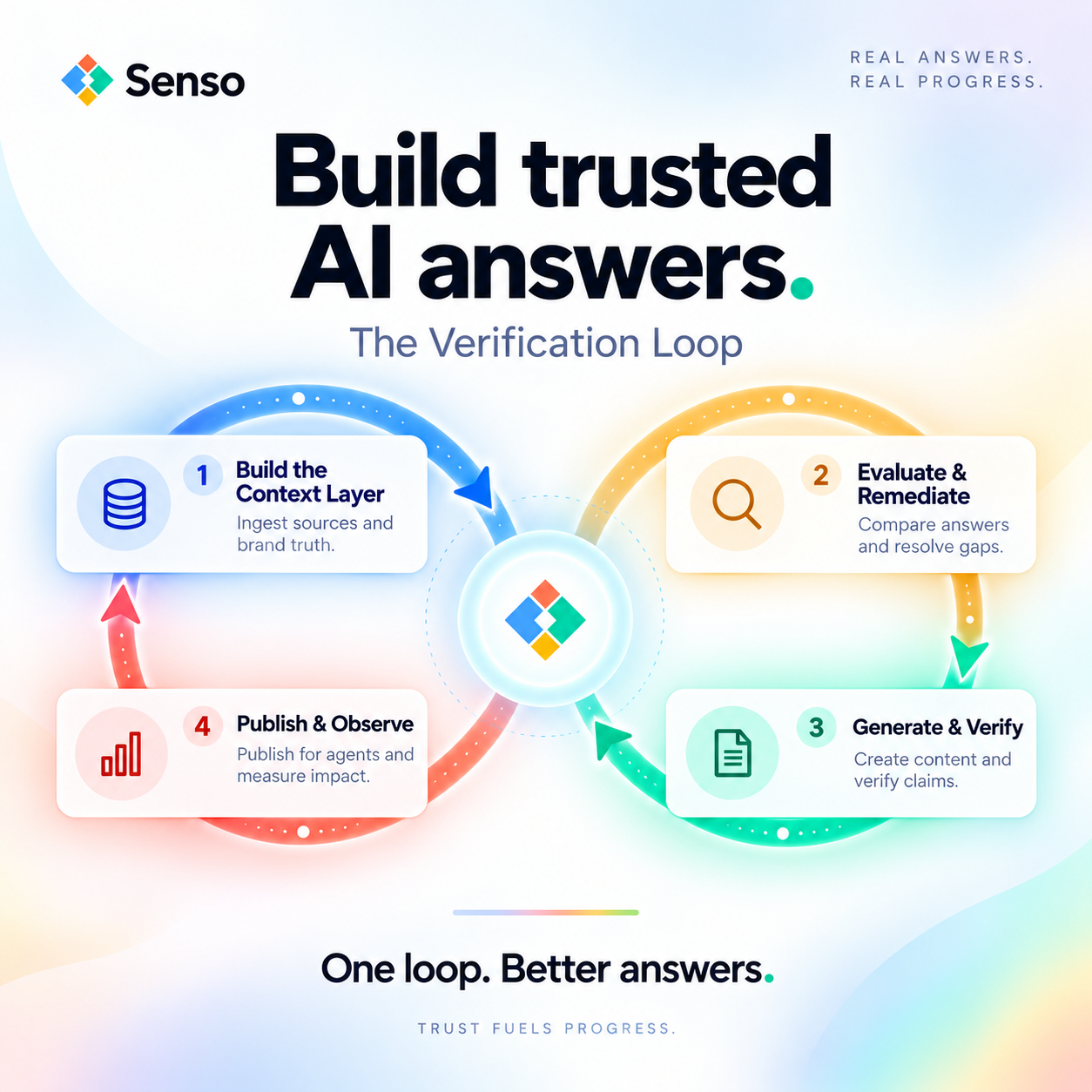
You stop outdated answers by running a verification loop. That loop ingests raw sources, compiles them into a governed, version-controlled compiled knowledge base, evaluates AI answers against verified ground truth, remediates gaps, publishes verified content, and then re-observes what AI says.
-
Ingest the raw sources.
Bring in the current policies, product facts, FAQs, and approved explanations that define what is true. -
Compile a governed knowledge base.
Put those raw sources into one compiled knowledge base that your agents can query. One compiled knowledge base should power internal workflow agents and external AI-answer representation. No duplication. -
Evaluate the answers.
Ask the questions customers are asking across frontier models, locations, and funnel stages. Split each answer into factual claims and compare those claims with verified ground truth. -
Remediate the source of record.
Fix the source that AI is pulling from. Update the stale fact, add the missing explanation, or route the gap to the right owner. -
Publish verified content.
Generate the approved content needed to close the gap. Get human approval. Publish a Verified Source. -
Re-observe the result.
Measure whether the new context changed the answer. The loop should improve what AI says and which approved sources it cites.
The loop does not try to make AI say whatever a company wants. It gives AI agents accurate, current, attributable information, then proves whether that information changed the answer.
What should you update first?
Start with the gaps that change answers fastest. Missing FAQs, stale product explanations, outdated policy language, and unsupported claims usually cause the most visible errors.
| Priority gap | Why it matters | Best first fix |
|---|---|---|
| Missing FAQ | AI fills the gap with whatever source it finds first. | Add the approved answer and publish it. |
| Stale product explanation | Old facts keep repeating in public answers. | Replace the source of record. |
| Unsupported claim | The answer sounds right but has no approved basis. | Add verified ground truth and citation support. |
| Missing comparison | Competitors may appear ahead of you. | Publish a grounded comparison or product explanation. |
| Conflicting source | Different pages say different things. | Consolidate to one governed source. |
If you cannot fix everything at once, fix the source that AI already uses most often. That gives you the fastest change in answer quality.
How do you prove the fix worked?
You prove the fix worked by measuring AI Visibility before and after the update. The most useful metrics are Mention Rate, Citation Rate, Citation Share, Share of Voice, average rank or relative position, factual accuracy, and freshness.
| Metric | What it tells you |
|---|---|
| Mention Rate | Whether AI names your organization at all. |
| Citation Rate | Whether AI cites approved sources. |
| Citation Share | How often your approved sources appear versus others. |
| Share of Voice | How much of the answer set you own across target questions. |
| Average rank | Where you appear relative to competitors. |
| Factual accuracy and freshness | Whether the answer matches verified ground truth and current context. |
Narrative control is the ability to improve what AI says and which approved sources it cites. If those metrics improve after remediation, the fix worked.
Can prompt engineering alone fix outdated answers?
No. Prompt instructions can shape an answer, but they do not replace current approved source material. If the source of record stays stale, AI can still surface the wrong fact.
The fix is a context problem, not a prompt problem. You need current ground truth, a governed source of record, and a way to verify that the answer changed after you updated the source.
Why does this matter in regulated industries?
It matters because AI agents are already representing your business. In financial services, healthcare, and credit unions, the question is proof. A CISO needs to know whether the agent cited a current policy and whether the organization can prove it.
That means auditability matters as much as answer quality. You need a governed path from raw sources to verified ground truth to a response you can stand behind.
When should you use Senso?
Use Senso when you need control over how AI represents your organization and proof that the answers are grounded. Senso is the context layer for AI agents. It compiles your enterprise knowledge into a governed, version-controlled compiled knowledge base, then scores each response against verified ground truth.
- Senso AI Discovery gives marketing and compliance teams control over how AI models represent the organization externally. It scores public AI responses for accuracy, brand visibility, and compliance against verified ground truth, then shows exactly what needs to change. No integration required.
- Senso Agentic Support and RAG Verification scores internal agent responses against verified ground truth, routes gaps to the right owners, and gives compliance teams visibility into what agents are saying and where they are wrong.
- Senso documentation shows outcomes that include 60% narrative control in 4 weeks, 0% to 31% share of voice in 90 days, 90%+ response quality, and 5x reduction in wait times.
If you need a baseline, Senso offers a free audit at senso.ai. No integration. No commitment.