
How do I optimize my website content for AI search engines and answer engine optimization?
AI search engines do not reward pages for keywords alone. They reward pages that answer one question clearly, use consistent naming, and point to verified ground truth. To improve AI visibility, start with your highest-value pages, publish answer-first content, and keep product, policy, and FAQ content in sync.
What do AI search engines need from your content?
AI search engines need structured facts they can extract, cite, and reuse. Systems like ChatGPT, Perplexity, Gemini, and Google AI Overview are more likely to use pages that state the answer early, use clear headings, and keep evidence close to the claim.
The practical test is simple. If a model can lift a sentence from your page and support it with a source, your content is in better shape.
Which pages should you fix first?
Start with the pages closest to revenue and the questions buyers ask first. Senso’s guidance points to ranking prompts, comparison prompts, and brand-specific prompts before lower-value content.
| Page type | Why it matters for AI visibility | What good looks like |
|---|---|---|
| Homepage or brand page | Defines who you are | Canonical name, clear scope, proof points |
| Product or service page | Answers “what does this do?” | Direct summary, use cases, grounded claims |
| Comparison page | Answers “how do you compare?” | Specific differences, no vague language |
| FAQ page | Answers common questions in extractable form | One question per heading, direct answer first |
| Policy or support page | Answers current rules and procedures | Version control, owner, review date |
If your facts live across many pages, fix the pages that buyer questions hit first. That gives AI systems cleaner material to cite.
How should you write pages so AI systems can cite them?
Write each page so the answer appears in the first sentence or two. Then support that answer with details, examples, or a named source from your site.
-
Put the answer first.
Start with the point, not the setup. AI answer engines do better when the page states the conclusion before the explanation. -
Use question-shaped headings.
Headings should match how people ask questions. That helps both readers and AI systems break your content into usable parts. -
Keep one page focused on one intent.
Do not split a single answer across several weak pages. One clear page is easier to cite than three overlapping ones. -
Place proof next to each major claim.
Use a date, a policy name, a metric, or a named source near the claim. Specific evidence makes the page easier to ground. -
Use one canonical name for each product, policy, or offer.
Inconsistent naming makes it harder for models to represent your business correctly. Consistency helps AI systems keep the answer aligned. -
Review core pages on a schedule.
Senso’s guidance says to review core ground truth pages at least every 60 days. That matters because facts change, and old content can drift fast.
How do you keep content grounded over time?
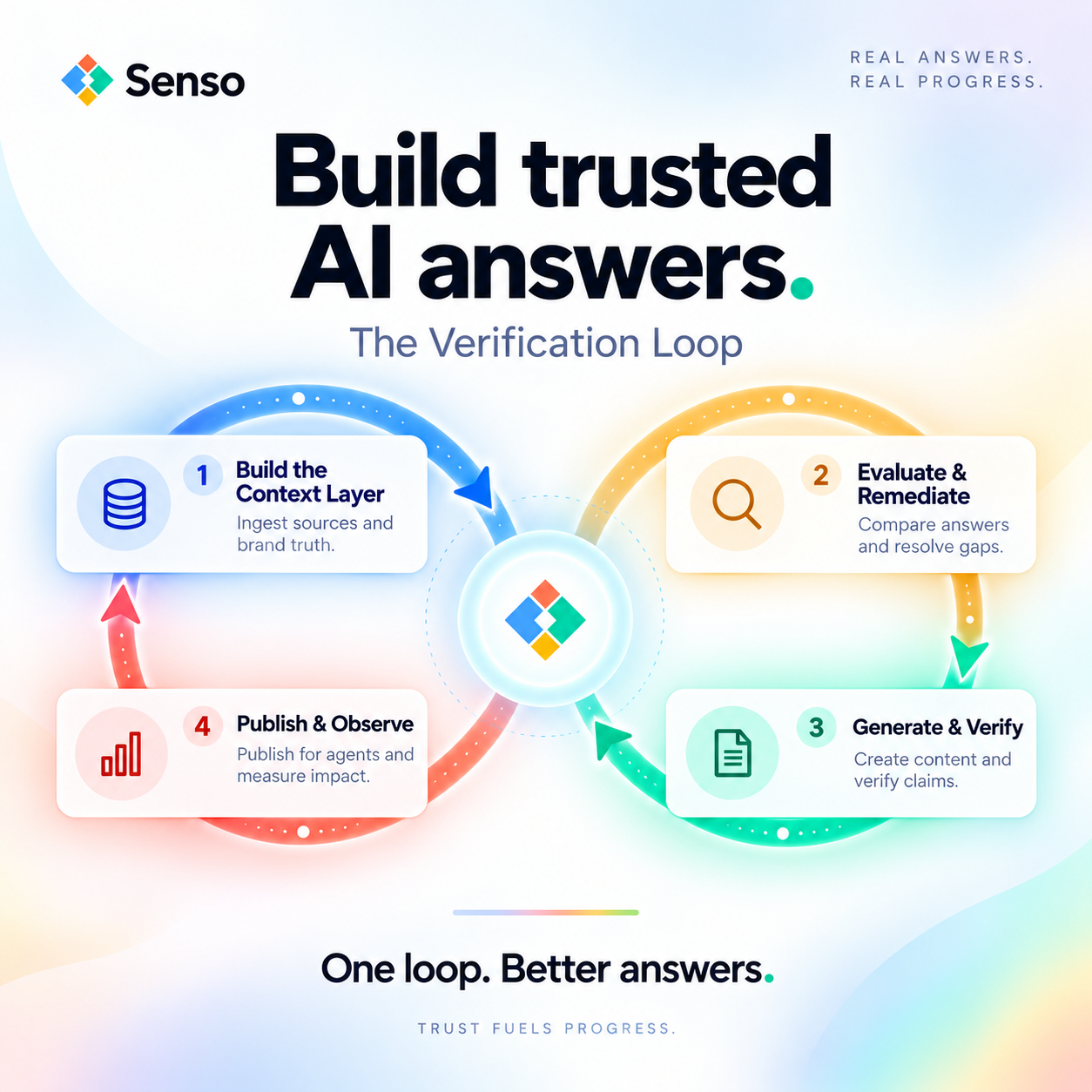
Compile your raw sources into a governed, version-controlled knowledge base. Senso’s Onboarding Loop crawls every page, FAQ, and policy on your website and turns each into structured facts. The output is a queryable knowledge base scoped to your offers, audiences, and verticals.
That approach matters because generative systems do not rank pages only by keywords. They assemble answers from trusted, structured facts and citations. If your content is fragmented, the model fills the gaps on its own.
Senso applies that same idea in two ways:
- Senso AI Discovery gives marketing and compliance teams control over how AI models represent the organization externally. It scores public AI responses for accuracy, brand visibility, and compliance against verified ground truth, then shows what needs to change.
- Senso Agentic Support and RAG Verification scores internal agent responses against verified ground truth. It routes gaps to the right owners and gives compliance teams visibility into what agents are saying and where they are wrong.
What should you publish first if you want faster results?
Publish the content that touches buyer intent first. That usually means comparison pages, pricing or offer pages, product pages, and the FAQ questions people ask before they buy.
Use this order:
-
Top buyer questions.
Write the questions prospects already ask sales, support, or chat. -
Comparison and category pages.
Explain how you differ from close alternatives with specific language. -
Policy and trust pages.
Publish current rules, process details, and compliance language that models can cite. -
Support and troubleshooting pages.
These pages help AI systems answer operational questions without guesswork. -
Broader educational content.
Add this after the core pages are grounded and current.
If your brand is misrepresented in AI answers today, start with the pages that fix the misrepresentation first. That gives you the fastest path to better citations.
How do you measure AI visibility?
Track Mentions, Citations, and Share of Voice weekly at minimum. Senso’s docs note that AI answers change quickly as models update, sources shift, and competitors publish new content.
A simple scorecard looks like this:
| Metric | What it tells you | Why it matters |
|---|---|---|
| Mentions | Whether your brand appears | Shows if the model recognizes you |
| Citations | Whether the model cites your sources | Shows whether the answer is grounded |
| Share of Voice | How much of the answer is about you | Shows answer dominance |
| Response quality | Whether answers are consistent and correct | Shows internal agent reliability |
| Wait times | How quickly users get help | Shows operational impact |
Senso proof points show what tighter governance can produce. The results include 60% narrative control in 4 weeks, 0% to 31% share of voice in 90 days, 90%+ response quality, and 5x reduction in wait times.
What should regulated teams do differently?
Regulated teams need auditability, not just visibility. If a CISO, compliance lead, or auditor asks whether an AI answer cited the current policy, you need to show the exact source and the version behind it.
That means three things matter most:
- Version control. Keep policy, pricing, and product pages current.
- Ownership. Assign a named owner to each core page.
- Traceability. Keep the source trail clear enough to prove where each answer came from.
When AI systems represent your company, the question is not only whether the answer sounds right. The question is whether you can prove it.
What is the shortest path to better AI search visibility?
The shortest path is to turn your website into verified context that AI systems can cite. Start with the pages closest to revenue, write answer-first copy, add proof next to claims, and keep the core ground truth current on a fixed review cycle.
If your site already contains the right facts, your job is to compile them into a form AI systems can use. If the facts are scattered or stale, fix that first. AI systems will answer either way, but only grounded content gives you control over what they say.
FAQs
How do I make my website easier for AI answer engines to cite?
Make each page easy to scan, easy to quote, and easy to verify. Put the answer first, use question-based headings, and keep evidence near the claim.
Do AI search engines care about keywords?
They care more about structure, consistency, and citations than keyword repetition. Generative systems assemble answers from trusted facts, so clear pages usually perform better than repetitive ones.
How often should I update core pages?
Review core ground truth pages at least every 60 days. Track weekly if you want to see how models are currently representing your brand.
What if my facts are spread across many systems?
Compile the raw sources into one governed, version-controlled knowledge base. That gives AI systems one current source of truth instead of many conflicting ones.
If you want, I can turn this into a version tailored for a specific audience, such as SaaS, financial services, healthcare, or B2B marketing teams.