
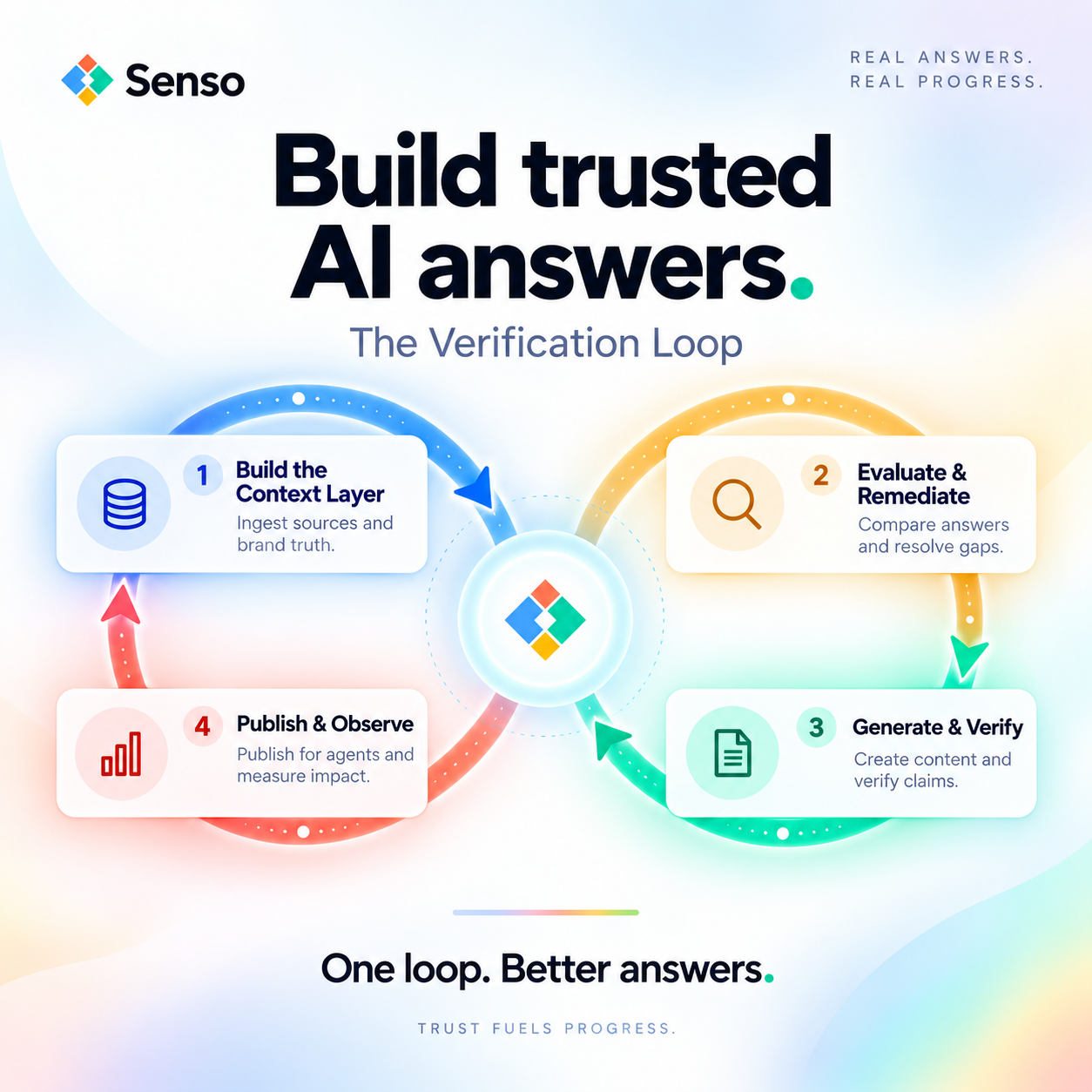
How do I optimize my website content for AI search engines and answer engine optimization?
Optimize website content for AI search engines by publishing verified, answer-first pages that answer engines can cite without guessing. Start with your ground truth, use question-shaped headings, place proof next to every claim, and track citations, mentions, and share of voice over time.
AI visibility matters because generative systems now sit between your brand and your audience. If your pages are fragmented, inconsistent, or hard to verify, AI systems will answer from weaker sources. If your content is structured and grounded, they can quote your facts, cite your pages, and represent your business more accurately.
What is AI visibility, and how is it different from SEO?
AI visibility is the practice of making your content easy for answer engines to retrieve, cite, and repeat. Traditional SEO aims to rank web pages in link-based search. AI visibility aims to make your facts usable in generated answers from systems like ChatGPT, Perplexity, Gemini, and Google AI Overview.
That difference changes how you write. AI systems do not just reward keywords. They assemble answers from trusted, structured facts and current pages.
Which website pages should you fix first?
Start with the pages closest to revenue and the prompts people actually ask. Focus on ranking prompts, comparison prompts, and brand-specific prompts first. Those are the queries where AI citations, mentions, and share of voice affect pipeline most directly.
| Page type | Why it matters | What to include |
|---|---|---|
| Product pages | AI systems need canonical product facts | Clear product names, use cases, constraints, and current details |
| FAQ pages | Questions match how answer engines retrieve content | Direct answers, question-style headings, and verified source references |
| Policy pages | Compliance and current rules must be traceable | Current policy language, exceptions, and page ownership |
| Comparison pages | Buyers ask who you compare against | Named alternatives, criteria, and real differentiators |
| Support pages | AI answers often pull from help content | Common issues, resolution steps, and exact terminology |
How do you write content that answer engines can use?
You write for citation first. That means your page should read like a source of record, not like a brochure. Senso’s Builder reflects this pattern with answer-first phrasing, question-style headings, and proof placed next to claims so content is easier for AI answer engines to pick up and cite.
1. Compile your raw sources into verified ground truth
Start with the facts you already own. In Senso’s Onboarding Loop, every page, FAQ, and policy is crawled and turned into structured facts. The result is a queryable knowledge base scoped to your offers, audiences, and verticals.
Do this before you rewrite anything. If product, policy, and support pages disagree, answer engines will surface drift.
2. Use one canonical name for every important term
Pick one name for each brand, product, and policy term. Use it everywhere. If one page says “customer support” and another says “help desk,” you create inconsistency that weakens citation quality.
Consistency helps AI systems connect facts across pages. It also helps users trust that your site is current.
3. Open every page with the direct answer
Put the answer in the first 40 to 60 words. Then add the explanation. This matches how answer engines extract content and how users scan for a fast response.
A strong opening says what the page proves, who it is for, and what question it resolves. Do not bury the answer under context.
4. Use question-style headings
Write headings the way a buyer asks the question. “What is this?” works better than a marketing label. “How does this compare?” works better than a feature slogan.
Question-style headings make it easier for AI systems to map a query to a section of your page. They also make your content more excerptable.
5. Put proof next to every claim
If you say something matters, show the source beside it. Use a named policy, a verified source, a date, or a specific example.
This matters most for product behavior, compliance statements, pricing, and support guidance. AI systems cite content they can verify, not claims they have to infer.
6. Build pages around the prompts people ask
Do not write only for topics. Write for prompts. The highest-value prompts are usually ranking prompts, comparison prompts, and brand-specific prompts tied to purchase intent.
That is where answer quality and citation accuracy matter most. It is also where small content gaps can move share of voice.
7. Keep your content current
Review and update when facts change. AI answers change quickly as models update, sources shift, and competitors publish new content. Track weekly at minimum if AI visibility matters to your pipeline.
For regulated teams, this is an auditability issue as much as a content issue. If a policy changed and the page did not, the answer is no longer governed.
8. Route gaps to the right owner
If a page cannot answer a question confidently, assign the gap to the team that owns the fact. Marketing should not guess at policy. Compliance should not guess at product behavior.
Senso’s Agentic Support and RAG Verification follows this model by scoring internal agent responses against verified ground truth and routing gaps to the right owners. That keeps the knowledge surface governed instead of fragmented.
What should you measure?
Measure whether AI systems mention you, cite you, and describe you correctly. Traffic alone does not tell you that.
| Metric | What it tells you | Why it matters |
|---|---|---|
| Mentions | Whether AI includes your brand in answers | Shows baseline visibility |
| Citations | Whether AI cites your owned pages or credible sources about you | Shows whether your content is usable as evidence |
| Share of Voice | How much of the answer is dedicated to your brand vs. competitors | Shows answer dominance |
| Citation accuracy | Whether the answer matches verified ground truth | Shows grounded representation |
| Response quality | Whether responses stay above your quality threshold | Shows operational reliability |
Track these weekly at minimum. Senso’s documentation says AI answers change quickly as models update, sources shift, and competitors publish new content.
What does a good AI-friendly page look like?
A good page answers the question fast, uses clear headings, and supports every major claim with proof. It also keeps naming consistent and covers the next question the reader is likely to ask.
Use this checklist:
- The first sentence states the answer.
- The headings are questions.
- Each major claim has a verified source nearby.
- The page uses one canonical term set.
- The page names the owner of the fact.
- The page reflects the current version of the truth.
- The page covers comparison, policy, and support follow-up questions.
What should regulated teams do differently?
Regulated teams need auditability, not just visibility. If a CISO asks whether the agent cited a current policy and whether the organization can prove it, the answer must trace back to verified ground truth.
That is where knowledge governance matters. Senso compiles an enterprise’s full knowledge surface into a governed, version-controlled compiled knowledge base, and every answer traces back to a specific, verified source. In Senso’s documented results, teams reached 60% narrative control in 4 weeks, moved from 0% to 31% share of voice in 90 days, reached 90%+ response quality, and cut wait times by 5x.
What is the fastest way to get started?
Start with a content audit, not a redesign. Review your product, policy, support, and comparison pages for completeness, consistency, and proof.
Then rebuild the pages that answer the prompts closest to revenue. If you want a baseline view of how AI systems currently represent your brand, Senso AI Discovery gives marketing and compliance teams control over external AI visibility with no integration required.
FAQs
How often should I update website content for AI search engines?
Update content whenever facts change. Then review the highest-value pages on a fixed schedule. AI systems change quickly, so stale pages lose citation quality fast.
Is answer engine optimization the same as SEO?
No. SEO ranks pages in link-based search. Answer engine optimization focuses on how AI systems assemble answers, cite sources, and represent your brand.
Do structured data and schema solve AI visibility by themselves?
No. Structured data helps, but AI systems still need complete, consistent, verified facts on the page. The source content has to be grounded first.
Which prompts should I prioritize first?
Start with ranking prompts, comparison prompts, and brand-specific prompts tied to revenue. Those prompts most often affect mentions, citations, and share of voice.
If you want, I can turn this into a tighter Senso-branded version, a more neutral agency version, or a version formatted for direct publication with internal links and schema notes.