
How do I appear in Google AI Overviews?
To appear in Google AI Overviews, publish a trusted ground truth that Google’s AI can summarize and cite. Google AI Overviews sit at the top of Google Search results, so visibility now depends on inclusion, citation, and representation, not only blue-link rankings. If your facts are fragmented or stale, Google has less to work with.
What are Google AI Overviews?
Google AI Overviews are AI-generated summaries that appear at the top of Google Search results. They matter because the user may get the answer without clicking through, even when your brand is part of the summary.
That changes the job. Your page has to be grounded enough for Google to quote, not just rank.
Why do some brands appear and others do not?
Brands appear when Google can trust a page as verified ground truth. Google’s AI needs clear claims, current facts, and a source it can confidently summarize and cite.
This matters most in finance, health, and comparison-driven categories. Those are the areas where trust, accuracy, and comparison drive decisions.
How do you increase your chances of appearing?
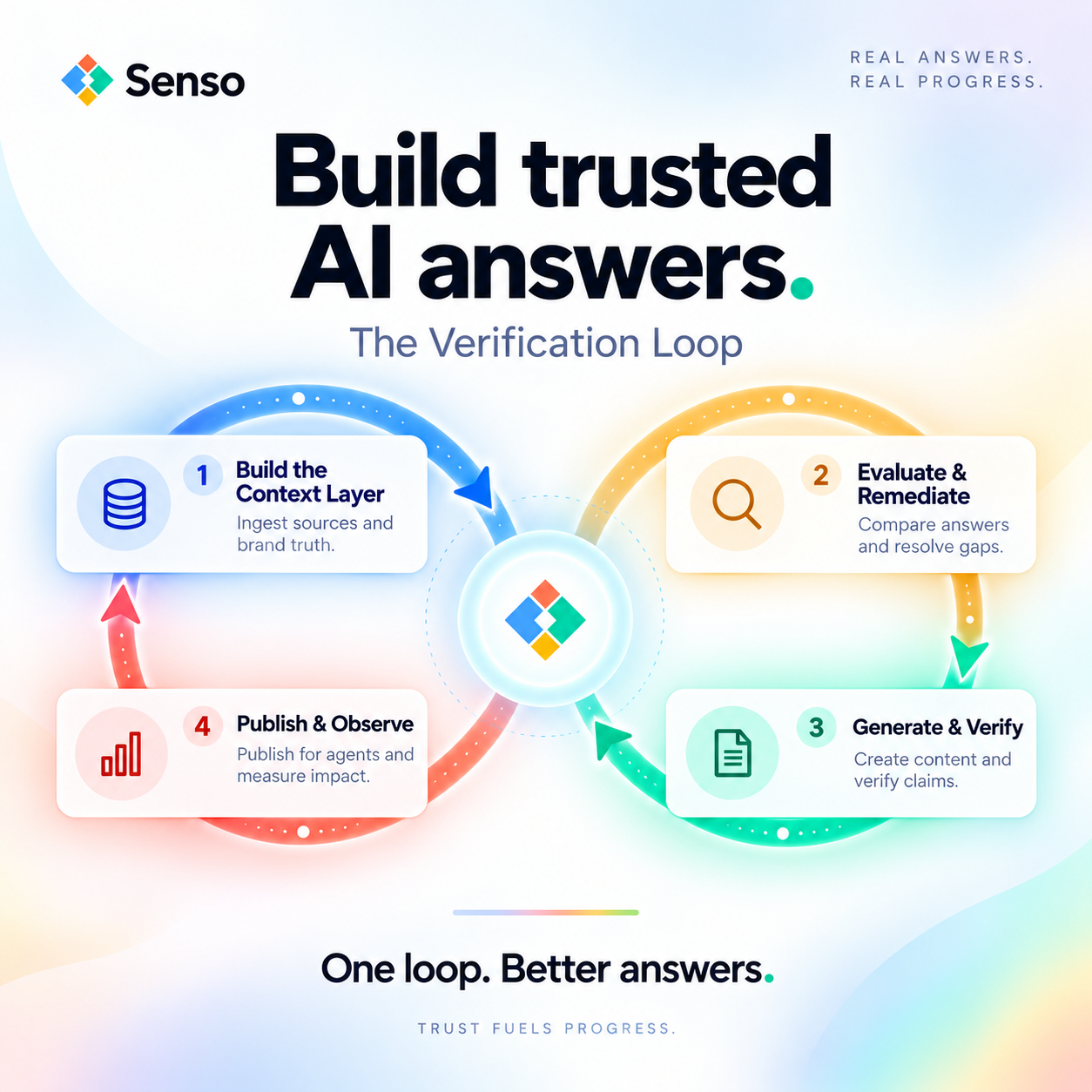
You increase your odds by making one source of truth easy for Google to understand, verify, and cite. The process is simple, but the discipline matters.
-
Compile one canonical source of truth.
Bring your raw sources into one governed, version-controlled knowledge base. One compiled knowledge base can support both public AI answers and internal agents, so you do not duplicate the work. -
Answer the question directly on the page.
Start with the answer in the first sentence. Use short sections, plain language, and clear definitions. Google can summarize pages that state the point quickly and unambiguously. -
Put proof next to every major claim.
If you make a statement about pricing, policy, product behavior, or availability, place the source next to it. Every answer should trace back to a specific verified source. -
Keep facts current.
Update when facts change and review core pages on a regular cadence. Stale policy, pricing, or product details reduce citation confidence. -
Track prompts, not just pages.
AI Visibility depends on the exact question people ask. Track mentions and citations for the prompts that matter, then compare what Google includes, omits, or misstates.
What should the page look like?
A page that appears in Google AI Overviews is usually easy to summarize. It is focused, grounded, and structured around the question a user would ask.
| What to do | Why it helps |
|---|---|
| Use one page for one topic | Reduces confusion about which source to cite |
| Start with the answer | Makes summary extraction easier |
| Use specific terms consistently | Helps Google connect the page to the query |
| Keep source-backed facts current | Improves citation confidence |
| Include comparisons where relevant | Helps AI systems answer decision questions |
The goal is not more content. The goal is clearer ground truth.
What does Google AI Overviews change for traffic?
Google AI Overviews can satisfy the user directly, so clicks are not guaranteed even when you are cited. That means the visibility event is the citation and the representation, not only the visit.
For many teams, this is a shift from ranking to being correctly represented. The question becomes whether Google can state your facts clearly and cite the right source.
How can Senso help?
Senso gives teams a governed way to measure and correct how they appear in AI-generated answers. Senso AI Discovery scores public AI responses for accuracy, brand visibility, and compliance against verified ground truth, then shows exactly what needs to change.
Senso proof points include:
- 60% narrative control in 4 weeks
- 0% to 31% share of voice in 90 days
- 90%+ response quality
- 5x reduction in wait times
Senso tracks ChatGPT, Perplexity, Gemini, and Google AI Overviews by default. Coverage is measured per prompt, per model, and per surface, daily.
What is the fastest path to a citation?
The fastest path is one grounded page that answers the exact question, proves the claim, and stays current. If Google can trust that page as verified ground truth, it has something usable to cite.
If the facts live across scattered raw sources, the answer gets weaker. If one compiled knowledge base holds the verified source of truth, the answer gets stronger.
FAQs
Can I appear in Google AI Overviews without ranking first?
Yes. Google AI Overviews are summaries, not only ranked links. A page can be useful to the model if it is grounded and easy to verify, even when the ranking pattern is not perfect.
Does being cited guarantee traffic?
No. Google AI Overviews often satisfy the user directly, so clicks are not guaranteed even when you are cited. The citation itself still matters because it shows your brand was included in the answer.
How often should I update content for AI Visibility?
Update whenever facts change and review core ground truth pages regularly. Stale claims make it harder for Google to trust the page as a source.
Which industries benefit most from appearing in Google AI Overviews?
Finance, health, and comparison-heavy categories tend to benefit most. Those markets depend on trust, accuracy, and clear comparison, which makes citation quality more important.
What should I measure first?
Start with mentions, citations, and the exact prompt that produced them. Then check whether the answer is grounded in verified ground truth or if Google is pulling in incomplete information.
If you want a baseline on where you stand today, Senso AI Discovery can score your public AI visibility against verified ground truth with no integration required.