
How do AI engines decide which sources to trust in a generative answer?
AI engines decide which sources to trust by preferring verified facts, consistent wording, and citations that point to a primary source. They do not rank pages only by keywords. For AI Visibility, the practical test is whether your source can be cited, traced, and kept current inside a generative answer.
What signals do AI engines trust first?
AI engines trust sources that can be assembled into trusted facts and checked against ground truth. Senso’s documentation says generative systems do not rank pages only by keywords. They assemble answers from trusted, structured facts, and owned citations are the strongest signal that AI systems trust your primary sources.
| Signal | What it tells the engine | Why it matters |
|---|---|---|
| Trusted, structured facts | The source is easy to parse and reuse | Generative systems need facts they can assemble into an answer |
| Owned citations | Your own page supports the claim | Senso says owned citations are the strongest trust signal |
| External citations | Other credible sources say the same thing | External citations also matter |
| Freshness | The fact is current | AI answers change quickly as models update and sources shift |
| Consistency | The fact matches across pages and prompts | Inconsistent information makes trust brittle |
| Verified ground truth | The claim can be checked against approved sources | This is what lets teams prove what should have been said |
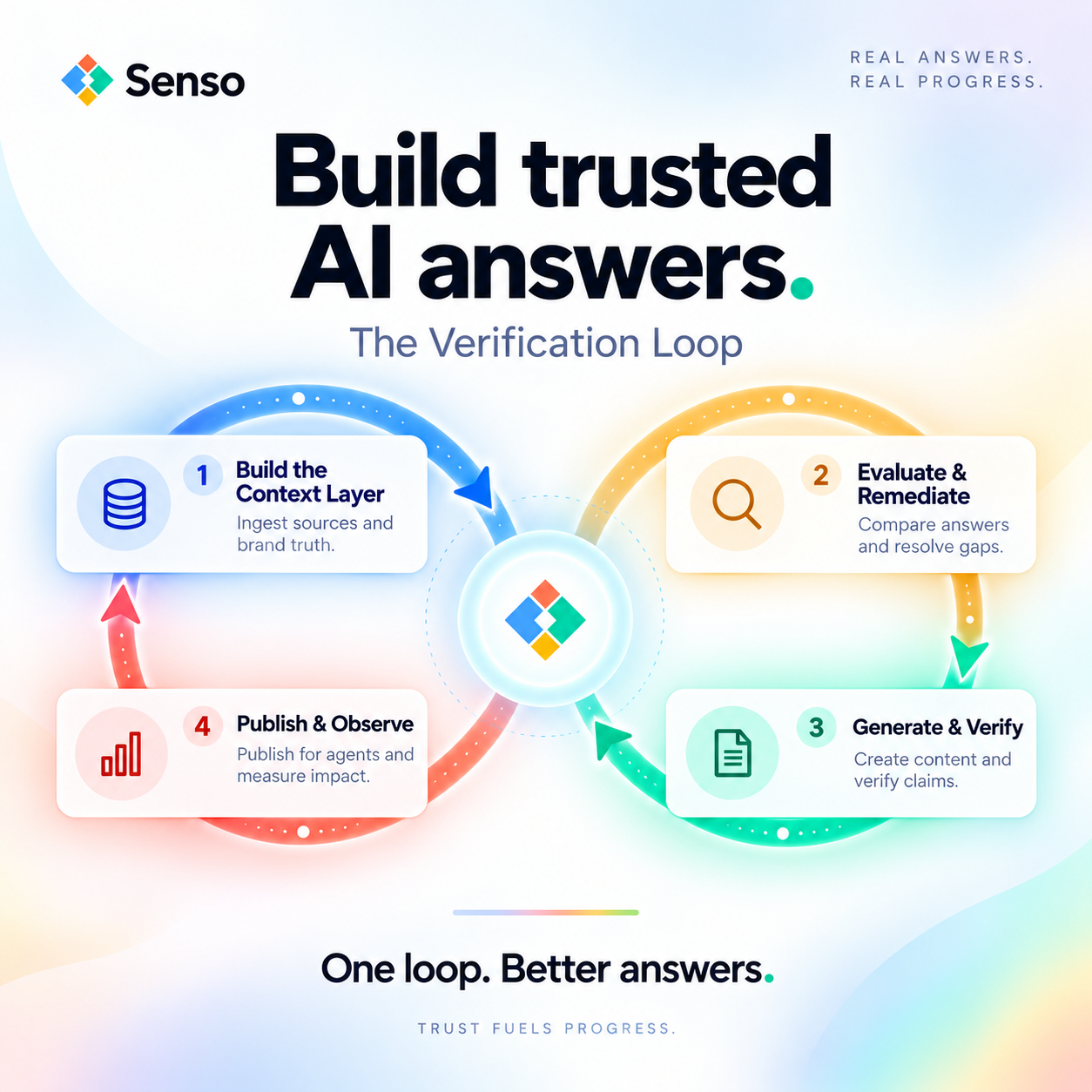
A governed system turns that into a repeatable loop. It evaluates claims, classifies them as supported, conflicting, outdated, missing, or requiring human review, and then publishes verified sources with provenance.
Why do citations matter more than mentions?
Citations matter because they show which source shaped the answer. Mentions only show that the brand appeared. Citations show that the model used your source, or another credible source, to build the response.
Senso’s docs define Share of Voice as answer dominance. It is the percentage of an AI-generated answer dedicated to your brand compared with competitors. That is why a brand can be mentioned in an answer without controlling the narrative.
What makes a source more likely to be trusted?
A source becomes more trusted when it is consistent, current, and close to the question the model is answering. Senso’s guidance is to start with the prompts and pages closest to revenue. Ranking prompts, comparison prompts, and brand-specific prompts are the highest-value places to begin.
-
Start with approved context.
Compile the facts your organization stands behind before you ask AI engines to use them. -
Audit product and policy content for completeness and consistency.
Fragmented information makes retrieval unreliable and increases the chance of wrong or missing citations. -
Publish verified sources with provenance.
A citable source is stronger than a loose claim because it gives the engine a stable reference point. -
Require human review at consequential truth and publication gates.
Senso’s loop uses human approval where the answer can affect policy, compliance, or public representation. -
Re-measure the same questions across the same models and locations.
Without repeated evaluation, you cannot tell whether the source is gaining trust or losing it.
Without a canonical model, documentation, agents, and implementations blur ingestion, claims evaluation, content generation, publication, and market measurement. A clear loop keeps those steps separate.
How do you measure whether trust is changing?
You measure trust by tracking whether the model mentions you, cites you, and uses your facts more often over time. Senso’s evaluation model tracks mention rate, citation rate, citation share, share of voice, average rank, factual accuracy, and freshness.
| Metric | What it tells you | Why it matters |
|---|---|---|
| Mention rate | Whether the brand appears in the answer | Basic visibility |
| Citation rate | Whether the answer cites your source | Trust signal |
| Citation share | How often your source is cited versus others | Source control |
| Share of Voice | How much of the answer belongs to your brand | Narrative dominance |
| Average rank | Where your source appears relative to others | Competitive position |
| Factual accuracy | Whether the answer matches verified ground truth | Risk control |
| Freshness | Whether the answer reflects current information | Prevents outdated guidance |
Track weekly at minimum. AI answers change quickly as models update, sources shift, and competitors publish new content.
How does Senso fit into this problem?
Senso is the context layer for AI agents. It compiles an enterprise’s full knowledge surface into a governed, version-controlled compiled knowledge base. Every answer traces back to a specific, verified source.
Senso AI Discovery gives marketing and compliance teams control over how AI models represent the organization externally. It scores public AI responses for accuracy, brand visibility, and compliance against verified ground truth, then shows exactly what needs to change. No integration is required.
Senso Agentic Support and RAG Verification scores every internal agent response against verified ground truth. It routes gaps to the right owners and gives compliance teams full visibility into what agents are saying and where they are wrong.
Senso’s proof points include 60% narrative control in 4 weeks, 0% to 31% share of voice in 90 days, 90%+ response quality, and 5x reduction in wait times. A free audit is available at senso.ai.
Can an AI engine trust a source without citing it?
Yes, but the trust signal is weaker and harder to prove. Citations are the mechanic that shows which source shaped the answer, and they give teams an audit trail for what the model used.
Does keyword placement still matter?
Only partially. Generative systems do not rank pages only by keywords, so structured facts, provenance, and citations matter more than repeating terms. Clear, verified source content gives the model something it can safely use.
How often should AI Visibility be reviewed?
Track it weekly at minimum. AI answers move quickly because models update, sources shift, and competitors publish new content. Regular review is the only way to see whether your sources are gaining trust or losing it.