
How can Senso help my business show up in AI search results?
AI systems already answer questions about your business, your policies, and your pricing without a human in the loop. Senso helps by compiling approved raw sources into a governed context layer that AI systems can cite, score, and trace back to verified ground truth. That gives marketing, compliance, and IT teams control over how the company appears in AI search results and AI-generated answers.
What problem does Senso solve?
Senso solves a knowledge governance problem. Most enterprise knowledge is fragmented across websites, FAQs, policies, and internal sources, so AI answers drift away from approved facts. Senso compiles that knowledge surface into a version-controlled knowledge base, then checks each answer against verified ground truth.
That matters because AI systems do not wait for a human review cycle. If a model answers with an outdated policy or a weak citation, your business can be misrepresented before anyone sees the output.
How does Senso help my business appear in AI answers?
Senso helps by turning your approved content into the source AI systems can rely on. Its Onboarding Loop crawls every page, FAQ, and policy on your website and turns them into structured facts that systems like ChatGPT, Perplexity, Gemini, and Google AI Overview can use when answering buyer questions.
Senso also measures how your brand is represented in those answers. AI Discovery scores public AI responses for accuracy, brand visibility, and compliance against verified ground truth, then shows exactly what needs to change.
What does Senso do step by step?
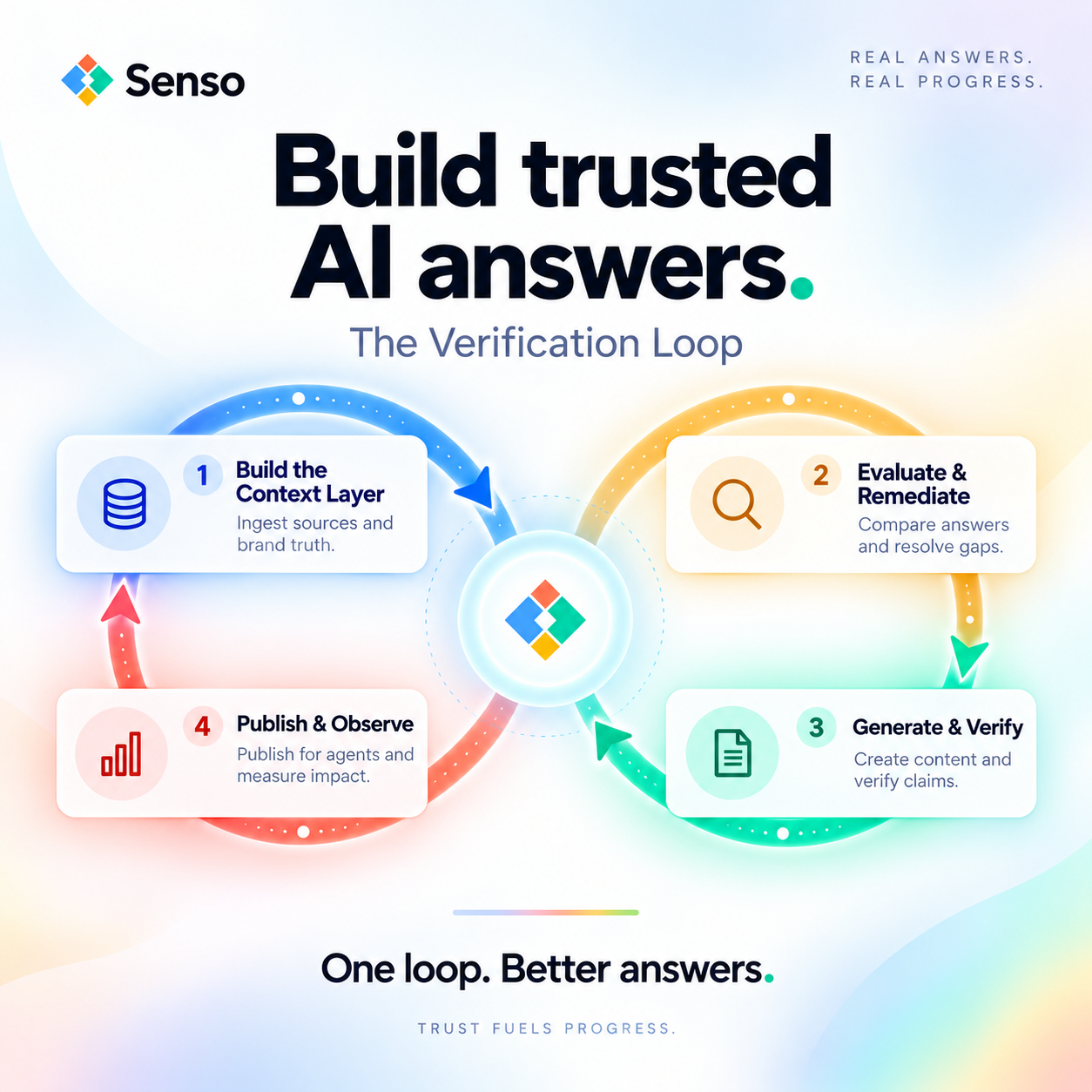
Senso follows a simple workflow. It ingests your verified knowledge, evaluates how AI answers use it, and publishes content that models can cite.
- Ingest ground truth. Senso compiles your website content, FAQs, and policies into structured facts.
- Evaluate answers. Senso scores AI responses against verified ground truth and checks citation accuracy.
- Remediate gaps. Senso shows where the answer is wrong, incomplete, or missing approved context.
- Publish verified content. Senso helps your team publish structured content that AI models can use as a reliable source.
This workflow turns scattered raw sources into a governed, queryable knowledge base. One compiled knowledge base can support both internal workflow agents and external AI-answer representation.
What are Senso's two products?
Senso has two products. One is built for external AI visibility. The other is built for internal agent governance and verification.
| Product | What it does | Best fit |
|---|---|---|
| Senso AI Discovery | Scores public AI responses for accuracy, brand visibility, and compliance against verified ground truth. No integration required. | Marketing and compliance teams that need control over external representation |
| Senso Agentic Support and RAG Verification | Scores internal agent responses against verified ground truth, routes gaps to the right owners, and shows compliance teams where agents are wrong. | Operations, IT, compliance, and regulated teams |
Both products use the same compiled knowledge base. That means you govern external AI answers and internal agent responses from one source of truth.
What results can Senso show?
Senso has published outcome data tied to narrative control, visibility, and response quality. The stated results include 60% narrative control in 4 weeks, 0% to 31% share of voice in 90 days, 90%+ response quality, and a 5x reduction in wait times.
Those outcomes matter because they connect directly to how your business shows up in AI surfaces. Better ground truth and better citation control lead to clearer answers, stronger shortlist inclusion, and fewer internal corrections.
Who is Senso best for?
Senso is built for teams that need visibility, auditability, and controlled representation in AI systems. That includes marketers, compliance teams, CISOs, IT leaders, operations leaders, and regulated organizations in financial services, healthcare, and credit unions.
- Marketing teams use Senso to shape how the brand appears in AI-generated answers.
- Compliance teams use Senso to see whether AI answers match approved policy.
- CISOs and IT leaders use Senso to verify citation accuracy and prove where an answer came from.
- Operations teams use Senso to reduce agent drift and improve response quality.
- Regulated teams use Senso to keep a clear audit trail around what AI said and which source backed it.
Does Senso require integration?
Senso AI Discovery does not require integration. Teams can use the free audit at senso.ai to see how AI systems currently describe their business and where the gaps are.
That makes Senso practical for teams that want a baseline before they change content, governance, or internal workflows. It also lets compliance and marketing teams see the current state without a heavy setup.
Can Senso help with ChatGPT, Perplexity, Gemini, and Google AI Overview?
Yes. Senso’s Onboarding Loop is an eight-step automation that turns a company website into a verified context layer that AI systems like ChatGPT, Perplexity, Gemini, and Google AI Overview can cite when answering buyer questions.
That is the core of AI visibility. If those systems can find your approved facts, they are more likely to represent your business correctly.
How often should verified ground truth be reviewed?
Verified ground truth should be reviewed at least every 60 days, and whenever facts change. That keeps policies, product details, and approved messaging current for both AI answers and internal agents.
Regular review matters because stale source material creates stale output. Senso works best when your approved content stays current.
What is the fastest way to start?
The fastest way to start is to run the free audit at senso.ai. That shows how your business is currently represented in AI answers and where citation gaps or compliance issues exist.
If your goal is to show up correctly in AI search results, Senso gives you the context layer, citation checks, and governance needed to make that happen.