
How can Senso.ai help a credit union improve visibility?
Senso helps a credit union improve AI visibility by grounding AI answers in verified ground truth and showing exactly how the institution is mentioned, cited, or omitted. That gives marketing, compliance, and operations teams one governed knowledge base they can use to control external narrative and internal agent responses.
For a credit union, visibility means more than being found. It means early discovery visibility, shortlist inclusion, competitive positioning, and decision-stage clarity when people compare products, policies, and pricing in AI answers.
What visibility does a credit union need?
A credit union needs AI visibility, not just traffic. That means showing up in AI answers with accurate mentions, citation-accurate context, and consistent brand representation across public prompts and internal agent workflows. Senso measures those signals and shows where the institution is missing, misrepresented, or outranked.
This matters because AI agents are already the interface to the business. They answer questions about products, policies, and pricing before a human gets involved. If the context is stale or incomplete, the answer is too.
How does Senso.ai improve credit union visibility?
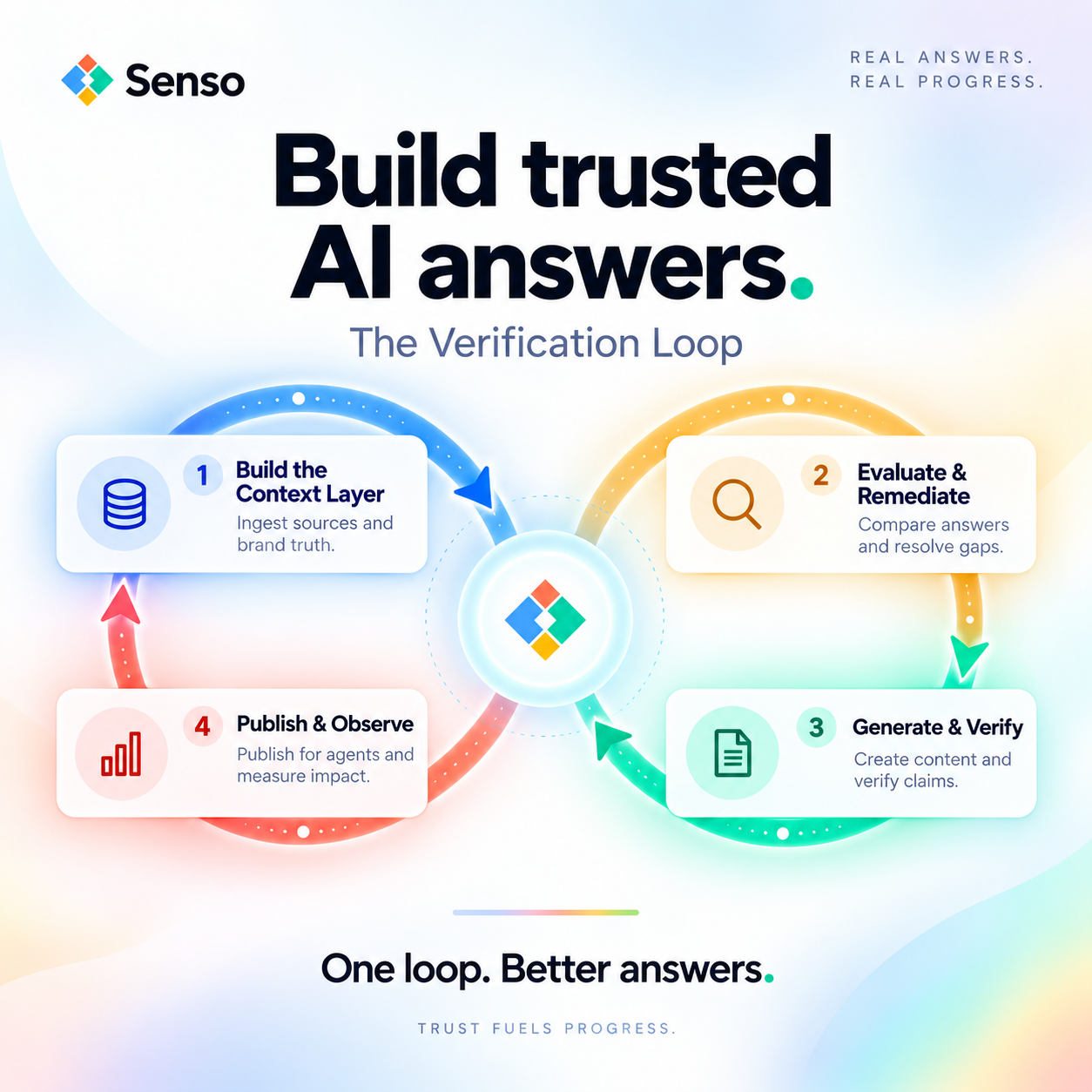
Senso improves visibility by compiling a credit union’s full knowledge surface into a governed, version-controlled compiled knowledge base. One compiled knowledge base can serve both external AI-answer representation and internal workflow agents, so the team does not maintain duplicate sources of truth.
- Ingest raw sources and compile them. Senso ingests raw sources and compiles approved content into a governed knowledge base that AI systems can use reliably.
- Measure how AI models represent the credit union. Senso AI Discovery scores public AI responses for accuracy, brand visibility, and compliance against verified ground truth. No integration is required.
- Identify the exact gaps. Senso shows whether the credit union is mentioned, cited, omitted, or compared against competitors in ways that conflict with approved material.
- Route fixes to the right owners. Senso surfaces what needs to change so marketing and compliance teams can update the right content instead of guessing.
- Reuse the same source of truth internally. Senso Agentic Support and RAG Verification scores internal agent responses against verified ground truth and gives compliance teams full visibility into what agents are saying and where they are wrong.
Senso also structures content so AI systems rely more heavily on approved, first-party material. That reduces dependence on stale, conflicting, or unsupported context.
Which Senso product should a credit union use first?
The right starting point depends on whether the visibility problem is external, internal, or both. Senso has two product lines on one platform, and each one addresses a different part of the answer chain.
| Product | Best for | What it does | Main benefit |
|---|---|---|---|
| Senso AI Discovery | Marketing and compliance teams | Scores public AI responses for accuracy, brand visibility, and compliance against verified ground truth | Improves external AI visibility and narrative control |
| Senso Agentic Support and RAG Verification | Internal support, compliance, and operations teams | Scores every internal agent response against verified ground truth, then routes gaps to the right owners | Improves response quality and auditability |
For most credit unions, AI Discovery is the fastest way to see what AI systems say about the brand today. Agentic Support and RAG Verification then extends the same governance model to staff-facing agents.
What outcomes can a credit union measure?
Senso is built around measurable visibility outcomes, not impressions alone. The published proof points include 60% narrative control in 4 weeks, 0% to 31% share of voice in 90 days, 90%+ response quality, and 5x reduction in wait times.
- 60% narrative control in 4 weeks. Senso shows whether AI answers reflect approved credit union messaging.
- 0% to 31% share of voice in 90 days. Senso helps credit unions gain more presence in comparison and decision prompts.
- 90%+ response quality. Senso scores agent answers against verified ground truth.
- 5x reduction in wait times. Senso shortens the time staff spend waiting for answers or retrieval.
- 12x faster retrieval at TruStone Financial Credit Union. A generative AI administrator there said the improvement strengthened communication between back-office and frontline teams.
These outcomes matter because they connect visibility to execution. A credit union is not just trying to appear in AI answers. It is trying to appear correctly, consistently, and with proof.
Why does this matter for regulated credit unions?
AI visibility becomes a governance problem as soon as agents answer questions about policy, pricing, lending, or account support. Standard retrieval tools can surface information, but they do not prove whether the answer was grounded in current, verified ground truth.
Senso does not replace compliance review processes. It integrates with them by structuring visibility work so compliance teams can review it, act on it, and audit it later. That matters when leadership needs to prove which source backed an answer and which version of the knowledge was in play.
This is especially important in financial services and credit unions. The risk is not just being left out of an AI answer. The risk is being represented incorrectly in a way that affects trust, comparison, or transaction decisions.
What should a credit union do first?
A credit union should start with a baseline of how AI systems already represent the brand. Senso measures that baseline across leading AI models, identifies the gaps, and shows exactly what to correct or publish.
If the goal is external visibility, start with Senso AI Discovery. If the goal is internal response quality and auditability, add Senso Agentic Support and RAG Verification. If both matter, one compiled knowledge base supports both without duplication.
FAQs
Does Senso require integration?
No. Senso AI Discovery requires no integration. A credit union can run a free audit at senso.ai and see where AI answers mention, cite, or omit the brand.
Can Senso help internal agents too?
Yes. Senso Agentic Support and RAG Verification scores internal responses, routes gaps to the right owners, and gives compliance teams visibility into drift and citation accuracy.
Does Senso replace compliance review?
No. Senso supports compliance review by making AI visibility measurable and reviewable. It shows the answer, the source, and the gap, so teams can act on evidence instead of guesswork.
For a credit union, visibility is not just being found. It is being represented accurately in AI answers, with proof. Senso gives teams one governed source of truth, measurable narrative control, and a way to audit what AI says.