
How can I prove that accurate AI answers are driving engagement or conversions?
Prove it by building a chain from verified answer quality to logged action. Track whether AI includes your brand, cites approved sources, and stays current, then match those answers to CTA engagement, bookings, applications, completed transactions, and receipt coverage. If you cannot trace the source and the action, you only have correlation.
What does proof look like?
Proof means you can show three things in the same record. The answer was grounded, the user engaged, and the engagement led to a measurable outcome. In regulated work, a good answer without a source trail is not enough because a CISO or compliance lead needs auditability, not a screenshot.
That proof chain should include the question, the model response, the verified source that shaped it, the action that followed, and the receipt or completion record. Senso treats that as one governed flow, not separate reports.
Which metrics should you track?
Track two layers. The first layer shows whether AI answers represent you correctly. The second layer shows whether those answers lead to engagement or conversion. AI Visibility metrics measure how visible, credible, and influential your brand is inside AI-generated answers.
| Layer | Metrics | What it proves |
|---|---|---|
| AI visibility | Mention Rate, Citation Rate, Citation Share, Share of Voice, average rank, factual accuracy, freshness, response quality, model pickup time, persistence | AI is including your brand, citing approved sources, and reflecting current facts |
| Engagement | CTA engagement, wait times, click-through to next step | The answer moved the user to act |
| Conversion | Completion, exception rate, transaction accuracy, receipt coverage | The action was completed safely and can be verified |
Traditional rankings tell you where a URL sits on a results page. Mentions tell you whether AI models include your brand at all. Share of Voice tells you how much of an AI-generated answer is dedicated to your brand compared with competitors.
How do you connect an AI answer to a click or sale?
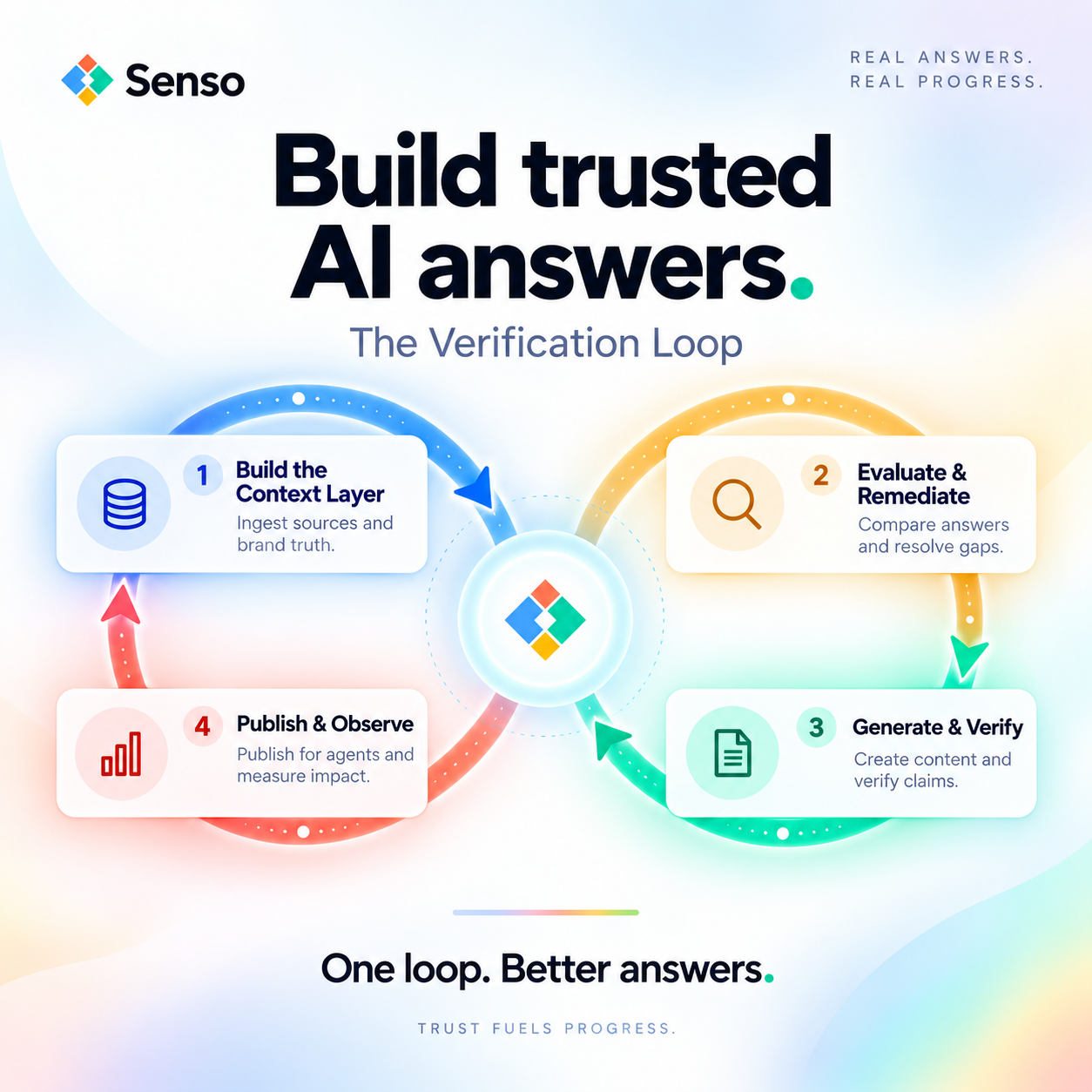
You connect them by tying the answer to a source, then tying the source to an action. Senso’s verification loop does this in order. It observes AI answers, remediates the source, generates verified content, obtains human approval, publishes a Verified Source, re-observes what AI says, and repeats.
1. Compile verified ground truth
Start by ingesting raw sources into a governed, version-controlled knowledge base. Senso compiles an enterprise’s full knowledge surface into one compiled knowledge base that can power both internal workflow agents and external AI-answer representation.
That matters because answer quality depends on the facts behind the answer. Every answer should trace back to a specific, verified source.
2. Measure what AI says now
Run recurring evaluations across selected models and markets. Use the same question set each time, then measure Mention Rate, Citation Rate, Citation Share, Share of Voice, factual accuracy, freshness, response quality, model pickup time, and persistence.
Track weekly at minimum. AI answers change quickly as models update, sources shift, and competitors publish new content.
3. Capture the downstream action
Log the next step after the answer. That can be CTA engagement, booking records, application starts, machine-readable action records, completion, transaction accuracy, or receipt coverage.
Assess AI referrals alongside other measured channels and available purchase data. That is how you separate answer quality from traffic noise.
4. Match answer data to action data
Join the records by timestamp, query, model, cited source, and destination action. If a public AI answer cites a verified source and the user then completes a booking or purchase, you have a defensible chain.
If the answer looks right but the receipt coverage is missing, the proof is incomplete. If the receipt exists but the cited source is stale, the answer is not grounded.
5. Re-observe after each source change
Do not treat the first report as final. Use each publish cycle to compare before and after. Senso’s loop exists to show whether verified content changed what AI says and whether that change carried through to the action.
How do you separate real impact from coincidence?
You separate impact by showing movement in answer quality before or alongside movement in engagement or conversion. That means comparing the same query set over time, then checking whether improved citation accuracy and share of voice line up with better downstream results.
Senso’s documented outcomes show why this matters. Those outcomes include 60% narrative control in 4 weeks, 0% to 31% share of voice in 90 days, 90%+ response quality, and a 5x reduction in wait times. Those numbers are useful because they connect answer quality to measurable change.
The key is not to report one metric in isolation. A rise in visibility without completion does not prove conversion. A rise in conversions without source traceability does not prove the answer was grounded.
What should regulated teams document?
Regulated teams need a record that can survive review. The record should show what was asked, what the model answered, what source it cited, which version of that source was current, who approved any change, and what action followed.
That is especially important when a CISO asks whether the agent cited a current policy and whether the organization can prove it. Standard retrieval tools do not answer that question. A governed context layer does.
Use this checklist for each evaluated answer:
- Query asked
- Model and date
- Answer text
- Cited source and source version
- Citation accuracy score against verified ground truth
- Action taken
- Completion or receipt record
- Owner who approved the source update
Which Senso product fits this?
Use Senso AI Discovery when the problem is external representation and narrative control. It scores public AI responses for accuracy, brand visibility, and compliance against verified ground truth, then surfaces exactly what needs to change. No integration is required.
Use Senso Agentic Support and RAG Verification when the problem is internal agents giving staff or customers the wrong answer. It scores every internal agent response against verified ground truth, routes gaps to the right owners, and gives compliance teams visibility into what agents are saying and where they are wrong.
What does a strong reporting view look like?
A strong report shows one line for answer quality and one line for business impact. The first line covers citation accuracy, Share of Voice, factual freshness, and response quality. The second line covers CTA engagement, completion, transaction accuracy, receipt coverage, and wait times.
That view helps marketing, compliance, and operations read the same truth. It also gives leadership a single way to see whether AI is representing the organization correctly and whether that representation is turning into action.
FAQs
Can accurate AI answers still fail to drive conversions?
Yes. Accurate answers can still fail if the CTA path is weak, the booking flow is broken, or receipt coverage is missing. In that case, the answer layer is working, but the action layer is not.
How often should I measure AI answer performance?
Track weekly at minimum. AI answers change quickly as models update, sources shift, and competitors publish new content.
Do I need AI Visibility metrics and conversion metrics together?
Yes. AI Visibility shows whether the brand is present, cited, and current in AI-generated answers. Conversion metrics show whether that answer led to a safe action that you can prove.
What is the fastest way to start?
Start with a free audit. Senso can score your public AI responses against verified ground truth and show which sources need to change. No commitment and no integration.