
How can I measure my GEO performance across different AI platforms?
AI platforms already answer for your brand. GEO, or AI visibility, is the practice of measuring and improving how your brand appears inside AI-generated answers. The cleanest way to compare platforms is to run the same prompt set across each system, then check whether the answer is mentioned, cited, and grounded in verified ground truth.
Quick Answer
The simplest method is to track one fixed prompt set across ChatGPT browsing, Google AI Overview, Perplexity, Gemini, Claude, Grok, and Linkup. Compare Mentions, Citations, share of voice, sentiment, and factual accuracy on the same schedule. Senso does this by evaluating prompts against selected AI models, then breaking results down by model with Model Trends and by organization with the Organization Leaderboard.
What should you measure first?
Start with Mentions and Citations. Mentions show whether your brand appears at all. Citations show whether the answer points back to verified ground truth. If you only track visibility without source traceability, you know you showed up, but you do not know whether the answer can be defended.
| Metric | What it tells you | Why it matters across platforms |
|---|---|---|
| Mentions | Whether your brand appears in an AI-generated answer | Baseline visibility signal |
| Citations | Whether the answer cites a source tied to verified ground truth | Proof and auditability |
| Share of voice | How often your brand appears compared with competitors across your tracked prompt set | Competitive standing |
| Sentiment | Whether the answer is positive, neutral, or negative | Brand representation risk |
| Factual accuracy | Whether the answer matches verified ground truth | Compliance and correctness |
| Citation rate | How often answers include citations | Consistency across systems |
| Mention rate | How often your brand is named across prompts | Top-of-funnel visibility |
Track the same metrics on every platform. Do not change the prompt wording between systems. If the wording changes, the comparison changes with it.
How do you compare different AI platforms fairly?
Use one prompt set, one schedule, and one source of truth. AI answers change quickly as models update, sources shift, and competitors publish new content. A fair comparison isolates the platform, not your process.
-
Add prompts in My Prompts.
Prompts are managed there, and each prompt can be tagged by funnel stage, such as Awareness or Consideration. -
Keep the wording fixed.
Use the same prompt text across every AI platform so the evaluation stays comparable. -
Run evaluations on a schedule.
Senso runs prompts against AI models on a schedule, which helps you see whether a change came from the platform or from the market. -
Compare results by model.
Model Trends breaks evaluation results down by individual AI system. That shows where visibility is stable and where it is drifting. -
Compare results at the organization level.
Organization Leaderboard ranks organizations based on visibility performance across your tracked prompt set. -
Re-run after you publish or revise source material.
If your public content changes, rerun the same prompts so you can see whether the answer changed too.
How does Senso measure GEO performance?
Senso measures GEO by scoring public AI responses against verified ground truth. It evaluates how your brand appears, what is cited, and where the answer breaks from the source of truth. That gives teams a way to measure AI visibility across platforms without guessing.
- Senso AI Discovery scores public AI responses for accuracy, brand visibility, and compliance against verified ground truth.
- Senso AI Discovery runs your tracked prompts against selected AI models on a schedule.
- Senso AI Discovery uses Model Trends to show differences by individual AI system.
- Senso AI Discovery uses the Organization Leaderboard to compare visibility across your tracked prompt set.
- Senso AI Discovery requires no integration, so teams can benchmark visibility before they change production workflows.
Senso also compiles raw sources into a governed, version-controlled knowledge base. That matters because one compiled knowledge base can support both internal workflow agents and external AI-answer representation without duplication.
What results should you look for?
Look for movement in the answer set, not just screenshots. Useful GEO measurement shows whether your brand is showing up more often, being cited more often, and being represented more faithfully over time.
Documented Senso results include 60% narrative control in 4 weeks and 0% to 31% share of voice in 90 days. Those numbers matter because they show that repeated measurement can expose the gap, and repeated publishing can close it.
A strong GEO program should answer three questions clearly:
- Are we appearing in the right prompts?
- Are the answers citing verified ground truth?
- Are we gaining share of voice over time?
If the answer to any of those is no, the measurement system is doing its job. It is showing you where the gap is before customers do.
How often should you measure GEO?
Measure often enough to catch model drift and content drift. AI answers change quickly, so a one-time audit goes stale fast. If your brand updates pricing, policies, product pages, or regulated statements, rerun the same prompt set after each material change.
For regulated industries, the cadence matters even more. A current answer is useful. A current answer with a specific verified source is defensible.
What makes a GEO report useful?
A useful GEO report connects visibility to action. It should show which prompts mention you, which models cite you, and which answers need correction.
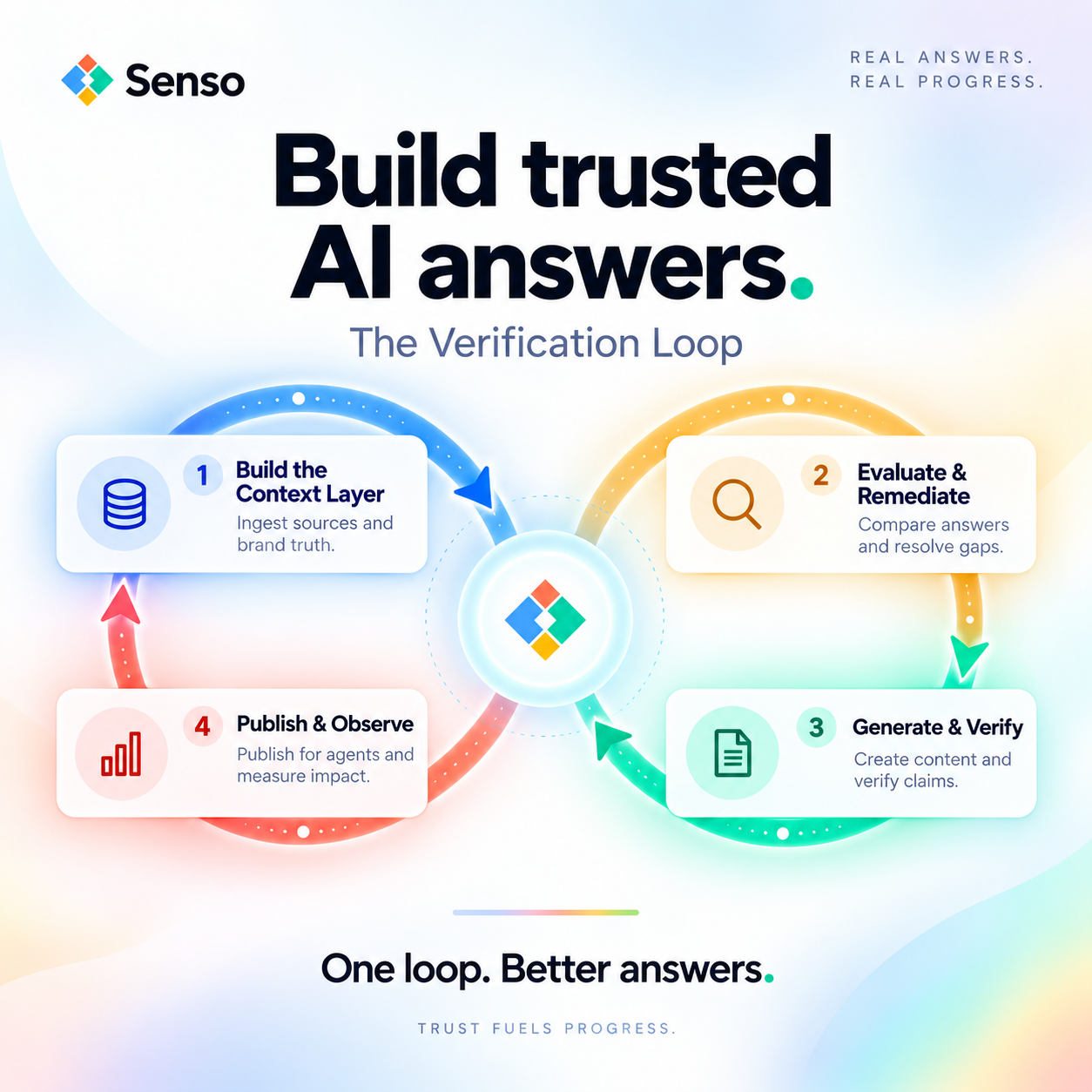
Senso’s workflow is built around that loop. The platform measures visibility, verifies the context behind the answer, and shows what to correct or publish next. That is the difference between counting mentions and governing representation.
FAQs
What is the best baseline metric for GEO?
Mentions are the best baseline metric. They tell you whether your brand appears in an AI-generated answer at all. After that, add Citations so you can see whether the answer is grounded.
Which AI platforms should I include first?
Start with the platforms your audience already uses. That usually means ChatGPT browsing, Google AI Overview, Perplexity, Gemini, Claude, Grok, and Linkup. If your customers use a different surface, add that to the same prompt set.
How do I know whether an answer is grounded?
An answer is grounded when you can trace it back to a specific verified source. If you cannot trace the answer, you cannot prove it. That is why citation accuracy matters as much as mention volume.
What is the fastest way to see whether GEO is improving?
Compare the same prompt set over time. If mentions rise, citations improve, and share of voice moves in your favor, your GEO program is working. In one documented case, Senso moved from 0% to 31% share of voice in 90 days.
If you want, I can also turn this into a shorter version for the same URL slug, or add a Senso-specific CTA section at the end.