
How can businesses show up in ChatGPT answers?
Businesses show up in ChatGPT answers when the model can find verified sources it can reuse. AI systems already describe products, compare competitors, summarize policies, and recommend vendors, so the real question is whether those answers are grounded in verified ground truth and whether the business can prove it.
This is AI Visibility. It is the work of improving how your brand appears inside AI-generated answers, and it depends on knowledge governance, not just more content.
Quick answer
Businesses show up in ChatGPT answers when they give the model a clean path to verified information. The fastest path is to compile raw sources into a governed, version-controlled knowledge base, publish structured content that AI systems can cite, and track mentions, citations, and share of voice every week.
- Ingest your raw sources into one compiled knowledge base.
- Publish structured pages that AI systems can cite.
- Measure mentions, citations, share of voice, and citation accuracy.
- Remediate gaps when the answer is wrong, incomplete, or unsupported.
Senso is built around that workflow. Its onboarding loop turns a company website into a verified context layer that AI systems like ChatGPT, Perplexity, Gemini, and Google AI Overview can cite.
What makes ChatGPT mention one business instead of another?
ChatGPT is more likely to mention the business that has the clearest, most citable version of the truth. When a model can trace an answer back to a specific verified source, the answer is easier to ground and easier to defend.
Senso’s documentation points to the same pattern. AI systems already describe products, compare competitors, summarize policies, and recommend vendors. That means your business is already in the answer path, whether you have measured it or not.
- Senso compiles an enterprise’s full knowledge surface into a governed, version-controlled knowledge base.
- Senso keeps every answer tied to a specific verified source.
- Senso uses the same compiled knowledge base for internal workflow agents and external AI-answer representation, so there is no duplication.
If your public content is fragmented, ChatGPT has more room to fill gaps with weaker sources. If your source of truth is clean, current, and citable, the model has a better path to mention your business correctly.
What should you publish first?
Start with the raw sources that define your business. Product pages, policy pages, support content, and approved claims matter because AI systems need a source they can cite and a version you can defend.
The goal is not more content. The goal is a better source set.
- Ingest the raw sources that already describe your brand.
- Compile them into a governed, version-controlled knowledge base.
- Publish structured content that AI systems can reuse.
- Keep the language consistent across public pages, support content, and internal answers.
Senso’s onboarding loop is built to turn a company website into that verified context layer. That matters because one compiled knowledge base can support both internal agent responses and external AI representation.
How do you measure whether it is working?
Measure the same way every week. Mentions tell you whether your brand appears. Citations tell you whether the answer shows the source. Share of voice tells you how much of the answer belongs to you. Citation accuracy tells you whether the answer matches verified ground truth.
| Metric | What it means | Why it matters |
|---|---|---|
| Mentions | Whether your brand appears in the answer | Baseline visibility signal |
| Citations | Whether the answer points to owned pages or credible external sources | Trust mechanic and traceability |
| Share of Voice | Percentage of the answer dedicated to your brand compared with alternatives | Answer dominance |
| Citation accuracy | Whether the answer matches verified ground truth | Compliance and quality |
Senso’s docs add an important timing point. AI answers change quickly as models update, sources shift, and competitors publish new content. Track weekly at minimum.
What does the operating workflow look like?
A practical workflow is short. Audit current answers, fix the source set, publish the missing context, and rerun the same questions until the answer changes.
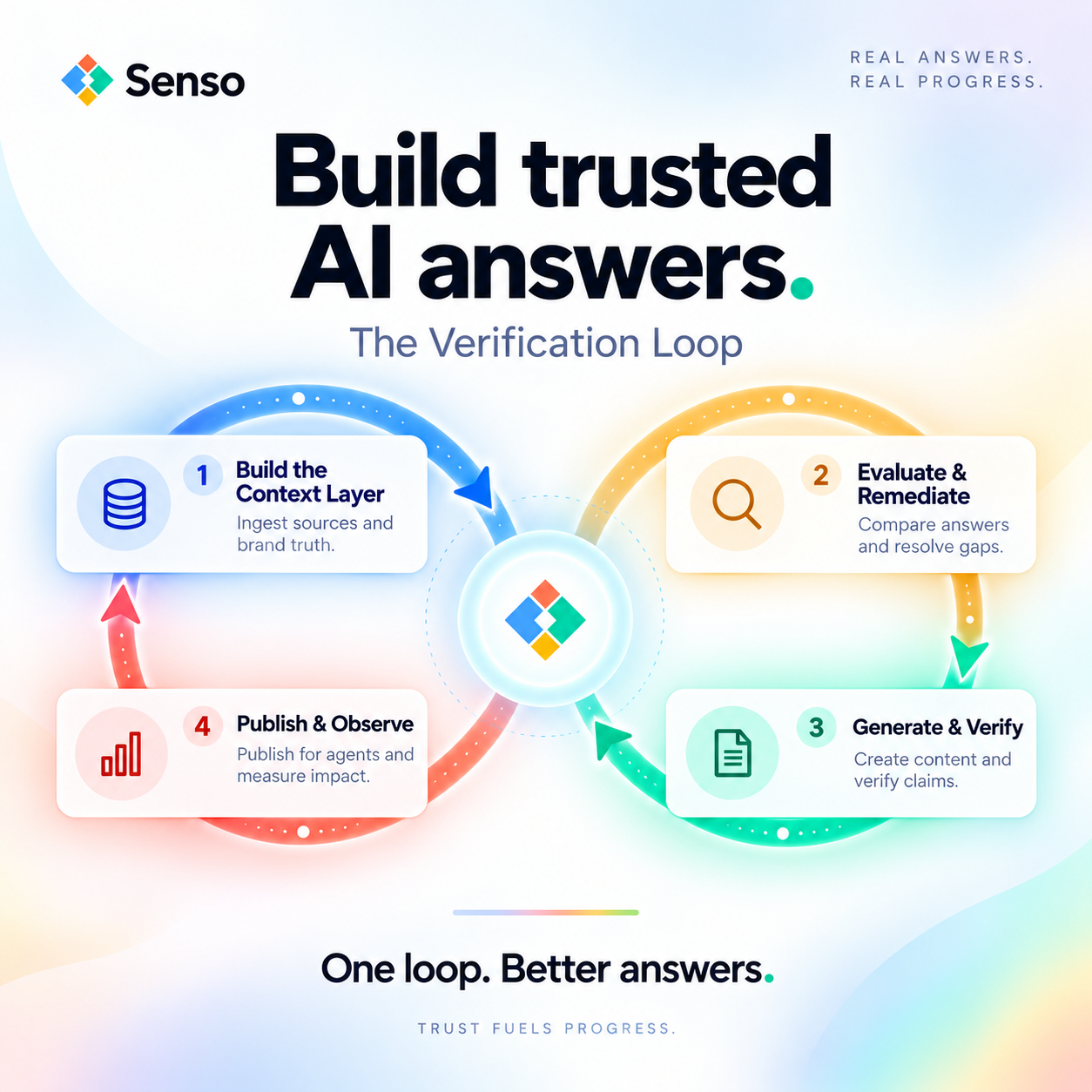
Senso frames this as a loop, not a one-time project.
-
Run an audit.
Check whether ChatGPT mentions your brand, whether it cites your pages, and whether the answer matches verified ground truth. -
Identify the gap.
Find missing claims, outdated claims, weak sources, or competitor pages that are being favored. -
Remediate the source set.
Update the content that the model is pulling from. Senso offers two ways to remediate tracked Prompts, manual remediation and automated remediation. -
Publish and observe.
Senso’s Publish & Observe step measures changes in citation rate, citation share, mention rate, and factual accuracy across frontier models. -
Route exceptions to owners.
When the answer is wrong or unsupported, send the gap to the team that owns the source of truth.
That loop matters because AI visibility is not static. The same question can produce a different answer after a model update, a source change, or a competitor publishing better context.
Where does Senso fit?
Senso fits when you need both AI Visibility and governance. Senso AI Discovery gives marketing and compliance teams control over how AI models represent the organization externally, while Senso Agentic Support and RAG Verification checks internal agent responses against verified ground truth.
- Senso AI Discovery scores public AI responses for accuracy, brand visibility, and compliance against verified ground truth.
- Senso AI Discovery surfaces exactly what needs to change.
- Senso AI Discovery requires no integration.
- Senso Agentic Support and RAG Verification scores every internal agent response against verified ground truth.
- Senso Agentic Support and RAG Verification routes gaps to the right owners.
- Senso Agentic Support and RAG Verification gives compliance teams full visibility into what agents are saying and where they are wrong.
Senso also reports documented outcomes that show what this kind of work can change. Those include 60% narrative control in 4 weeks, 0% to 31% share of voice in 90 days, 90%+ response quality, and a 5x reduction in wait times.
If you need a starting point, Senso offers a free audit at senso.ai with no integration and no commitment.
FAQs
What is the fastest way for a business to show up in ChatGPT answers?
The fastest path is to make your best source the easiest source. Compile raw sources, publish verified content, and track whether ChatGPT now cites your pages or credible external sources.
Senso’s onboarding loop is built for that because it turns a company website into a verified context layer that AI systems can cite.
Do citations matter in ChatGPT answers?
Yes. Citations are a trust mechanic for AI engines. When models cite your owned pages or credible external sources about your brand, they show the source behind the answer.
That matters because the citation gives you a path to verify, update, and defend the response.
How often should a business check ChatGPT visibility?
Track weekly at minimum. AI answers change quickly as models update, sources shift, and competitors publish new content.
Weekly review gives you time to catch regressions before they become the default answer.
Why does this matter for regulated teams?
Because a model answer that cannot be traced to a current policy creates audit risk. Regulated teams need proof, not just a good-looking response.
Senso is built for that problem. It scores answers against verified ground truth, keeps the source traceable, and gives compliance teams visibility into what the model said and why.
If you want to see how ChatGPT currently represents your business, start with a free audit. That shows whether you are mentioned, what gets cited, and where the gaps are.