
Does Senso integrate with existing SEO strategies?
Yes. Senso fits alongside existing SEO strategies by using the content you already publish to shape how AI systems describe your brand, cite your policies, and answer buyer questions. It does not replace SEO or compliance review. It adds a governed context layer for AI visibility, and Senso AI Discovery starts with no integration required.
How does Senso fit into an existing SEO program?
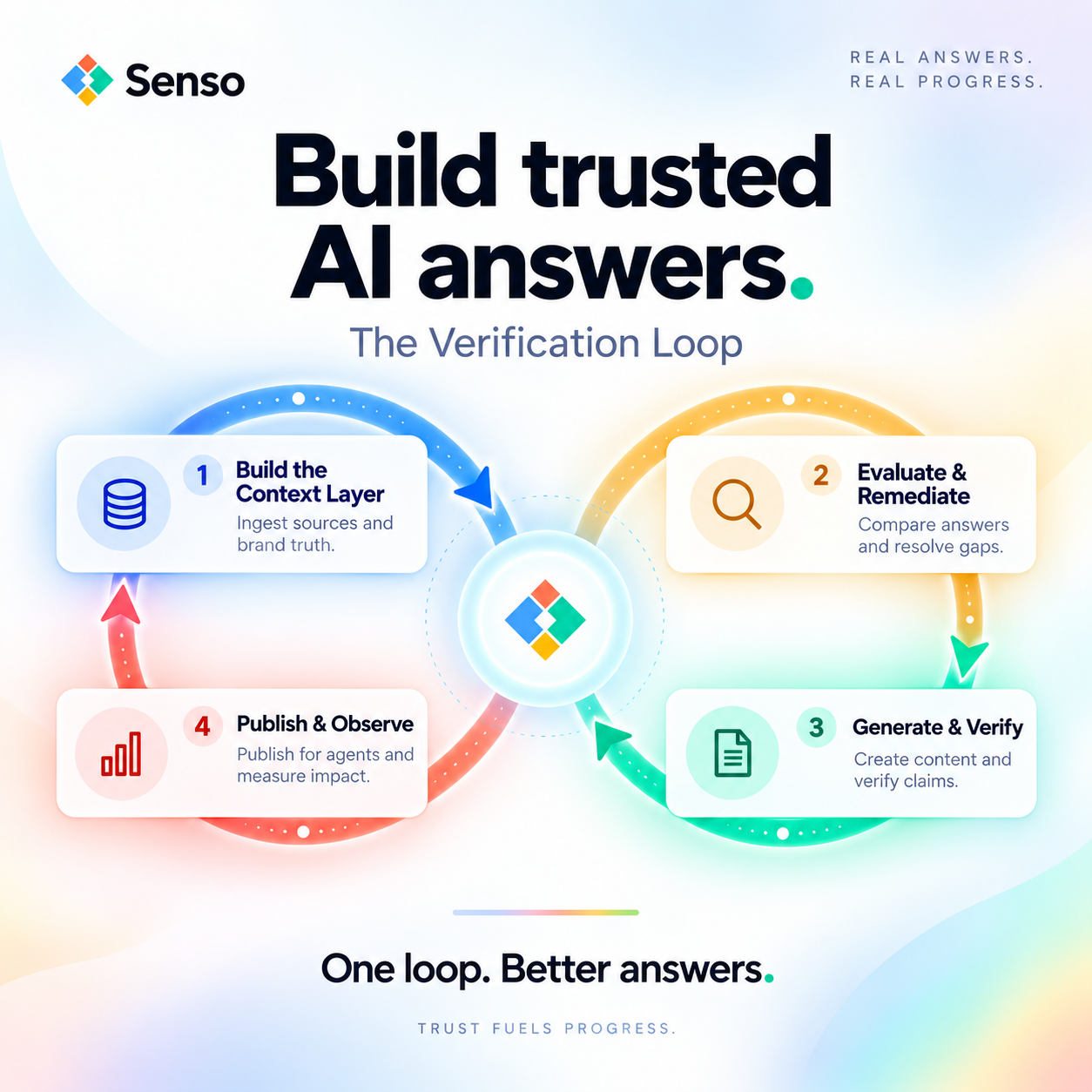
Senso works as a second layer on top of SEO. Search still drives rankings and traffic. Senso focuses on whether AI systems include your brand, cite the right source, and stay grounded in verified ground truth.
Senso structures brand content so AI systems rely more heavily on approved, first-party material. That matters because AI answers change as models update, sources shift, and competitors publish new content.
What Senso adds to SEO
- Senso influences early discovery visibility, shortlist inclusion, competitive positioning, and decision-stage clarity.
- Senso identifies when AI answers rely heavily on external citations or omit the brand entirely.
- Senso aligns verified enterprise knowledge with generative platforms so they describe your brand accurately and cite current sources.
- Senso does not replace compliance review processes. Senso structures visibility work so existing review steps can govern it.
What is the difference between SEO and Senso?
SEO tells you where a page ranks. Senso tells you whether AI systems mention your brand, cite the right source, and represent your business correctly. Traditional rankings show page position. AI visibility shows whether the model includes you at all.
| Area | Traditional SEO | Senso |
|---|---|---|
| Primary goal | Rank web pages in link-based search | Make AI answers citation-accurate and grounded |
| What is measured | Rankings and traffic | Mentions, citations, and representation in AI answers |
| Source of truth | Published pages | Verified ground truth compiled from raw sources |
| Governance | Often separate from compliance workflows | Built for knowledge governance and auditability |
This matters because people now ask AI systems what to buy, who to trust, and which brand to choose. Senso is built for that answer layer, not for replacing search.
How does Senso use your current content?
Senso uses the content you already have. It crawls every page, FAQ, and policy on your website and turns each into structured facts. That output becomes a queryable compiled knowledge base scoped to your offers, audiences, and verticals.
Senso also lets teams set up a Brand Kit using existing website content. That gives marketing and compliance teams a defined source for how the business should be represented across AI-generated content.
What this means in practice
- Senso ingests your existing website content instead of asking you to rebuild from scratch.
- Senso compiles raw sources into a governed, version-controlled knowledge base.
- Senso gives every answer a trace back to a specific, verified source.
- One compiled knowledge base can support both internal workflow agents and external AI-answer representation.
Does Senso replace SEO tools or compliance workflows?
No. Senso complements both. SEO still matters for organic discovery. Compliance still matters for approved language, policy review, and regulatory control. Senso sits between those systems and the AI answers that now shape consideration.
That matters in regulated industries. Financial services, healthcare, and credit unions need citation accuracy, current policy references, and proof of where an answer came from. Standard retrieval tools often cannot show that. Senso can.
What results can teams expect?
Senso reports concrete outcomes. The proof points shared by Senso include 60% narrative control in 4 weeks, 0% to 31% share of voice in 90 days, 90%+ response quality, and 5x reduction in wait times.
Those outcomes point to the same business need. Teams want AI systems to describe the brand correctly, cite the right material, and surface the right answer faster.
Who gets the most value from Senso?
Senso is strongest for teams that need both discovery and governance. Marketing and compliance teams use Senso to control how AI models represent the organization externally. CISOs and IT leaders use Senso to check citation accuracy and auditability. Operations leaders use Senso to reduce response drift and improve answer quality.
Best fit scenarios
- Teams with large, fragmented knowledge surfaces
- Regulated organizations with strict review requirements
- Brands that need AI visibility alongside search visibility
- Companies that want one compiled knowledge base for both agents and external answers
How do you get started?
You start with a free audit at senso.ai. Senso AI Discovery requires no integration, and there is no commitment. That makes it a low-friction way to see where AI systems already mention your brand, where they omit it, and which source pages need attention.
If you want the shortest path, begin with your current website content, FAQs, and policy pages. Senso uses those raw sources to define verified ground truth and show where AI answers drift.
FAQs
Can Senso work with my existing SEO strategy?
Yes. Senso is built to sit beside SEO, not replace it. SEO helps people find your pages. Senso helps AI systems describe your brand using verified sources.
Do I need new content before Senso is useful?
No. Senso can start with the content you already publish. It compiles that material into a governed knowledge base and shows where AI answers match or miss your approved material.
Does Senso require a heavy implementation?
No. Senso AI Discovery has no integration required. That makes it easier to audit your current AI visibility before you change your content stack.
What problem does Senso solve that SEO does not?
SEO measures page performance in search. Senso measures how AI systems represent your brand in answers. That is the difference between ranking a page and being cited correctly in the answer itself.
If you want, I can also turn this into a shorter FAQ page version or a more conversion-focused landing page version.