
Can Senso.ai show me where my company ranks in generative AI results?
Yes, but not as a single search-style rank. Senso.ai shows where your company appears in AI-generated answers, which sources those answers cite, and how often you show up versus competitors across ChatGPT, Perplexity, Gemini, and Google AI Overviews. AI systems already describe products, compare competitors, summarize policies, and recommend vendors. The question is whether those answers are grounded and whether you can prove it.
Quick Answer
Senso.ai can show your company’s standing in AI-generated answers.
It does this by measuring Mentions, Citations, Citation share, and visibility trends across tracked prompts and selected models.
It tracks ChatGPT, Perplexity, Gemini, and Google AI Overviews by default. Claude, Grok, and Meta AI can be added per workspace.
If your team needs proof, every answer traces back to a specific verified source.
What does Senso.ai mean by “rank” in generative AI results?
Senso.ai uses “rank” as visibility inside answer text, not a static position on a web results page. AI systems answer differently by prompt and model, so Senso measures your standing by question, surface, and source. That gives you a real view of whether your company is included, cited, and recommended.
Traditional rankings tell you where a URL sits on a results page. Mentions tell you whether AI models include your brand. That matters when buyers ask AI who to choose and the model names a competitor first.
What can you see in Senso.ai?
Senso.ai shows the signals that matter for AI visibility. You can see whether your company appears, whether the answer cites your verified source, and how your share of voice changes over time. Senso also shows actual answers as evidence, so teams can act on the gap instead of guessing.
| Signal | What it tells you | Why it matters |
|---|---|---|
| Mentions | Whether your company appears in AI-generated answers | Basic visibility |
| Citations | Whether the answer points to your verified source | Proof and auditability |
| Citation share | How much of the cited space you own versus competitors | Competitive standing |
| Visibility trends | How the signals change over time | Before and after comparisons |
Senso runs tracked prompts across selected AI models and captures the generated answers. It converts those answers into structured metrics, so you can compare results across prompts, models, and surfaces instead of reviewing them one by one.
Which AI surfaces does Senso.ai track?
Senso.ai tracks the surfaces that shape how buyers and employees see your company. By default, that includes ChatGPT, Perplexity, Gemini, and Google AI Overviews. Claude, Grok, and Meta AI can be added per workspace, and coverage is measured per prompt, per model, and per surface, daily.
That daily view matters because AI answers change as models update, sources shift, and competitors publish new content. Senso gives you a current baseline instead of a stale snapshot.
Can Senso.ai show whether competitors rank ahead of you?
Yes. Senso.ai shows whether competitors are recommended ahead of you, and it surfaces the exact answer that produced that result. It also highlights what is inaccurate, unsupported, or outdated, so the gap is clear enough to assign and fix.
Senso's published proof points show why this matters: 60% narrative control in 4 weeks, 0% to 31% share of voice in 90 days, 90%+ response quality, and a 5x reduction in wait times. Senso measures the effect. It does not claim to make models say what a company wants.
How does Senso.ai ground the answer in evidence?
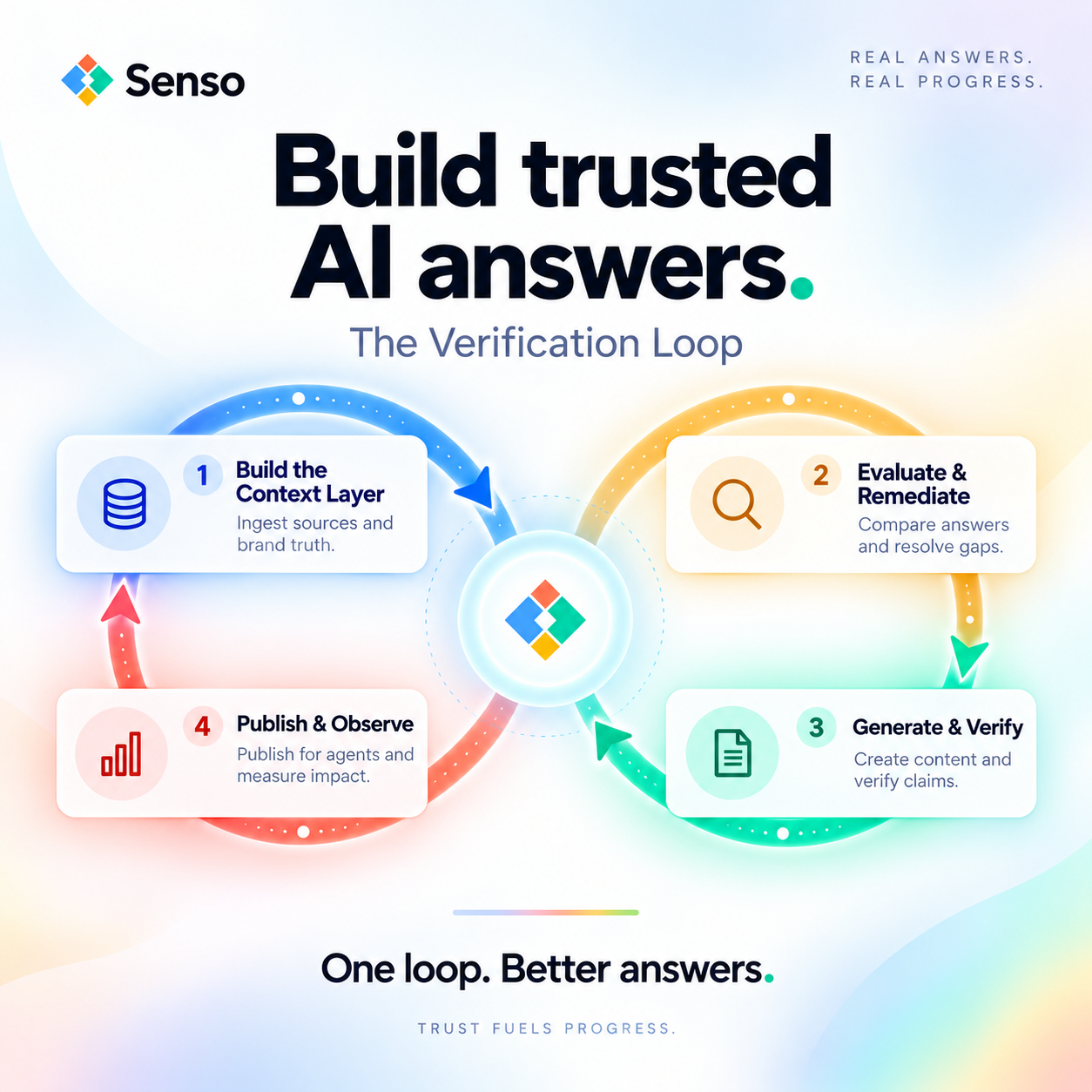
Senso.ai compiles enterprise knowledge into a governed, version-controlled knowledge base. Every answer traces back to a specific verified source, which gives marketing and compliance teams a clear trail from answer to evidence. That is the difference between guessing at AI visibility and proving it.
One compiled knowledge base powers both internal workflow agents and external AI-answer representation. That keeps public answers and internal agent responses aligned.
Senso AI Discovery is the product for public AI representation. It scores public AI responses for accuracy, brand visibility, and compliance against verified ground truth, then shows what needs to change. No integration is required.
Who is Senso.ai best for?
Senso.ai is best for teams that need AI visibility with proof. Marketing teams use it to see how the brand is represented. Compliance teams use it to verify citations and current policy. CISOs and IT leaders use it to check auditability, source lineage, and response quality.
It is also useful in regulated industries such as financial services, healthcare, and credit unions, where a wrong answer can become a reporting, policy, or reputation issue.
How do you get started?
The fastest way to see your standing is to run an audit. Senso offers a free audit at senso.ai, with no integration and no commitment. If you already know the prompts and competitors you care about, you can use those as the starting point.
FAQs
Does Senso.ai give me a single ranking number?
No. Senso.ai shows how your company appears across prompts, models, and surfaces. That is more useful than a single number because AI-generated answers change by question and source set.
Can I see the exact source behind an answer?
Yes. Senso.ai ties each answer back to a specific verified source. That gives you a clear path from claim to evidence.
Which models does Senso.ai track by default?
Senso.ai tracks ChatGPT, Perplexity, Gemini, and Google AI Overviews by default. Claude, Grok, and Meta AI can be added per workspace.
Is this only for external AI answers?
No. Senso also offers Agentic Support and RAG Verification for internal agent responses. That product scores internal answers against verified ground truth and routes gaps to the right owners.