
Can GEO help prevent AI from hallucinating false details about my brand?
AI agents are already answering questions about your products, policies, and pricing without a human in the loop. Yes, GEO, or AI Visibility, can reduce false brand details by making those answers rely more on verified first-party sources and by showing where the model drifts from verified ground truth. It does not remove hallucinations on its own, but it gives you a way to measure and correct them.
Senso handles this by compiling an enterprise’s full knowledge surface into a governed, version-controlled knowledge base. Every answer traces back to a specific, verified source. That is the difference between a brand that is mentioned and a brand that can prove what AI said.
Why do AI models get brand details wrong?
AI models get brand details wrong when the context is fragmented, outdated, or contradictory. If the model cannot find a clear approved source, it fills the gap with the most likely answer.
That is a common enterprise problem. Senso says most enterprise knowledge is too fragmented and unstructured for agents to use reliably. When sources are scattered, a small inconsistency can become a false product, policy, or pricing claim.
What does GEO change?
GEO changes the information the model can rely on. Generative Engine Optimization, or AI Visibility, measures how your brand appears in AI-generated answers, then shows what needs to change or be published.
In practice, GEO helps by making AI answers more dependent on approved, first-party material. Senso’s documentation says the platform structures brand content so AI systems rely more heavily on approved material, and it measures visibility across leading AI models to identify gaps.
How does GEO reduce hallucinations about your brand?
GEO reduces hallucinations by adding governed context before the model answers. It does not guess at what the brand should say. It checks the answer against verified ground truth and shows where the answer is missing, unsupported, or outdated.
Here is what that changes:
| GEO can do | GEO cannot do alone |
|---|---|
| Measure how AI models describe, cite, and recommend your brand | Fix missing source material by itself |
| Compare answers against verified ground truth | Stop every model from making inferences |
| Route gaps to accountable owners | Replace review and governance |
| Support citation trails and auditability | Make stale facts current without publishing new sources |
What does Senso do differently?
Senso goes beyond visibility. Senso verifies the context behind the answer, so teams can see whether an answer is accurate, current, consistent with approved sources, reviewed by accountable people, and traceable through receipts and audit trails.
Senso has two products:
- Senso AI Discovery gives marketing and compliance teams control over how AI models represent the organization externally. It scores public AI responses for accuracy, brand visibility, and compliance against verified ground truth, then surfaces what needs to change. No integration is required.
- Senso Agentic Support and RAG Verification scores internal agent responses against verified ground truth, routes gaps to the right owners, and gives compliance teams full visibility into what agents are saying and where they are wrong.
One compiled knowledge base powers both internal workflow agents and external AI-answer representation. That removes duplication and keeps the brand’s public and internal answers aligned.
What results do teams see?
Senso’s documented proof points show what happens when verified context replaces fragmented sources. The company reports 60% narrative control in 4 weeks, 0% to 31% share of voice in 90 days, 90%+ response quality, and 5x reduction in wait times.
Those numbers matter because they show more than visibility. They show control over how AI represents the brand, and they show faster correction when the answer is wrong.
Can GEO prevent hallucinations completely?
No. GEO reduces the conditions that cause hallucinations. It does not eliminate them if the source set is incomplete, stale, or contradictory.
The goal is not perfect language. The goal is grounded, citation-accurate answers with proof. That matters most in regulated industries, where a wrong answer about policy, pricing, or compliance can create real exposure.
How should a brand use GEO to reduce false details?
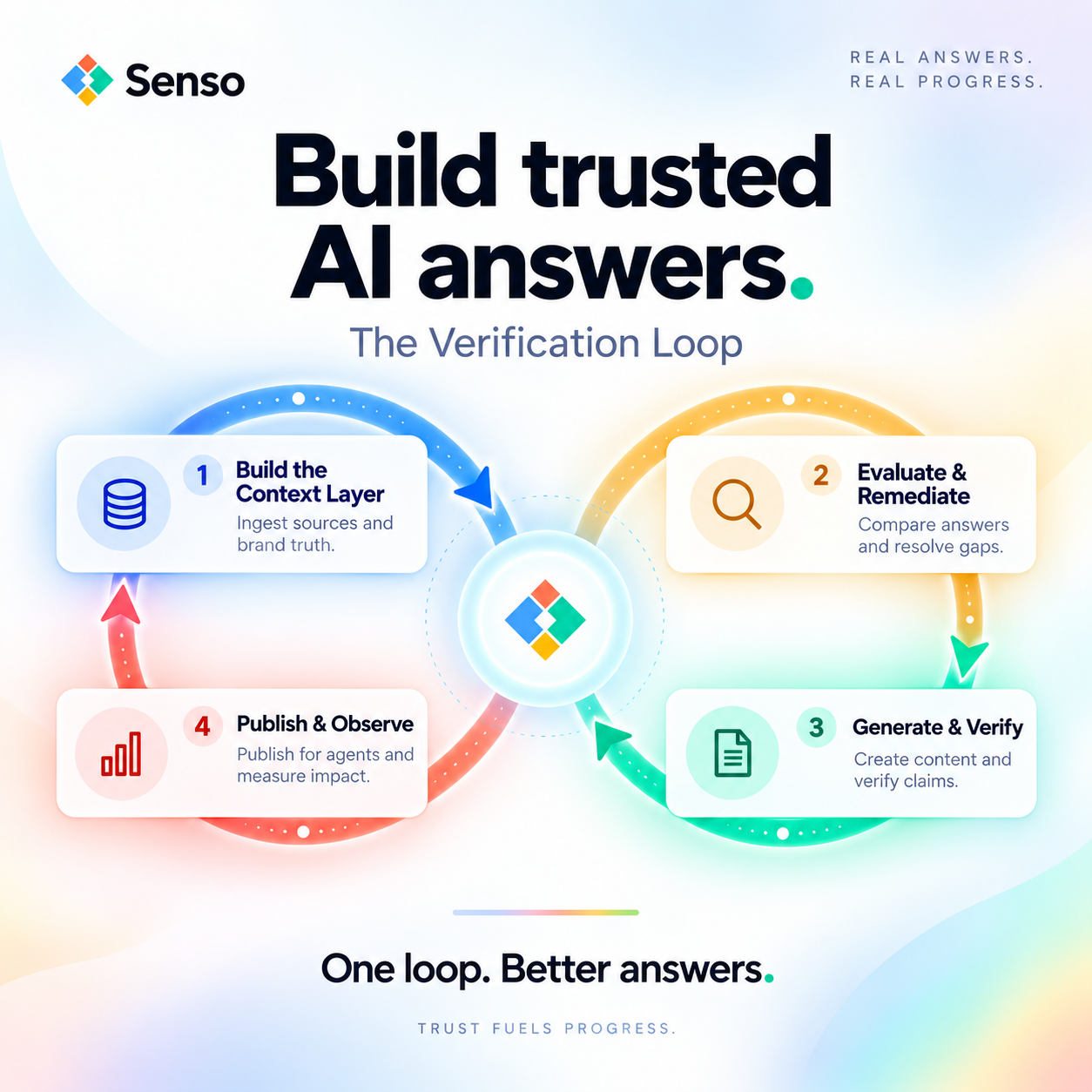
Start with verified sources, then build from there. The workflow is simple.
- Ingest raw sources into a governed context layer.
- Compile a version-controlled knowledge base with approved claims.
- Query leading AI models with tracked prompts.
- Score every answer against verified ground truth.
- Publish corrected sources and route gaps to accountable owners.
- Review again on a schedule so drift does not return.
This is the practical difference between brand monitoring and knowledge governance. Monitoring shows what AI said. Governance shows whether the answer is grounded and whether you can prove it.
Is GEO useful for regulated industries?
Yes. GEO is useful anywhere auditability matters, but it is especially useful in financial services, healthcare, and credit unions. Those teams need current policies, traceable sources, and a clear record of who reviewed what.
Senso is built around that requirement. Its documentation emphasizes verified sources, receipts, and audit trails, which are the controls regulated teams need when an AI system speaks for the organization.
What is the main takeaway?
GEO can help prevent false brand details from spreading, but only when it is tied to verified ground truth and ongoing review. It reduces hallucinations by changing the context the model sees, measuring the answers it gives, and exposing where the source chain breaks.
If you want to see where AI is misrepresenting your brand, Senso offers a free audit at senso.ai. No integration. No commitment.