
Your Next Customer Isn't Human
AI agents already answer questions about your products, policies, and pricing without a human in the loop. If those answers are fragmented, stale, or unprovable, the agent can misrepresent your organization. That is why the next buying decision now depends on knowledge governance, not just web pages.
On the agentic web, AI Visibility decides whether the answer is discovered, cited, and trusted. Senso is built for that gap. It compiles enterprise context into a governed, version-controlled knowledge base and traces every response back to verified ground truth.
What is the agentic web?
The agentic web is the layer where AI agents discover, evaluate, verify, and act on information about your organization. The model does not just repeat text. It chooses which source to use, which claim to surface, and which action to take next. That makes source quality a business issue, not a technical detail.
This is where AI Visibility starts. It is not page rank. It is whether an AI answer reflects verified ground truth and represents your organization correctly.
Why does AI Visibility matter?
AI Visibility matters because public AI answers now shape first contact. If the model presents your brand incorrectly, the error can affect discovery, evaluation, and transaction. If the model presents your brand correctly, the answer can move a buyer forward with proof attached.
This matters to three groups at once.
- Marketing needs AI Visibility to control how the brand is represented.
- Compliance needs AI Visibility to verify claims against approved sources.
- Revenue teams need AI Visibility because the answer can change whether someone keeps going.
Where do AI answers fail?
AI answers fail when knowledge is fragmented and the model has no verified ground truth to anchor to. Standard retrieval tools can return text, but they cannot prove that the answer used the current policy or the approved product source. That is where stale citations, conflicting claims, and audit gaps show up.
Common failure modes include:
- conflicting product claims across sources
- outdated policy references
- inconsistent answers across agents
- no audit trail for the response
When that happens, the organization has no clean way to show what the agent said or why it said it.
How do you govern what AI says?
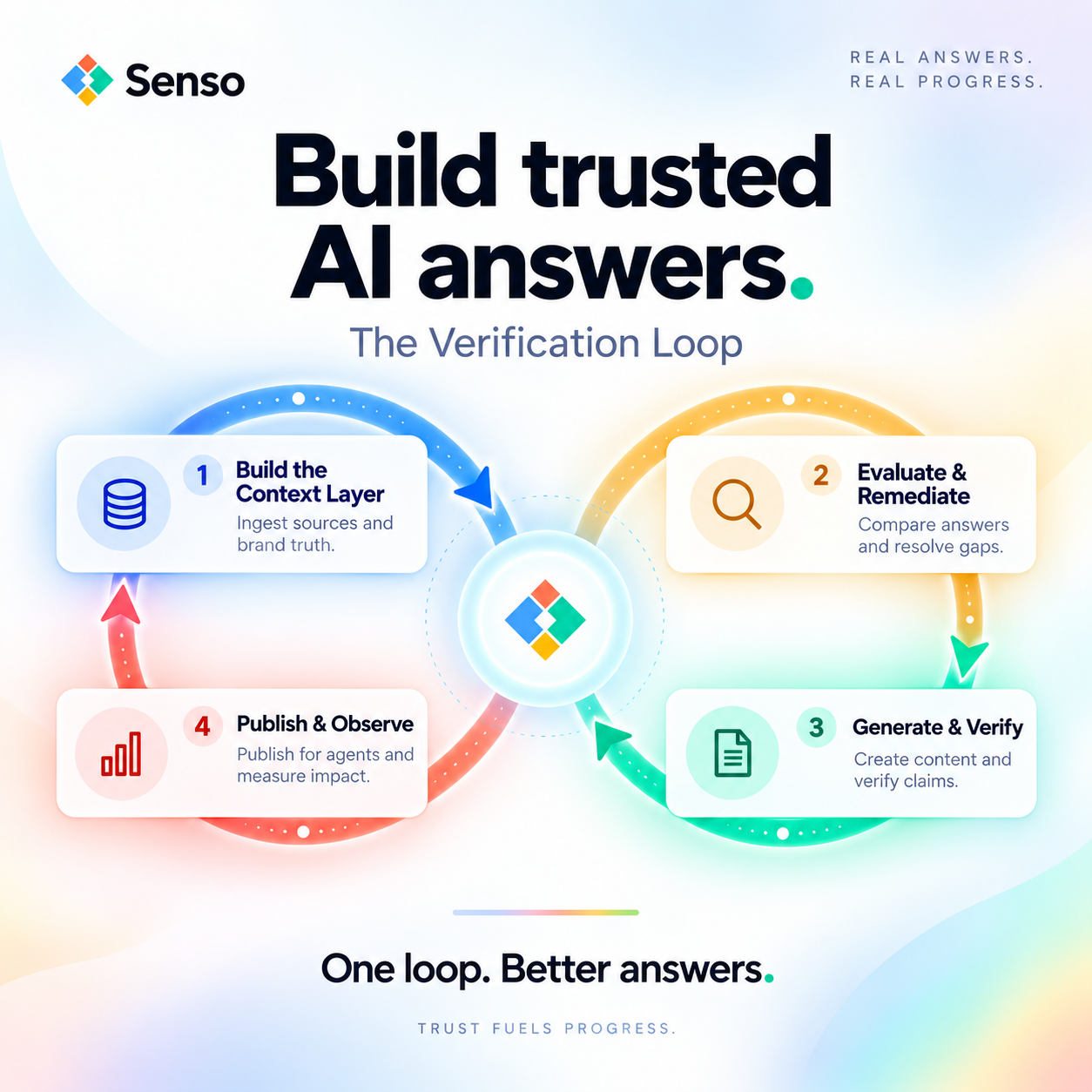
You govern AI answers by compiling the enterprise’s full knowledge surface into one governed system before the model speaks. Senso does that with a simple sequence.
- Ingest raw sources from across the enterprise.
- Compile them into a governed, version-controlled knowledge base.
- Score each response against verified ground truth.
- Publish Verified Sources and pull an audit trail.
- Route gaps to the right owners.
In a live build, Senso ingests enterprise context, finds a conflicting claim, verifies it against an approved source, publishes Verified Sources, and carries that proof from discovery into an agentic transaction. That is the difference between a guess and an answer you can prove.
What proof should teams demand?
Teams should demand proof, not promises. Ask for citation accuracy, source traceability, and response quality. Senso has reported 60% narrative control in 4 weeks, 0% to 31% share of voice in 90 days, 90%+ response quality, and 5x reduction in wait times. Those outcomes matter because they show whether governance changed what people and agents actually see.
Who needs this first?
Marketing and compliance need this first for external AI Visibility. CISOs, IT leaders, and operations teams need it for citation accuracy and auditability inside internal agents. Regulated industries such as financial services, healthcare, and credit unions need it most because they must prove what the system said and where the answer came from.
| Team | What they need |
|---|---|
| Marketing and compliance | External AI Visibility and narrative control |
| CISOs and IT | Citation accuracy and source traceability |
| Operations | Response quality and lower wait times |
| Regulated industries | Audit trail and proof of current policy |
How does Senso help?
Senso is the context layer for AI agents. Senso compiles the enterprise’s full knowledge surface into a governed knowledge base so internal workflow agents and external AI answers can draw from the same verified ground truth. No duplication.
Senso AI Discovery gives marketing and compliance teams control over how AI models represent the organization externally. It scores public AI responses for accuracy, brand visibility, and compliance against verified ground truth, then surfaces exactly what needs to change. No integration is required.
Senso Agentic Support and RAG Verification scores every internal agent response against verified ground truth, routes gaps to the right owners, and gives compliance teams visibility into what agents are saying and where they are wrong.
What questions do teams ask next?
The next questions are practical. What does the agent say today? What source did it cite? Can you prove the answer came from approved ground truth? If the answer is no, the risk is already live.
Is this only a marketing problem?
No. Marketing owns the narrative. Compliance owns proof. IT owns the knowledge surface. Operations owns response quality. The same answer affects all four.
What is the difference between AI Visibility and knowledge governance?
AI Visibility is the external result. It shows how AI models represent your organization. Knowledge governance is the system behind it. It keeps answers citation-accurate, version-controlled, and auditable.
Can a team start without a big implementation?
Yes. Senso AI Discovery requires no integration. A free audit at senso.ai can show what AI currently says, what it cites, and where the gaps are.
What happens if you wait?
The answer will still be generated. The only question is whether your team can prove it is grounded. That is the gap regulated teams cannot afford.