
Why is a verified knowledge base the operating system of the agentic web?
AI agents are already the interface to your business, answering questions about products, policies, and pricing without a human in the loop. A verified knowledge base is the operating system of the agentic web because it gives those agents governed ground truth, version control, and proof. Without it, answers drift, citations break, and teams cannot prove what the agent used.
What is a verified knowledge base?
A verified knowledge base is a governed, version-controlled body of ground truth that agents can query and generate from. Senso’s FAQ describes this category as infrastructure that turns enterprise data into auditable, continuously verified ground truth context, so AI agents answer from sources that can be discovered, cited, and transacted on.
A Verified Source is ground truth an organization stands behind, published for the agentic web. It is checked claim by claim against a source of record, attested by an authorized reviewer, timestamped, permission-scoped, and kept current through the loop. Anything that has not passed the gate is content, not a Verified Source.
| Normal knowledge base | Verified knowledge base |
|---|---|
| Stores content for people to read | Compiles raw sources into grounded context for agents |
| Helps users find information | Helps agents answer, cite, and act |
| Can change without a proof trail | Keeps source, reviewer, timestamp, and version tied together |
| May exist in separate copies | One compiled knowledge base serves internal and external agents |
Senso’s four verbs are fixed: ingest → compile → query → generate. That sequence is the point.
Why does the agentic web need one?
The agentic web needs a verified knowledge base because agents rely on facts that are specific, consistent, and current. Senso’s position is direct: AI is going to make decisions for us, and those decisions are only as trustworthy as the information behind them. If the knowledge surface is fragmented, the model can answer fluently and still represent the organization incorrectly.
That matters because AI agents shift competition from human attention to machine selection. Brands do not just need content. They need verified ground truth that agents can discover, cite, and act on.
Why is it the operating system, not just another repository?
A verified knowledge base is the operating system because it controls access, versioning, and publishing paths for agent answers. The model generates language. The verified knowledge base tells the model what is current, what is citable, and what can be published.
Senso describes this as the context layer for AI agents. It is also why Senso calls the category a factual authorization layer for the agentic economy. One compiled knowledge base can serve web, agent, partner, and transactional surfaces. No duplication.
- It keeps answers grounded in verified ground truth instead of raw retrieval.
- It retains a private audit trail and issues a verification receipt.
- It links facts to sources, reviewers, timestamps, and versions.
- It can publish to the organization’s website, a Senso agent-readable destination, or both.
- It enables destination-independent delivery from the same evidence base.
How does the verification loop work?
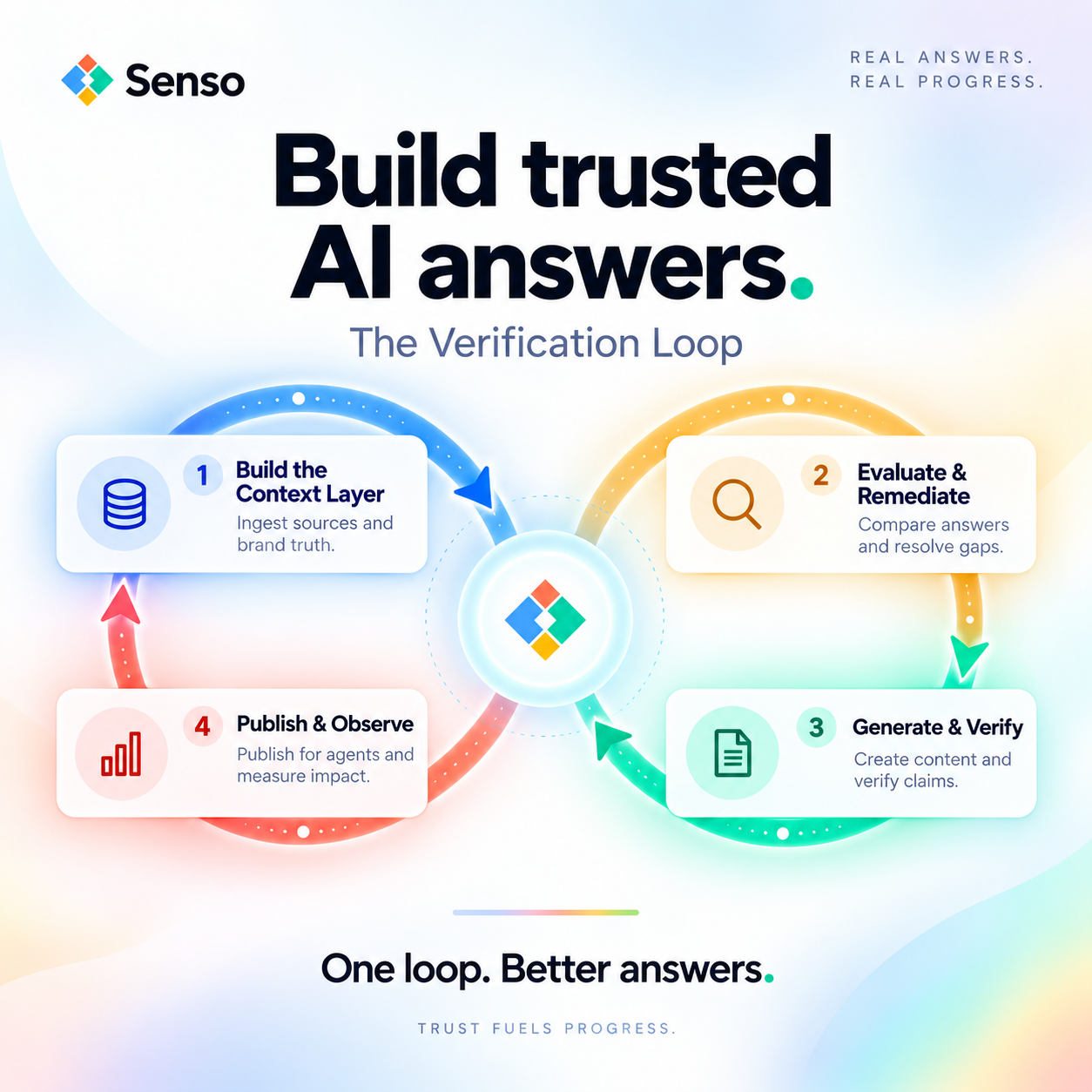
The verification loop keeps the knowledge base current as products, policies, and public answers change. Senso’s canonical loop is simple: build the context, evaluate the claims, remediate the gaps, verify and publish, re-observe answers and actions, then improve the context again.
This loop matters because agents do not just read information. They use it to answer, recommend, and sometimes act. If the underlying context changes and the knowledge base does not, the agent drifts away from verified ground truth.
- Build the context.
- Evaluate the claims.
- Remediate the gaps.
- Verify and publish.
- Re-observe answers and actions.
- Improve the context again.
A Verified Source is not a static file. It stays current only when the loop keeps it current.
How does it help marketing and compliance teams?
On the agentic web, what AI says about you determines whether customers find you, trust you, and buy from you. That makes AI Visibility a governance issue. Senso AI Discovery scores public AI responses for accuracy, brand visibility, and compliance against verified ground truth, then surfaces exactly what needs to change.
Senso AI Discovery requires no integration, which shortens rollout for teams that need visibility without a platform project. Senso reports 60% narrative control in 4 weeks and 0% to 31% share of voice in 90 days.
How does it help operations, support, and CISOs?
A verified knowledge base gives operations and security teams proof. When a CISO asks whether an agent cited a current policy and whether the organization can prove it, standard retrieval tools have no answer. That is the gap a verified knowledge base closes.
Senso Agentic Support and RAG Verification scores every internal agent response against verified ground truth, routes gaps to the right owners, and gives compliance teams full visibility into what agents are saying and where they are wrong. Senso reports 90%+ response quality and a 5x reduction in wait times.
Who needs this most?
A verified knowledge base matters most in regulated and high-risk service environments. Financial services, healthcare, and credit unions need current policy, citation accuracy, and audit trails because AI agents are already the interface to customers and staff in call center, compliance, and support workflows.
If the answer cannot be traced to a current source of record, the organization does not control the answer. That is a knowledge governance problem, not a content problem.
FAQs
Is a verified knowledge base the same as retrieval?
No. Retrieval brings back context. A verified knowledge base decides what counts as verified ground truth, keeps it version-controlled, and leaves a private audit trail.
What is a Verified Source?
A Verified Source is ground truth an organization stands behind, checked claim by claim against a source of record, attested by an authorized reviewer, timestamped, permission-scoped, and kept current through the loop.
Can one compiled knowledge base serve both external and internal agents?
Yes. Senso’s docs say one compiled knowledge base powers both internal workflow agents and external AI-answer representation. No duplication.
The agentic web does not run on more content. It runs on verified ground truth with proof. A verified knowledge base is the operating system because it compiles raw sources, controls what can be cited, and keeps every answer tied to a current source of record. The OS is not the model. The OS is the verified context that keeps the model grounded.