
Why does ChatGPT describe my company incorrectly
ChatGPT usually describes a company incorrectly because it is answering from fragmented public signals, stale pages, and incomplete context instead of a governed source of truth. When your website, third-party profiles, and policy pages disagree, the model fills gaps and can repeat the wrong version of your brand.
The fix is not better brand copy. The fix is verified ground truth, citation-accurate answers, and a way to trace every claim back to a specific source. That is an AI Visibility problem, and for regulated teams it is also a governance problem.
What makes ChatGPT describe my company incorrectly?
ChatGPT gets company descriptions wrong when the sources it can see are inconsistent or incomplete. It does not know which page you consider canonical unless the public record makes that clear.
| Common cause | What ChatGPT may do | What to change |
|---|---|---|
| Conflicting public pages | Blend old and new positioning into one answer | Publish one current version and retire stale copy |
| Missing citations | State facts without a source | Add verified source pages with traceable claims |
| Third-party profile drift | Repeat outdated industry, pricing, or category labels | Correct key external profiles |
| Entity ambiguity | Confuse your company with a similar brand | Clarify the brand name, market, and positioning |
| Brand voice mismatch | Sound generic or off-tone | Focus on factual grounding, not tone |
The problem is usually not one bad sentence. It is a source set that does not agree with itself.
What information does ChatGPT use to answer questions about my company?
ChatGPT uses the context it has, not your private intent. If the answer is not grounded in verified sources, it can blend public pages, stale mentions, and model assumptions.
That matters because the model does not automatically know your current policy, pricing, market category, or latest approved messaging. If those details are not easy to verify, the answer can drift.
A company can publish the correct homepage and still get described incorrectly. If other sources say something different, ChatGPT may treat those signals as valid too.
Why does brand voice not fix the problem?
Brand voice does not travel into an AI answer. Senso’s internal retro makes that plain. Models have their own system prompts and their own dialect.
You can affect the information a model surfaces. You cannot control the tone it uses to say it. Brand voice still matters, but only where humans read the page directly.
That is why rewriting slogans does not fix a wrong company description. The model needs grounded facts, not just polished language.
How do I find the source of the wrong answer?
You find the source by comparing the AI answer against verified ground truth, then tracing each claim back to a source. If a claim has no source, or the source is stale, you have found the problem.
A simple review process looks like this:
- Ask ChatGPT the same company question in a clean session.
- Copy every claim it makes.
- Mark each claim as correct, outdated, unsupported, or mixed with a competitor.
- Check whether each claim appears on a current page you own or on a third-party profile.
- Note which claims repeat across other AI surfaces, such as Perplexity, Gemini, or Google AI Overviews.
Senso measures mention rate, citation rate, and citation share across those surfaces. That makes the problem visible before and after a change.
How do I fix the source of truth?
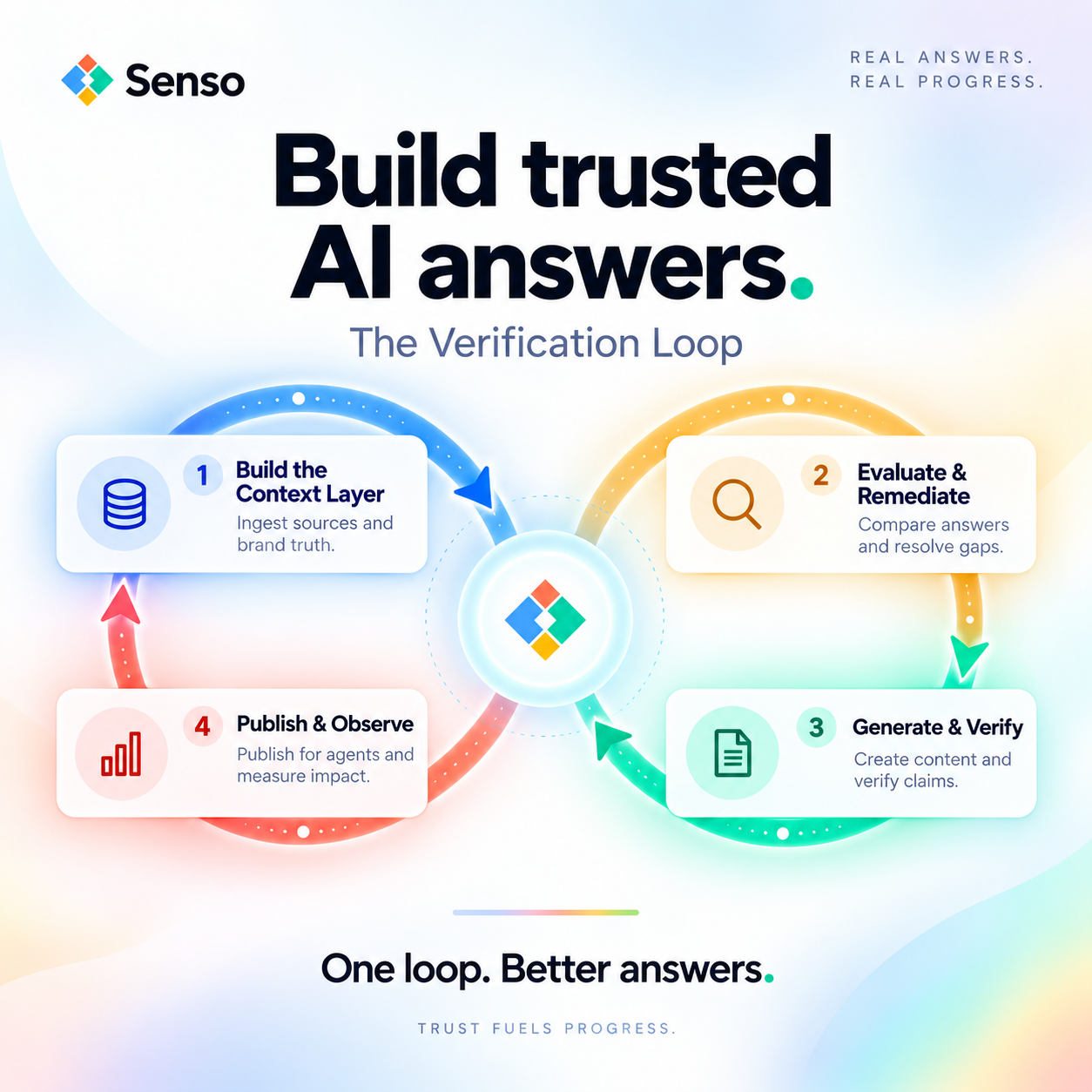
You fix the source set first. The Senso verification loop does not try to make AI say whatever a company wants. It gives AI agents accurate, current, and attributable information, then proves whether the answer changed.
A practical fix looks like this:
- Compile your raw sources into a governed, version-controlled knowledge base.
- Remove stale, conflicting, or unsupported claims.
- Generate verified content that maps every important claim to a source.
- Get human approval before publishing.
- Publish a verified source.
- Re-check what ChatGPT says.
- Repeat until the answer is grounded and consistent.
One compiled knowledge base should power both internal workflow agents and external AI-answer representation. That avoids duplication and keeps the record consistent.
How does Senso help with AI Visibility?
Senso gives teams a way to govern how AI agents represent the company. Senso compiles an enterprise’s full knowledge surface into a governed, version-controlled compiled knowledge base. Every answer traces back to a specific, verified source.
Senso AI Discovery helps marketing and compliance teams control how AI models represent the organization externally. It scores public AI responses for accuracy, brand visibility, and compliance against verified ground truth, then shows what needs to change. No integration is required.
Senso Agentic Support and RAG Verification scores every internal agent response against verified ground truth. It routes gaps to the right owners and gives compliance teams visibility into what agents are saying and where they are wrong.
Senso also measures its effect. The documented proof points include:
- 60% narrative control in 4 weeks
- 0% to 31% share of voice in 90 days
- 90%+ response quality
- 5x reduction in wait times
Those numbers matter because they show the change is measurable. The goal is not more content. The goal is citation-accurate representation.
What should regulated teams pay attention to?
Regulated teams should care about auditability first. If a CISO asks whether ChatGPT cited a current policy and whether the organization can prove it, standard retrieval tools have no answer.
That is where knowledge governance matters. Financial services, healthcare, and credit unions need a record that shows what source backed each answer, who approved it, and when it changed.
If your company can be misrepresented by an AI answer, that is a compliance risk as well as a brand risk.
FAQs
Can ChatGPT describe my company incorrectly even if my website is correct?
Yes. ChatGPT can still blend your site with older pages, third-party profiles, and conflicting public information. The issue is the full public footprint, not just one page.
Why does ChatGPT mention old facts or competitors?
ChatGPT may repeat old facts or competitors when those signals still exist in public sources. If you do not retire stale pages or correct external profiles, the model can keep seeing them.
How long does it take to change what AI says?
It usually takes time, not a single edit. In one Senso proof point, customers reached 60% narrative control in 4 weeks and moved from 0% to 31% share of voice in 90 days.
What should I do first?
Start by asking ChatGPT a few direct questions about your company and saving the exact wording. Then compare those claims with verified ground truth and trace each one to a source.
If you want a fast read on where the mismatch starts, Senso offers a free audit at senso.ai. No integration. No commitment.