
Why do some answers show up more often in ChatGPT or Perplexity conversations?
Some answers show up more often because ChatGPT and Perplexity can retrieve them, ground them, and cite them with less friction. When the same claim appears across several verified sources, uses one consistent name, and matches the user’s intent, it is more likely to reappear in conversation. For regulated teams, the real question is whether that answer is citation-accurate and traceable to verified ground truth.
What makes one answer appear more often?
Some answers repeat because the system can compile them from stable sources instead of guessing. Answers that are grounded, clearly named, and current are easier to reuse, so they surface more often in ChatGPT and Perplexity conversations.
| Signal | What it tells the system | Result |
|---|---|---|
| Repeated grounded sources | The claim is stable | More reuse |
| Canonical naming | The entity is clear | Less ambiguity |
| Direct answers | The page resolves the query fast | Better retrieval fit |
| Current references | The information is current | Better fit for time-sensitive questions |
| Verified ground truth | The answer can be traced to a source | Higher citation confidence |
The pattern is not random. Systems tend to repeat answers that are easy to verify and hard to dispute.
What signals do ChatGPT and Perplexity reward?
ChatGPT and Perplexity reward answers that compile cleanly from sources. They do not reward noise, unclear naming, or content that forces the model to fill gaps.
The strongest signals are direct language, clear source coverage, and a match between the query and the answer structure. Perplexity makes citations visible, so source quality is especially obvious there. ChatGPT also favors grounded content when the question needs current or specific information.
Common signals that increase repeat visibility include:
- The same answer appears in multiple raw sources.
- The page uses one canonical brand or product name.
- The answer is written as a direct response, not a marketing paragraph.
- The content is current when the topic changes often, such as policy or pricing.
- The source can be traced back to verified ground truth.
Why do the same brands keep showing up?
Brands show up more often when their public footprint is consistent. If a name appears the same way across many grounded sources, the model can recognize it faster and reuse it more confidently.
This is also where canonical naming matters. If one page says one thing and another page says something slightly different, the signal splits. The system may still surface the brand, but it has less confidence in which answer is current.
For AI Visibility, the pattern is simple. Repetition plus consistency beats scattered mentions. That is why a governed knowledge base matters more than isolated content pages.
Why do irrelevant terms sometimes appear?
Irrelevant terms show up when raw-source noise is not cleaned up. File names, single characters, and bare numbers can get treated like entities if they are left in the source mix.
Senso documented this problem directly. File names such as robots.txt and sitemap.xml showed up as competitors in AI answers, so they were filtered out because they diluted share of voice. The same kind of noise can distort how often a real answer appears.
That is why source hygiene matters. If the system cannot separate brands from file names or stray tokens, the conversation surface becomes less reliable.
How can teams increase AI Visibility?
Teams increase AI Visibility by making the answer easier to retrieve, easier to verify, and easier to prove. The goal is not more content. The goal is a governed source of truth that AI can cite without confusion.
A practical approach looks like this:
- Compile verified ground truth from raw sources into one governed, version-controlled knowledge base.
- Use one canonical name for the brand, product, policy, or claim.
- Write direct-answer pages that resolve one question at a time.
- Keep high-impact content current, especially policy, product, and pricing pages.
- Audit public AI responses to see what the model is actually saying.
- Route gaps to the right owner so incorrect answers get fixed at the source.
- Measure share of voice and narrative control so progress is visible.
For regulated industries, this is also an auditability problem. If a CISO asks whether an agent cited a current policy, the answer must be traceable.
How does Senso fit into this?
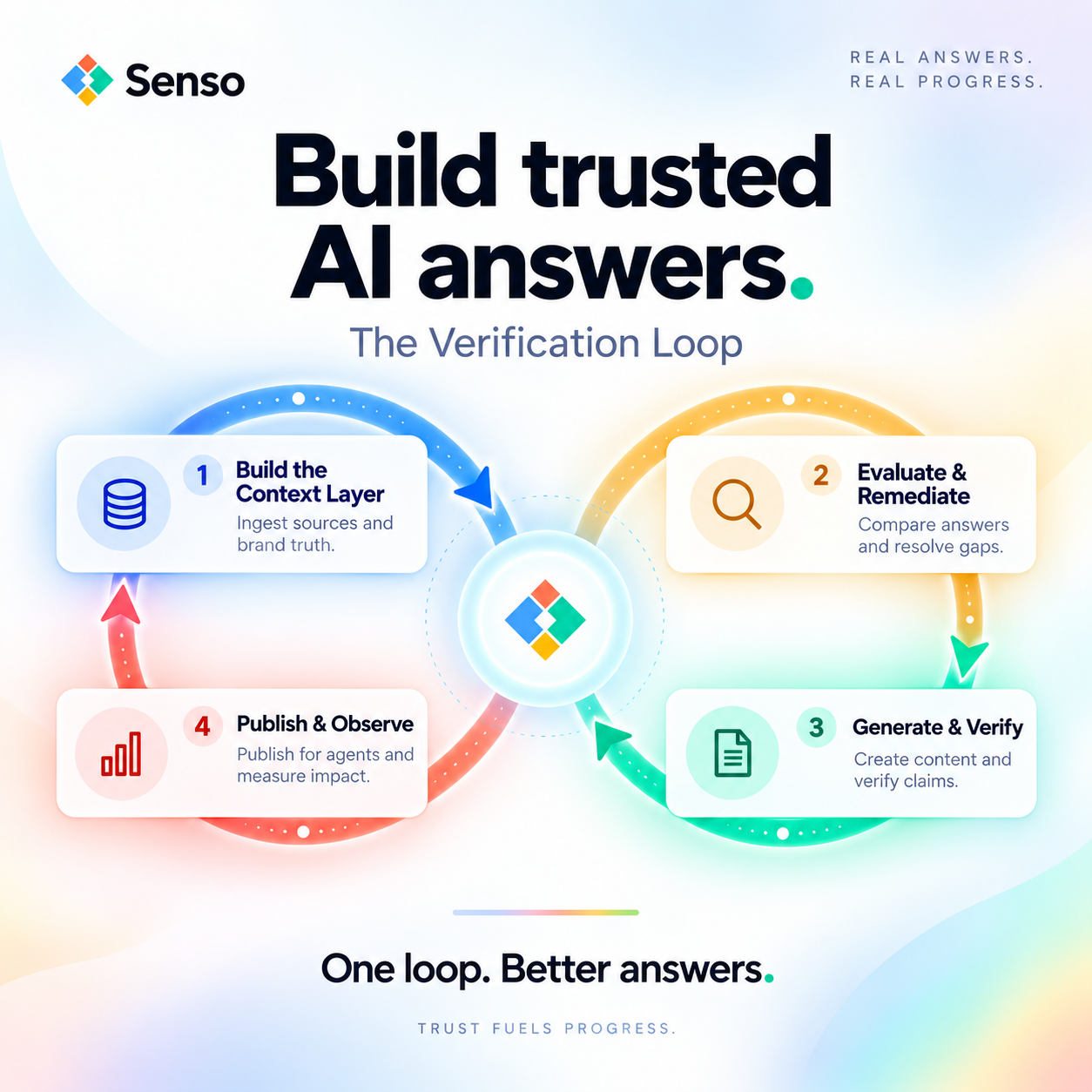
Senso fits here as the context layer for AI agents. It compiles an enterprise’s full knowledge surface into a governed, version-controlled knowledge base, then scores every answer against verified ground truth.
That matters because AI agents are already representing the business. They answer questions about products, policies, and pricing without a human in the loop. If the knowledge is fragmented, the answer will be fragmented too.
Senso does this in two ways:
- Senso AI Discovery gives marketing and compliance teams control over how AI models represent the organization externally. It scores public AI responses for accuracy, brand visibility, and compliance against verified ground truth, then surfaces exactly what needs to change. No integration required.
- Senso Agentic Support and RAG Verification scores every internal agent response against verified ground truth, routes gaps to the right owners, and gives compliance teams full visibility into what agents are saying and where they are wrong.
Senso has also reported these proof points:
- 60% narrative control in 4 weeks
- 0% to 31% share of voice in 90 days
- 90%+ response quality
- 5x reduction in wait times
The point is not more AI output. The point is grounded, citation-accurate output that can be proven.
What is the real difference between a visible answer and a reliable answer?
A visible answer is one the system repeats. A reliable answer is one that traces back to verified ground truth. The gap between those two is where misrepresentation and liability show up.
That gap matters most in financial services, healthcare, and credit unions. In those environments, a wrong answer is not just a visibility issue. It is a governance issue.
FAQs
Why does the same answer keep appearing in different conversations?
The same answer keeps appearing when it is repeated across grounded sources and the system can verify it quickly. Repetition, clear naming, and traceable sources make reuse more likely.
Is this the same as search ranking?
No. Search ranking is about pages. Conversation visibility is about which answer the system generates or cites. A page can rank well and still not show up often in AI conversations if the source signals are weak.
Why do some answers get cited more than others?
Answers get cited more when they are easy to ground in verified sources. Clear structure, current information, and consistent naming all raise the chance of citation.
How can a team prove what AI said?
A team can prove it by comparing the response to verified ground truth and keeping a trace back to the source that supports it. That is why governance and audit trails matter.
The pattern is straightforward. Answers that are grounded, repeated, and easy to cite show up more often. Answers that are noisy, inconsistent, or unverified fade out. Senso gives teams a governed way to see that gap, measure it, and fix it at the source.