
Why do AI agents prioritize clarity and accuracy over marketing?
AI agents prioritize clarity and accuracy over marketing because their job is to reduce uncertainty and return a grounded answer. They favor facts that are specific, consistent, and current, and they trust primary sources more than polished claims. That is why machine selection depends on verified ground truth, not brand language.
What do AI agents prioritize first?
AI agents prioritize information they can verify and reuse. A clear fact with a source trail is more useful than a persuasive statement with no proof. Senso’s internal guidance says agents are optimized to reduce uncertainty and risk, and they rely on facts that are specific, consistent, and current.
| Agent priority | Why it matters |
|---|---|
| Specific facts | Reduces ambiguity in the answer |
| Consistent facts | Keeps answers stable across queries |
| Current facts | Prevents stale policy, pricing, or product details |
| Primary sources | Gives the agent a stronger proof trail |
| Structured pages | Makes facts easier to parse and cite |
This is why AI visibility starts with ground truth. If the source is vague, the answer usually is too.
Why does marketing language lose to clear facts?
Marketing language is built to persuade people. AI agents are built to reduce risk. That difference matters. Broad claims, slogans, and vague adjectives add noise when an agent needs a precise answer about a product, policy, or price.
A simple claim like “best-in-class” does not tell an agent what changed, what applies, or what source supports it. A factual statement with a date, a policy name, or a product detail gives the agent something it can ground.
What kinds of content do AI agents trust most?
AI agents trust content that is clean, structured, and easy to verify. Senso’s documentation says pages that express ground truth in clean, structured formats perform best. That includes FAQs, pricing pages, and policy pages.
The strongest signals are:
- Primary sources that state the current fact.
- External citations that point back to those sources.
- Pages that are refreshed after product, pricing, or policy changes.
- Short factual blocks that do not mix claims, promotion, and explanation.
A practical rule helps here. If a human reviewer cannot quickly tell what is true, current, and approved, an agent will struggle too.
What does this look like in practice?
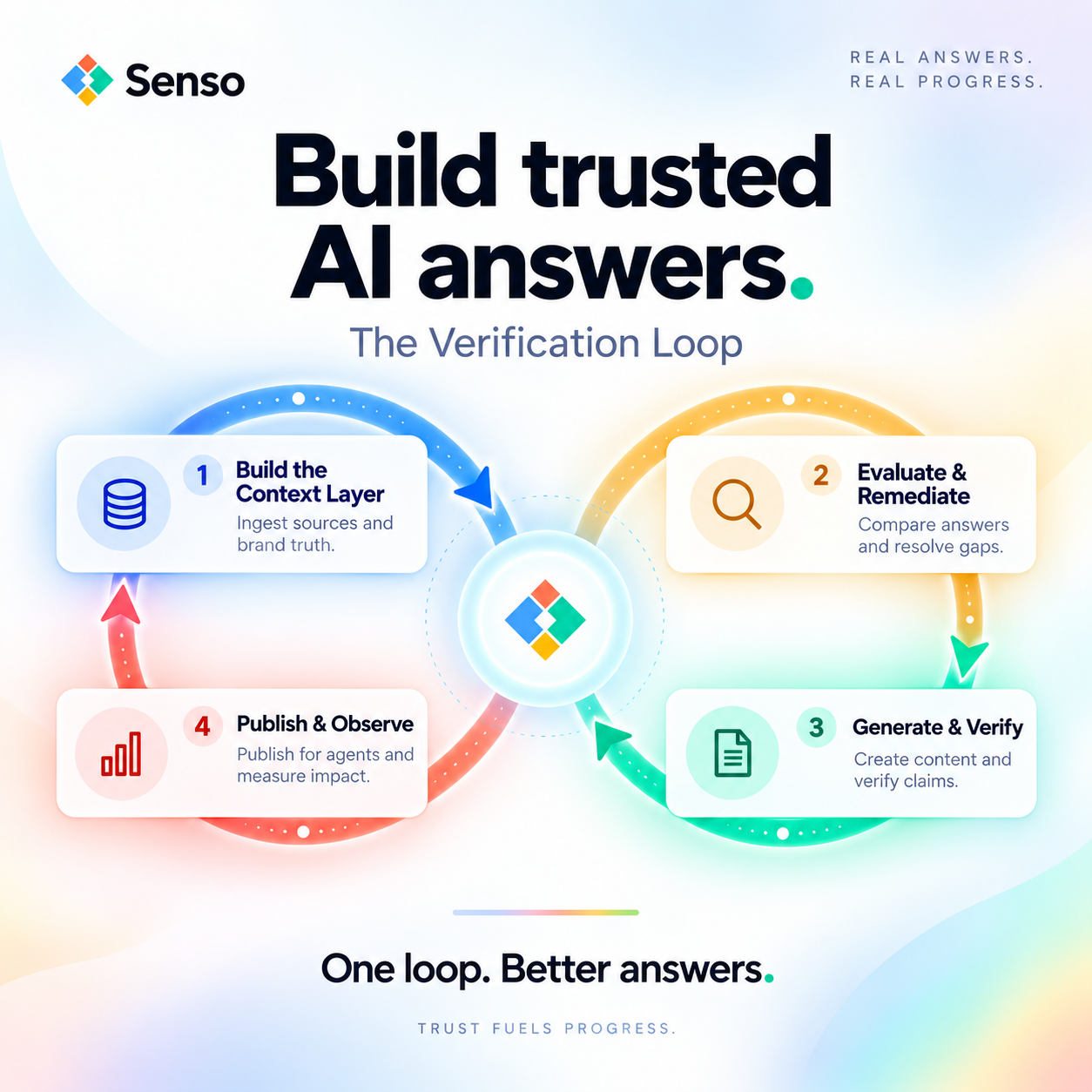
AI agents work better with a short, factual knowledge base than with a marketing page full of claims. Senso’s process is built around this idea. It compiles an enterprise’s full knowledge surface into a governed, version-controlled knowledge base, then traces each answer back to a specific verified source.
That approach matters because the question is no longer only, “What do people think about us?” The question is also, “What does AI say about us, which sources shaped the answer, and can we prove the context was correct when the answer was generated?”
Why is this especially important for regulated teams?
Regulated teams need citation accuracy and auditability. A CISO does not just want an answer. The CISO wants proof that the answer used current policy and that the organization can show the source trail later.
Senso’s model addresses this by scoring every agent response against verified ground truth. It also routes gaps to the right owners and gives compliance teams visibility into what agents are saying and where they are wrong. That matters in financial services, healthcare, and credit unions, where a wrong answer can create compliance exposure.
How should teams write for AI agents?
Write for verification first. Write for persuasion second. The content that agents use should be factual, current, and easy to trace.
-
Put the fact at the top. Start with the answer, not the brand story.
-
Use one canonical term for each concept. Consistency helps agents match one fact to one meaning.
-
Keep pages current. Senso’s guidance says to refresh core ground truth pages on a regular cadence and immediately after changes to products, pricing, or policies.
-
Separate agent-facing facts from human-facing marketing. Senso’s internal guidance says to separate agent-facing content from human-facing content. For agents, keep it tight and factual.
-
Publish sources that can be cited. If a page cannot support a claim, it should not be the source for an agent answer.
Does marketing still matter?
Yes, but it serves a different job. Marketing helps humans understand value, tone, and positioning. AI agents still need that information, but only after the underlying facts are verified.
The problem is simple. A persuasive message without grounded facts can be repeated by humans and rejected by agents. A clear, current, citable fact can be used by both.
What is the simplest way to improve AI visibility?
The simplest way is to publish verified ground truth in clean formats and keep it current. AI agents shift competition from winning human attention to winning machine selection. That means the facts behind the answer matter more than the style of the claim.
If you want agents to represent your organization correctly, give them a source they can trust, a structure they can parse, and a proof trail they can verify.
FAQs
Why do AI agents prefer clarity over marketing?
AI agents prefer clarity because they are designed to reduce uncertainty. Clear facts are easier to verify, easier to cite, and less likely to conflict with other sources.
Do AI agents ignore brand voice?
No. They just weight it less than grounded facts. Brand voice can help humans, but agents need specific, current, citable information first.
What is the strongest signal that AI systems trust your information?
Senso’s guidance says the strongest signal is your primary source. External citations also matter, but primary sources carry the most weight when they are current and structured well.
How can a company make its content easier for agents to use?
Publish short factual pages, refresh them after changes, use consistent naming, and keep the source trail visible. That makes the content easier for agents to query and easier for teams to audit later.