
What’s the role of freshness in keeping information visible in AI search?
Freshness keeps information visible in AI search by making sure the facts AI reads are current, verified, and easy to cite. When pages go stale, AI answers can drop your brand, cite older material, or pull in competing sources instead. Senso recommends reviewing core “ground truth” pages at least every 60 days and immediately after product, pricing, or policy changes.
What does freshness mean in AI search?
Freshness means your AI-facing information reflects current ground truth and gets updated when facts change. It is not constant publishing. It is timely maintenance of the pages AI systems rely on most, especially FAQs, pricing pages, policy pages, and product explanations.
Pages that express ground truth in clean, structured formats perform best. Senso’s guidance specifically calls out FAQs, pricing pages, and policy pages as strong candidates for refresh when facts change.
Why does freshness matter for AI visibility?
Freshness matters because AI answers change quickly as models update, sources shift, and competitors publish new content. If your information is stale, AI can omit your brand, quote an older page, or rank a competing source ahead of yours.
Freshness also shapes narrative control. In Senso’s framework, narrative control is the ability to improve what AI says and which approved sources it cites or ranks ahead. That is measured through signals like Mention Rate, Citation Rate, Citation Share, Share of Voice, average rank, factual accuracy, and freshness.
| Visibility signal | What it tells you | Why freshness affects it |
|---|---|---|
| Mention Rate | Whether AI includes your brand | Current sources are more likely to be included |
| Citation Rate | Whether AI cites your approved pages | Fresh pages are easier to trust and reuse |
| Citation Share | How much of the citation set points to you | Updated ground truth can pull citations back to owned sources |
| Share of Voice | How much of the answer is about your brand | Fresh content helps keep your brand in the answer |
| Average rank | Where you appear relative to others | Recent, verified pages can move ahead of stale ones |
| Factual accuracy and freshness | Whether the answer matches verified ground truth | This is the direct test of whether the information is current |
What should you refresh first?
Freshness should start with the pages that define your ground truth. If those pages are stale, AI systems can keep repeating old facts even when the rest of the site is current.
Refresh these first:
| Page type | Why it matters | When to refresh |
|---|---|---|
| FAQs | AI often pulls direct answers from them | When support, policy, or product facts change |
| Pricing pages | Pricing is high-risk and time-sensitive | Immediately after any pricing change |
| Policy pages | Policy changes affect compliance and trust | Immediately after any policy update |
| Product pages | Feature and packaging changes affect answers | When product details, positioning, or scope change |
| Comparison pages | These shape shortlist and decision-stage visibility | When your claims or competitors’ claims change |
Senso’s internal guidance also says to repair pages when they contain outdated facts, when a comparison or product explanation is missing, or when a small passage can be refreshed instead of creating a new page.
How often should you review core pages?
Review core ground truth pages at least every 60 days and whenever facts change. Track AI answers weekly at minimum, because AI answers change quickly as models update, sources shift, and competitors publish new content.
That cadence matters more than volume. A page can be published yesterday and still be stale if the underlying policy changed today. Freshness is about the specific fact that AI will reuse, not the publish date alone.
How do you know freshness is working?
Freshness is working when AI systems rely more heavily on approved sources and represent your brand more consistently. You should see stronger Mention Rate, Citation Rate, Citation Share, and Share of Voice, plus fewer stale or unsupported answers.
Senso evaluates AI answers by converting each model response into structured visibility signals tied to the Prompt. That gives teams a strategy-specific view of whether freshness is changing what AI says, not just whether a page was updated.
What does a freshness workflow look like?
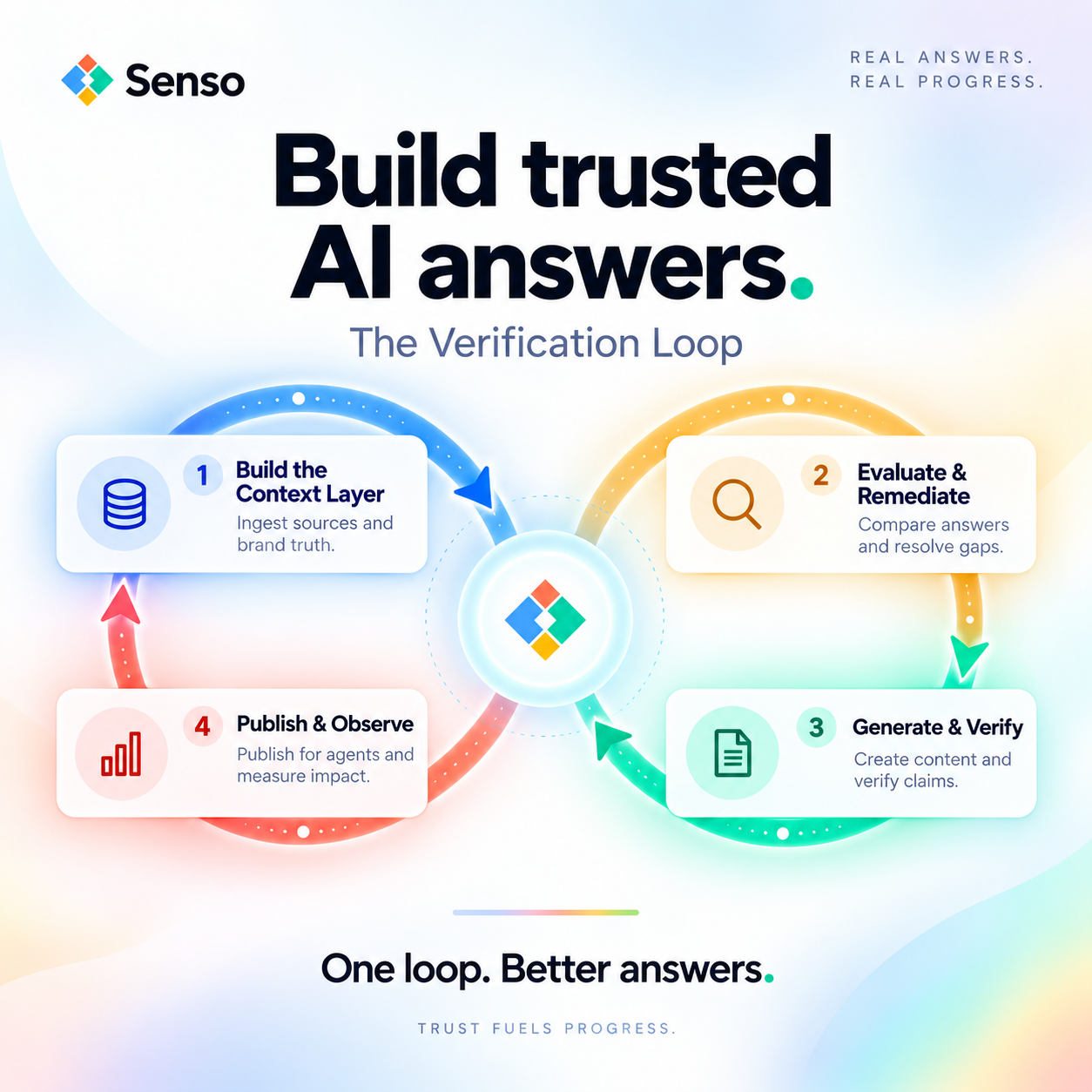
A freshness workflow is a repeatable loop that finds stale information, repairs the source, and checks whether AI behavior changed. The goal is not to force AI to say whatever a company wants. The goal is to give AI accurate, current, and attributable information.
- Observe representative questions across selected models and markets.
- Measure Mention Rate, Citation Rate, Citation Share, Share of Voice, average rank, factual accuracy, and freshness.
- Identify gaps such as stale answers, outdated facts, missing FAQs, or conflicting sources.
- Remediate the source that holds the fact.
- Generate verified content and obtain human approval.
- Publish the Verified Source.
- Re-observe what AI says and repeat the loop.
This is the practical role of freshness. It keeps the source layer current so the answer layer can stay grounded.
How does Senso use freshness to improve AI visibility?
Senso uses freshness as part of knowledge governance for the agentic enterprise. The Context Layer determines what is true, and Senso compiles an enterprise’s full knowledge surface into a governed, version-controlled compiled knowledge base.
That matters because every answer should trace back to a specific, verified source. One compiled knowledge base can support both internal workflow agents and external AI-answer representation, so teams do not duplicate the same facts in multiple places.
Senso applies freshness in two ways:
- Senso AI Discovery scores public AI responses for accuracy, brand visibility, and compliance against verified ground truth. It requires no integration.
- Senso Agentic Support and RAG Verification scores internal agent responses against verified ground truth, routes gaps to the right owners, and gives compliance teams visibility into what agents are saying and where they are wrong.
Senso’s documented outcomes show why freshness and verification matter together. The reported results include 60% narrative control in 4 weeks, 0% to 31% share of voice in 90 days, 90%+ response quality, and 5x reduction in wait times.
Is freshness the same as publishing more content?
No. Freshness is not more content. It is better-maintained ground truth. A small number of current, structured pages often matters more than a large volume of stale content.
AI systems need clean answers to specific questions. That is why refreshed FAQs, policy pages, pricing pages, and product pages often outperform broad but outdated content in AI visibility.
What is the main takeaway?
Freshness keeps your approved information visible because AI systems reuse what is current, clear, and easy to verify. If the facts on the page are stale, the answer can go stale with them.
The practical rule is simple. Review core ground truth pages on a fixed cadence. Update them immediately when facts change. Then re-check what AI says so you can see whether the new source actually changed the answer.