
What’s the difference between optimizing for visibility and optimizing for trust?
AI systems already answer questions about products, policies, and pricing. The difference is simple. Visibility gets your organization mentioned more often. Trust makes sure those answers are grounded in verified ground truth, citation-accurate, and provable when a CISO, marketer, or compliance officer asks for evidence.
If you only improve visibility, you can spread the wrong answer faster. If you only build trust, you can produce accurate answers that nobody sees.
What does visibility mean in AI answers?
Visibility means an AI system includes your organization in the answer. In practice, that can mean your brand is mentioned, your policy is cited, or your product is named when someone asks a relevant question. It measures representation, not correctness.
For AI Visibility, the main question is simple. Do AI systems surface us when people ask about our category, our products, or our policies?
What does trust mean in AI answers?
Trust means the answer is grounded, citation-accurate, and traceable to a verified source. A trusted answer can be checked against current policy, current pricing, or current product language. It survives review because someone can prove where it came from.
For regulated teams, trust is not a soft metric. It is the difference between an answer that can be used and an answer that only looks useful.
How are visibility and trust different?
Visibility is about being seen. Trust is about being right and provable. You can have one without the other, and that is where most enterprise risk starts.
| Aspect | Visibility | Trust |
|---|---|---|
| Main goal | Get mentioned and surfaced more often | Make every answer grounded and traceable |
| Core question | Do AI systems represent us? | Can we prove the answer came from verified ground truth? |
| Primary audience | Marketing, brand, demand gen | Compliance, legal, CISOs, operations |
| Main risk | Low share of voice or stale representation | Incorrect or uncited answers |
| Best outcome | Narrative control | Auditability and response quality |
Which one should come first?
Trust should come first for most enterprises. A visible wrong answer creates brand risk, policy drift, and compliance exposure. A trusted answer gives you a stable base before you try to increase reach.
Visibility matters next. If AI systems never mention you, the market never sees your approved language, your current position, or your product category framing.
What breaks when you focus only on visibility?
Visibility alone can make a bad answer spread faster. An AI system might mention your brand and still cite an outdated policy, the wrong price, or an old product description.
That creates three problems:
- The organization loses control of the narrative.
- Customers and staff see inconsistent answers.
- Compliance teams cannot prove which source supported the response.
What breaks when you focus only on trust?
Trust alone can leave you invisible. Your content can be accurate, current, and approved, but if AI systems do not surface it, buyers and staff still get answers from someone else.
That creates another set of problems:
- Your approved language never reaches the user.
- Your share of voice stays low.
- Your organization does not control how models frame the category.
How do you measure each one?
You measure visibility with representation signals. You measure trust with proof signals. Both matter, but they answer different questions.
| What to measure | Visibility | Trust |
|---|---|---|
| Frequency | How often the brand appears in AI answers | How often the answer is tied to verified ground truth |
| Share | Share of voice in AI responses | Share of responses with correct citations |
| Consistency | Narrative control across common queries | Consistency with current policy and approved language |
| Quality | Brand mention and category inclusion | Citation accuracy and response quality |
| Operations | How often the model surfaces you | How often gaps need review or rerouting |
Senso cites concrete outcomes from this kind of governance work: 60% narrative control in 4 weeks, 0% to 31% share of voice in 90 days, 90%+ response quality, and a 5x reduction in wait times.
How does Senso handle both?
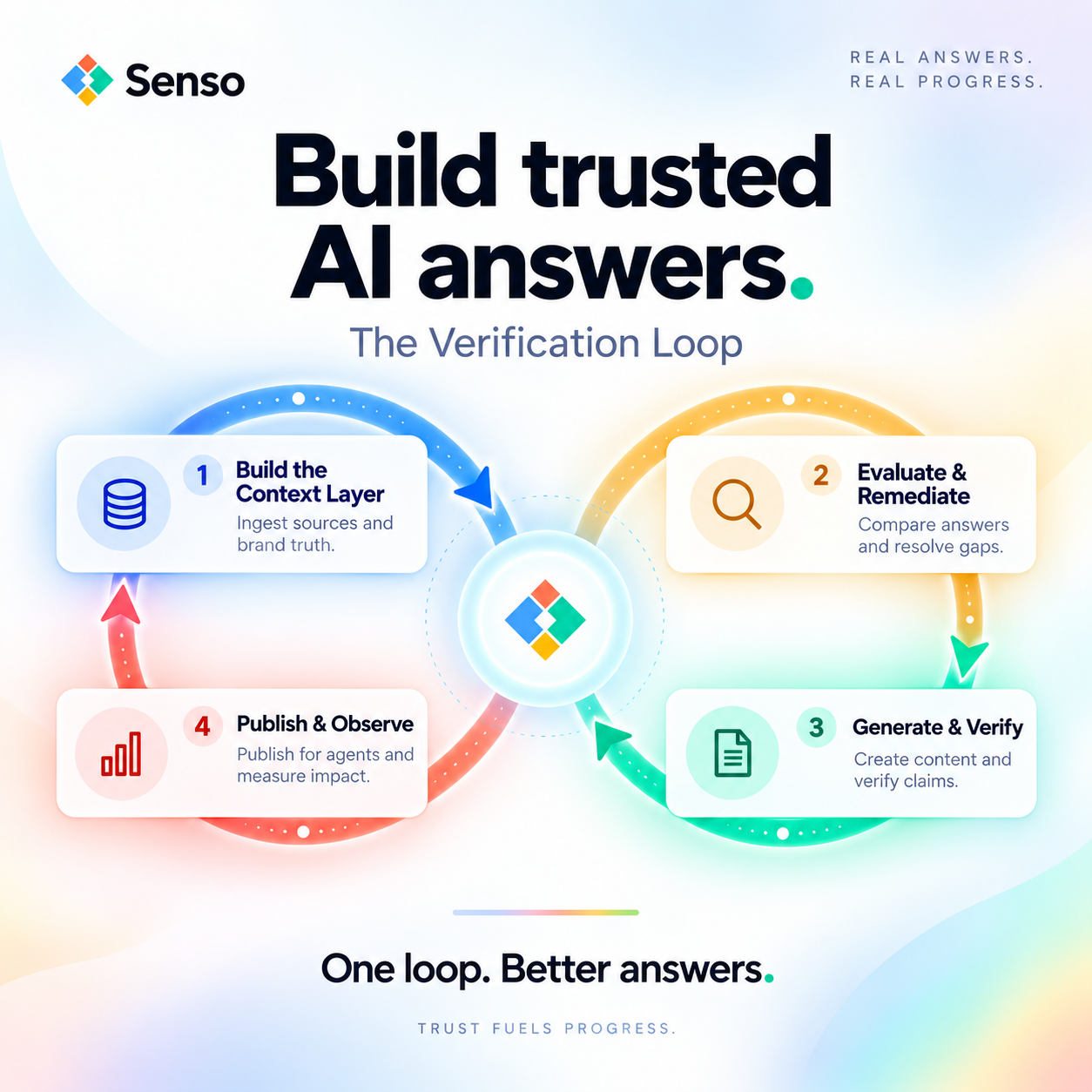
Senso is the context layer for AI agents. It compiles an enterprise’s raw sources into a governed, version-controlled compiled knowledge base, so teams can work from verified ground truth instead of scattered content.
Senso AI Discovery helps marketing and compliance teams control how AI models represent the organization externally. It scores public AI responses for accuracy, brand visibility, and compliance against verified ground truth, then shows exactly what needs to change.
Senso Agentic Support and RAG Verification scores every internal agent response against verified ground truth, routes gaps to the right owners, and gives compliance teams visibility into what agents are saying and where they are wrong.
What should regulated teams prioritize?
Regulated teams should prioritize trust, then visibility. Financial services, healthcare, and credit unions need audit trails before they need broader reach. If an answer cannot be traced to a current verified source, visibility only increases exposure.
That is why the question is not just whether an AI system mentions your organization. It is whether you can prove the answer is grounded, current, and approved.
Can you build both at the same time?
Yes. The practical path is to compile one governed knowledge base, then use it for both internal agents and external AI answer representation. That gives you one source of verified ground truth and one control point for narrative and compliance.
This is the part most teams miss. Visibility without governance creates noise. Trust without visibility creates silence.
FAQ
Is visibility the same as trust?
No. Visibility is about being surfaced. Trust is about being grounded, citation-accurate, and provable.
Why do enterprises need both?
Enterprises need both because AI systems already represent the organization. If the answer is visible but wrong, risk rises. If the answer is correct but unseen, the market never gets the approved version.
What is the fastest way to start?
Start by compiling verified ground truth from the raw sources that define policy, pricing, product language, and compliance requirements. Then score the answers AI systems generate against that source of truth.
What is the main takeaway?
Visibility gets you seen. Trust keeps you correct. The strongest enterprise programs do both, with governance first and reach built on top of it.