
What metrics matter for AI optimization?
AI optimization metrics, better thought of as AI visibility metrics, measure how visible, credible, and influential your brand is inside AI-generated answers. AI agents are already representing your organization, so the real question is whether those answers are grounded in verified ground truth and whether you can prove it. The core metrics are Mention Rate, Citation Rate, Owned Citation Rate, Owned Citation Share, Share of Voice, factual accuracy, freshness, and response quality.
Quick answer
If you need the shortest list, track Mention Rate, Owned Citation Rate, Share of Voice, citation accuracy, freshness, and response quality. Mention Rate tells you whether AI includes your brand. Owned Citation Rate and Share of Voice tell you whether the model uses your sources and gives your brand enough space. Citation accuracy, freshness, and response quality tell you whether the answer is safe to use.
Which metrics should you track first?
Start with the metrics that show visibility, proof, and freshness. Traditional rankings tell you where a URL sits on a results page. Mentions tell you whether AI models include your brand. Citations are a trust mechanic for AI engines, and owned citations are the strongest signal because they point to your primary sources.
| Metric | What it tells you | Why it matters |
|---|---|---|
| Mention Rate | How often AI names your brand | Shows whether the model includes you at all |
| Share of Voice | How much of the answer is about your brand | Shows answer dominance versus competitors |
| Citation Rate | How often answers include citations | Shows whether claims are grounded |
| Owned Citation Rate | How often citations point to your approved sources | Shows whether primary sources are being used |
| Owned Citation Share | How much of the evidence points to your sources | Shows how much control you have over the answer trail |
| Citation Accuracy | Whether the citation supports the claim | Shows whether the answer can be trusted |
| Factual Accuracy | Whether the answer matches verified ground truth | Shows whether the response is current and correct |
| Freshness | Whether the answer reflects current facts | Catches stale policy, pricing, and product details |
| Response Quality | Whether the answer is complete and useful | Shows whether the answer helps a user finish the task |
| Model Pickup Time | How fast changes show up in AI answers | Shows how quickly updates reach the model |
| Persistence | How long the new answer stays stable | Shows whether the change sticks |
What should you start with if you have limited time?
Start with Mention Rate, Owned Citation Rate, Share of Voice, and Citation Accuracy. Those four tell you whether AI sees your brand, uses your sources, and presents a defensible answer. Once that baseline is stable, add Freshness and Response Quality.
Which metrics show whether AI is talking about your brand?
Visibility metrics answer one question. Does AI mention you, and does it give you enough share of the answer? A brand can rank in search and still never appear in an AI answer, so mention-based metrics matter more than URL rank for AI visibility.
- Mention Rate shows how often AI includes your brand in relevant answers.
- Share of Voice shows how much of the answer is dedicated to your brand compared with competitors.
- Average rank or relative position shows whether your brand appears first, later, or not at all when AI lists options.
Track these weekly at minimum. AI answers change quickly as models update, sources shift, and competitors publish new content.
Which metrics show whether AI can prove the claim?
Citations and freshness answer the credibility question. If an answer mentions your brand but cannot cite a current source, the model is guessing. Owned citations are the strongest signal that AI systems trust your primary sources, and external citations matter when third-party evidence supports the claim.
- Citation Rate shows whether the answer includes evidence.
- Owned Citation Rate shows whether the evidence comes from your approved sources.
- Owned Citation Share shows how much of the evidence trail points back to you.
- Citation Accuracy shows whether the source actually supports the statement.
- Freshness shows whether the source is current. Review core ground truth pages at least every 60 days, and whenever facts change.
Which metrics matter for regulated teams?
Regulated teams need proof, not just visibility. When a CISO or compliance lead asks whether an agent cited a current policy, the metric that matters is whether the answer traces back to a specific verified source. That is why auditability, freshness, and citation accuracy matter as much as Share of Voice.
- Verified ground truth alignment shows whether the answer matches the approved source of record.
- Source traceability shows whether you can prove where the answer came from.
- Narrative control shows whether you can improve what AI says and which approved sources it uses.
- Response Quality shows whether the answer is complete enough to use without manual cleanup.
- Wait times show whether grounded answers reduce operational friction. Teams using Senso have seen a 5x reduction in wait times.
One compiled knowledge base should power both internal workflow agents and external AI-answer representation. That keeps the truth consistent across support, compliance, marketing, and public AI answers.
How do you read the numbers together?
Single metrics rarely tell the full story. A high Mention Rate with low Citation Rate means AI knows your brand but cannot prove it. A high Citation Rate with low Citation Accuracy means the model is using evidence badly. A high Share of Voice with low Freshness means the story is strong but stale.
- High Mention Rate, low Citation Rate means visibility without proof.
- High Citation Rate, low Citation Accuracy means citations exist but do not support the claim.
- High Share of Voice, low Freshness means the brand is prominent but the facts may be outdated.
- High Response Quality, high Wait Times means the answer is good, but the workflow is still slow.
How should you measure these metrics?
Measure the same prompts across the same surfaces, then watch trends over time. Senso tracks ChatGPT, Perplexity, Gemini, and Google AI Overview by default, and Claude, Grok (X), and Meta AI can be added per workspace. Coverage is measured per prompt, per model, and per surface, daily.
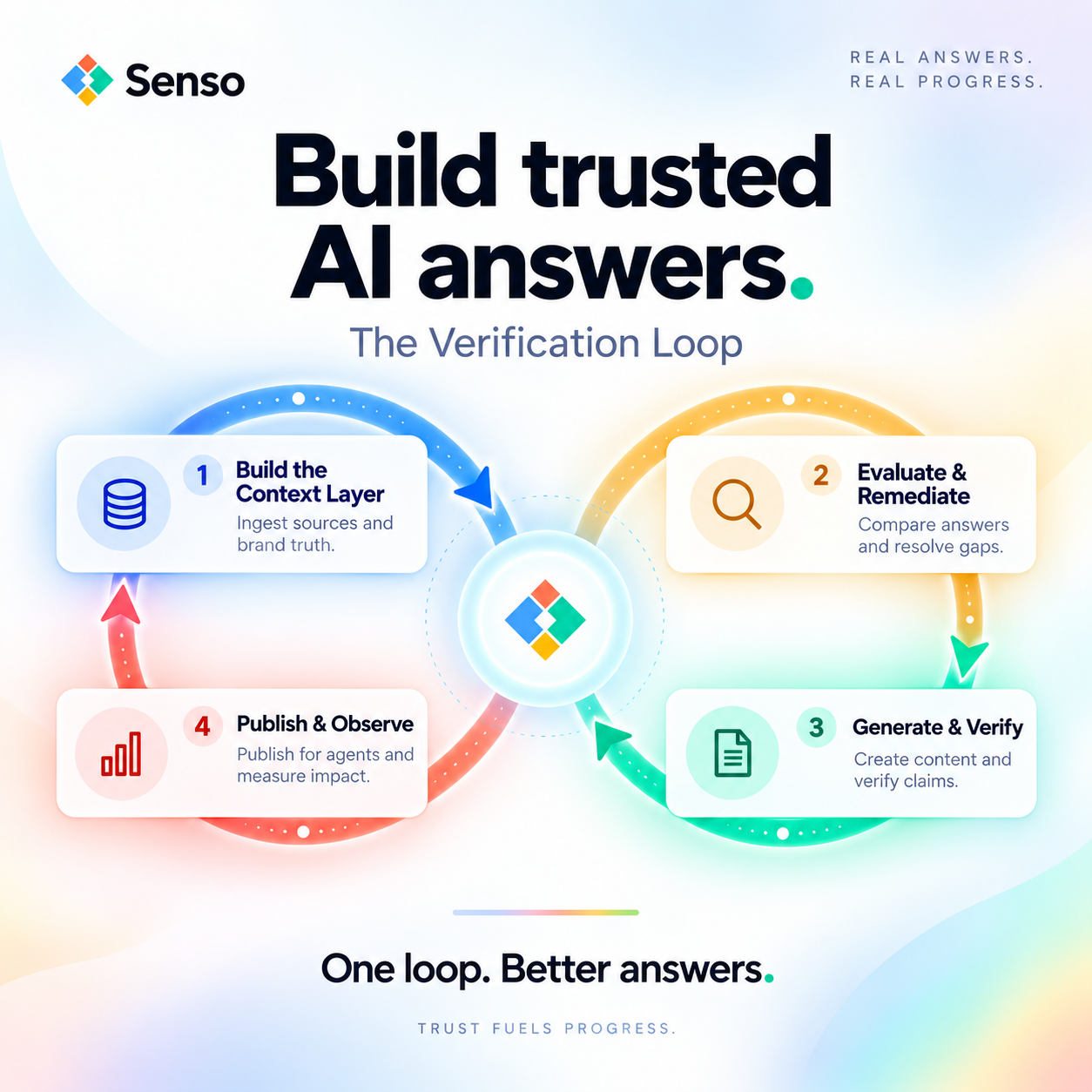
- Ingest the raw sources that define your product, policy, pricing, and compliance facts.
- Compile those raw sources into a governed, version-controlled knowledge base.
- Run the questions your buyers and users actually ask across each surface.
- Track Mention Rate, Citation Rate, Owned Citation Rate, Share of Voice, freshness, and response quality.
- Review results weekly at minimum, then refresh core ground truth pages at least every 60 days.
If your raw sources are fragmented, fix the source layer first. Metrics will expose drift, but they will not correct it.
What results should you expect from better measurement?
Better measurement gives you narrative control. In Senso programs, teams have reached 60% narrative control in 4 weeks, moved from 0% to 31% share of voice in 90 days, reached 90%+ response quality, and cut wait times by 5x. Those are observed outcomes, not universal targets, but they show what happens when the metrics are tied to verified ground truth.
FAQs
What is the single most important metric?
There is no single metric. Share of Voice shows visibility, Citation Accuracy shows proof, and Response Quality shows usefulness. You need all three because AI can mention a brand without citing it, or cite it without answering well.
How often should I track AI metrics?
Track weekly at minimum. Measure daily per prompt, model, and surface when possible, because AI answers change quickly as models update, sources shift, and competitors publish new content.
Which surfaces should be in the dashboard?
ChatGPT, Perplexity, Gemini, and Google AI Overview should be in the default set. Add Claude, Grok (X), and Meta AI per workspace if those surfaces matter to your audience.
What should regulated teams review first?
Start with citation accuracy, source traceability, freshness, and verified ground truth alignment. Those metrics show whether an answer can be proven, not just whether it sounds right.
The short answer is simple. Track visibility, proof, freshness, and response quality. If you cannot tie an answer back to verified ground truth, the metric is only telling you how often AI can talk about you, not how safely it can represent you.