
What kind of data does AI look at when deciding which brands to include in an answer?
AI usually looks at data it can retrieve, cite, and trust. That means approved first-party pages, credible external sources, brand mentions, citations, and fresh source material. It does not pull brands from one master list. It includes the brands it can ground in the answer.
Which data matters most to AI answer engines?
Verified first-party material matters most because it anchors the answer to facts the brand is willing to stand behind. Senso’s FAQs say AI systems rely more heavily on approved, first-party material when brand content is structured that way. The strongest data is current, canonical, and easy to trace back to a verified source.
| Data AI looks at | What it tells the model | Why it affects brand inclusion |
|---|---|---|
| Approved first-party pages | The brand’s own version of the facts | It gives the answer a verified source of truth |
| Citations and source tiers | Which pages support the claim | It shows whether the answer can be defended |
| Brand names and aliases | Which mentions belong to the same brand | It prevents evidence from being split across spellings |
| Credible external sources | Whether other sources repeat the same fact | It increases confidence in the brand claim |
| Freshness and version history | Whether the source is current | It helps keep answers grounded as facts change |
Traditional rankings tell you where a URL sits on a results page. Mentions tell you whether AI models include your brand. Senso’s FAQs track both because visibility and inclusion are not the same thing.
Why are citations so important?
Citations are a trust mechanic for AI engines. Senso’s glossary says every cited URL lands in exactly one of three tiers: Primary/Owned, Tracked, or External/Secondary. When a brand claim points back to a Primary/Owned page or a credible External/Secondary source, the answer is easier to include and easier to prove.
Citations also expose weak grounding. If an answer cites the wrong page, an outdated page, or no page at all, the brand representation becomes harder to defend. That matters most when a team needs auditability, not just visibility.
Why do brand names and aliases matter?
Brand naming matters because AI systems resolve surface-form spellings into one brand_key. If your brand appears under multiple names, abbreviations, or product labels, the evidence can fragment. That fragmentation makes it harder for AI to treat the brand as one consistent entity.
Senso’s glossary also tracks mentions two ways. It counts answers that mentioned the brand and the total number of name-drops. If aliases are not mapped cleanly, those counts spread out and the brand looks smaller than it is.
What happens when the source data conflicts?
Conflicting source data weakens the answer. If one page says one thing, another page says something different, and a third page is outdated, the model has less grounded material to rely on. For regulated teams, the real problem is not just inconsistency. It is the lack of proof.
The answer should trace back to a specific verified source. If it cannot, the brand may still appear, but the answer is harder to trust, harder to defend, and more likely to misstate the current policy or current offer.
How can you control what AI includes?
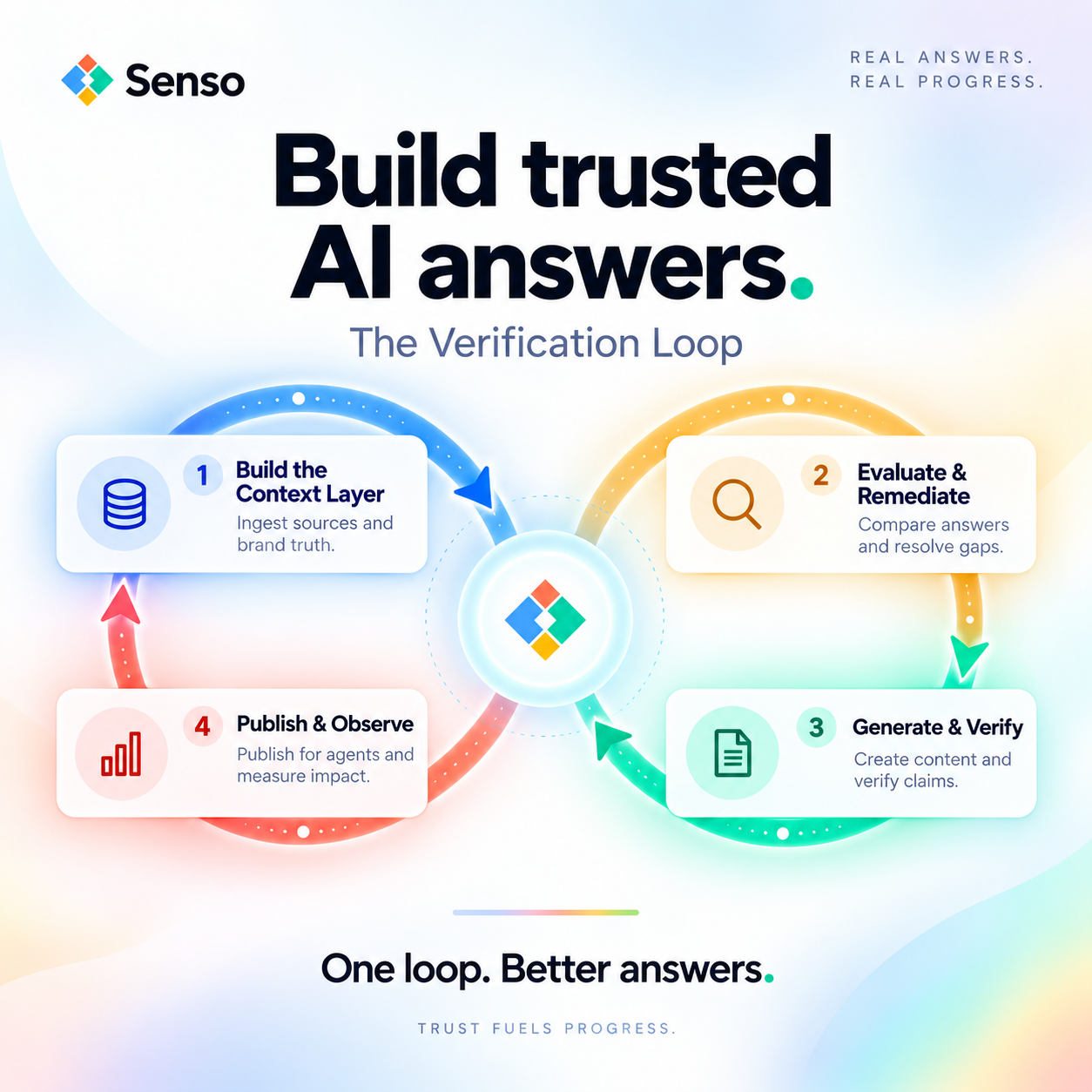
You control inclusion by controlling the source set. The best approach is to compile raw sources into a governed, version-controlled knowledge base, then keep that source of truth current. One compiled knowledge base can support both internal agents and public AI answer representation without duplication.
-
Ingest your raw sources into a governed knowledge base.
Compile approved policies, product facts, pricing language, and other core claims into one source of truth. -
Map every alias to one canonical brand name.
This keeps mentions, citations, and source references tied to the same entity. -
Review core ground truth pages at least every 60 days.
Senso’s FAQs say core “ground truth” pages should be reviewed at least every 60 days when facts change. -
Publish first-party pages for the claims you care about most.
AI systems are easier to ground when the brand owns the primary source. -
Track AI answers weekly.
Senso’s FAQs note that AI answers change quickly as models update, sources shift, and competitors publish new content. -
Watch mention counts and share of voice.
Share of Voice measures answer dominance. It is the percentage of an AI-generated answer dedicated to your brand compared with others.
Those are the signals that shape AI Visibility. They also show whether the brand is appearing early, showing up in shortlist moments, or missing the conversation entirely.
What matters most for regulated industries?
Current policy, approved disclosures, and audit trails matter more than volume. In regulated industries, the useful question is not only whether the brand appears. It is whether the answer can be traced to verified ground truth and whether the organization can prove it.
That is why citation accuracy matters so much for financial services, healthcare, and other regulated teams. If the answer cites the wrong policy or an outdated source, the brand faces a visibility problem and a governance problem at the same time.
What should you monitor after the brand starts appearing?
You should monitor both the data behind the answer and the answer itself. Senso’s FAQs define AI optimization metrics as measures of how visible, credible, and influential a brand is inside AI-generated answers. Those metrics give you a practical view of whether the source set is working.
Use this checklist:
- Are the cited URLs current and in the right tier?
- Are brand names and aliases mapped cleanly?
- Are first-party pages aligned with approved claims?
- Is sentiment improving or turning negative?
- Is share of voice growing or shrinking?
- Are mentions appearing in answers that matter to buyers?
If the answer changes, the source set usually changed first. That is why source governance matters before the public answer does.
FAQs
What data does AI rely on most when deciding which brands to include?
AI relies most on verified first-party material, credible citations, and consistent brand naming. Those inputs give the model enough grounding to include the brand with confidence.
Do external sources matter as much as owned pages?
Owned pages matter more for verified facts, but credible external sources still matter because they corroborate the claim. Strong brand inclusion usually comes from both.
How often should brand data be reviewed?
Senso’s FAQs say core ground truth pages should be reviewed at least every 60 days. AI answers should be tracked weekly because they can change quickly as models and sources change.
What is the biggest reason brands get excluded?
The most common reason is weak or fragmented grounding. That includes outdated pages, conflicting claims, missing citations, and inconsistent brand naming.
The brands AI includes are usually the ones backed by current first-party facts, consistent naming, and cited evidence. If you want stronger AI visibility, start with verified ground truth and the source data behind it.