
What is the agentic web and how should companies prepare for it?
AI agents are already answering questions about products, policies, and pricing. The agentic web is the environment where those answers shape discovery, trust, and purchases. Companies should prepare by compiling verified ground truth, publishing verified sources, and measuring citation accuracy before agents harden the wrong version of the business into the market.
Cloudflare reports that automated agents and bots now generate more than half of all web requests. That makes this shift operational, not theoretical.
What is the agentic web?
The agentic web is a web environment where AI agents do more than retrieve pages. They interpret intent, compare options, recommend vendors, and complete tasks on behalf of users.
That changes what companies need to control. It is no longer enough for a page to exist. The page has to be discoverable by agents, cited correctly, and grounded in verified ground truth.
Why does the agentic web matter now?
The agentic web matters now because agents are already shaping discovery and commerce. Cloudflare reported that AI “user action” crawling increased more than 15x during 2025. McKinsey estimates agentic commerce could mediate US$3-5 trillion of global consumer commerce by 2030.
Google’s Universal Commerce Protocol is designed to connect discovery, purchase, and post-purchase activity across AI surfaces and merchant systems. That shows where the web is moving.
How is the agentic web different from the traditional web?
The agentic web changes the unit of value from pages to answers. On the traditional web, people browse. On the agentic web, agents decide what to surface, what to cite, and when to act.
| Traditional web | Agentic web |
|---|---|
| People browse pages | Agents answer and act |
| Visibility depends on pages and links | Visibility depends on grounded answers and citations |
| Content teams publish pages | Teams maintain verified ground truth and audit trails |
| Success is traffic | Success is citation accuracy and transaction readiness |
This shift matters because a brand can lose demand if an agent summarizes a stale policy, omits a product, or cites the wrong pricing page.
How should companies prepare for the agentic web?
Companies should prepare by building knowledge governance before the wrong answer becomes the default. Start with the claims that affect revenue, risk, and customer decisions.
-
Identify the questions agents already answer.
Map the prompts that touch your products, policies, pricing, support, and compliance. Focus on the questions that matter most to buyers and regulators first. -
Compile raw sources into one governed knowledge base.
Bring raw sources into a compiled knowledge base that version-controls the enterprise truth set. One compiled knowledge base can support both internal workflow agents and external AI-answer representation, which avoids duplicate truth sets. -
Turn important claims into Verified Sources.
A Verified Source is ground truth an organization stands behind. It is checked claim by claim against a source of record, attested by an authorized reviewer, timestamped, permission-scoped, and kept current. -
Publish verified content where agents can read it.
Publish to an organization website, an agent-readable destination, or both. The goal is a structured, verified publishing surface that agents can query and cite. -
Score every answer against verified ground truth.
Measure citation accuracy, response quality, and compliance against the approved source set. If an answer is wrong, route the gap to the right owner and keep the private audit trail. -
Fix the source of drift, not just the symptom.
Some pages need re-indexing for agents. Some need a rewrite because the important chunk is buried in JavaScript or lacks evidence. The highest-value fix is often the chunk that needs updating, not a new article.
What does a context layer do?
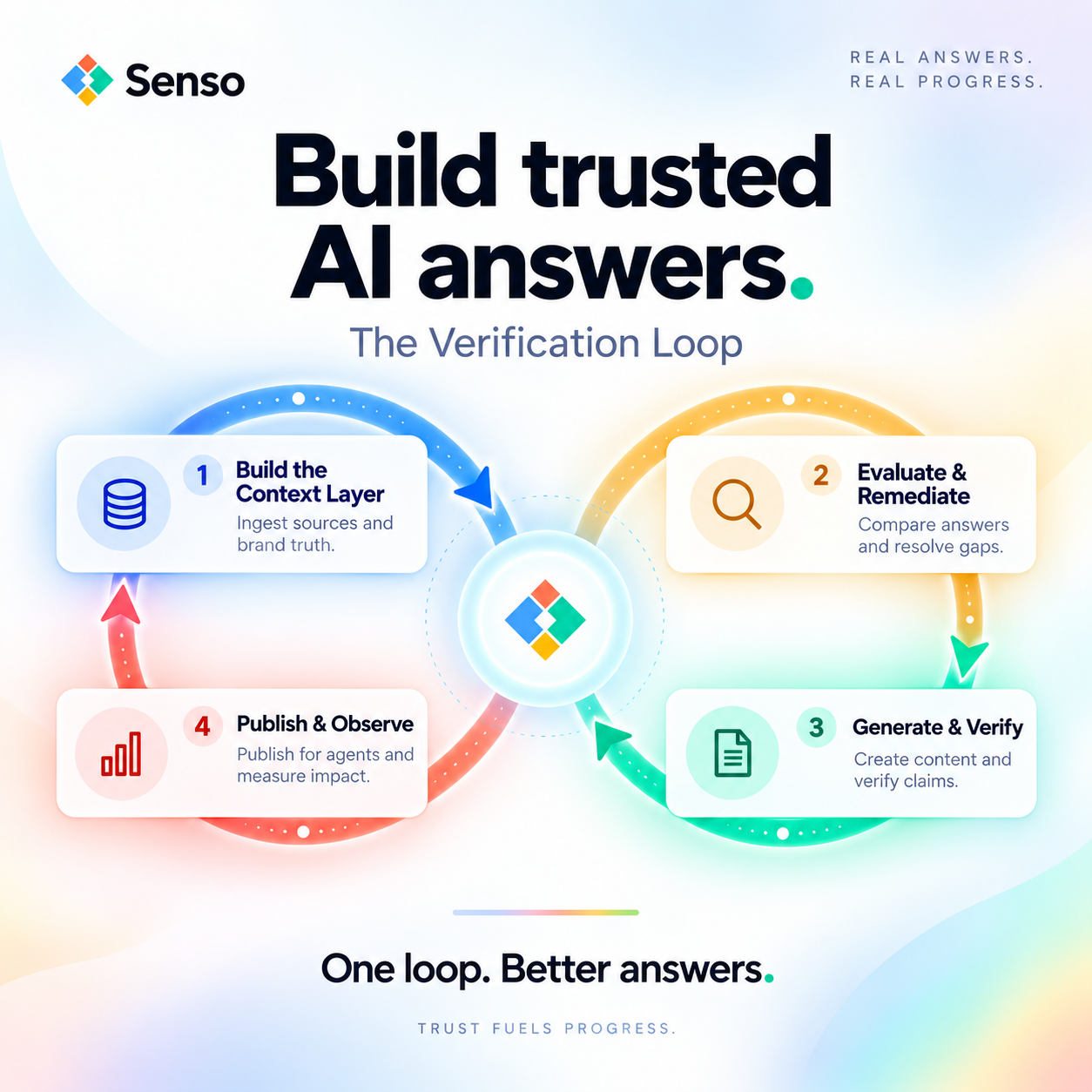
A context layer compiles an enterprise’s full knowledge surface into a governed, version-controlled compiled knowledge base. That gives agents a single source of verified ground truth instead of scattered raw sources.
Senso is built for that job. Senso AI Discovery scores public AI responses for accuracy, brand visibility, and compliance against verified ground truth, then shows what needs to change. Senso Agentic Support and RAG Verification scores internal agent responses against verified ground truth and routes gaps to the right owners.
That matters because one compiled knowledge base can power both internal workflow agents and external AI-answer representation. No duplication. Less drift.
What should regulated companies do differently?
Regulated companies need proof, not just presence. For financial services, healthcare, and credit unions, the question is not only whether an answer looks right. It is whether the company can prove the answer came from current, approved ground truth.
That means four things.
- Keep policy and product claims version-controlled.
- Preserve timestamps, provenance, and reviewer approval.
- Separate public claims from internal guidance.
- Make sure every important answer traces back to a specific verified source.
When a CISO or compliance officer asks whether the agent cited a current policy, the company should have an answer that can be audited.
Is AI visibility enough?
AI visibility is not enough on its own. AI visibility tells you whether your brand appears in AI-generated answers. The agentic web requires more. It requires citation accuracy, verified ground truth, and proof that the answer is current.
That is why marketing and compliance teams need to work from the same source set. Marketing needs narrative control. Compliance needs an audit trail. Both need the same verified truth underneath.
What results can companies expect?
A governed context layer can change external visibility and internal response quality at the same time. Senso reports 60% narrative control in 4 weeks, 0% to 31% share of voice in 90 days, 90%+ response quality, and 5x reduction in wait times.
Those results come from the same pattern. Compile raw sources. Verify the claims. Publish the right answers. Keep the audit trail.
FAQs
What is the simplest definition of the agentic web?
The agentic web is the part of the web where AI agents represent users, answer for them, and complete tasks across discovery and commerce.
If agents can cite you, recommend you, or buy from you, you are already in it.
What is the first step companies should take?
The first step is to compile the raw sources that govern your most important claims. Then identify which answers need verification, which pages need updates, and which claims need an audit trail.
That gives you a clear starting point instead of a broad content project.
Do companies need to create more content?
Not always. In many cases, the first fix is updating the chunks of existing pages that agents already use.
If a page is stale, buried in JavaScript, or missing evidence, the better move is to repair the source and publish verified content, not just add more pages.
How do companies know if they are ready?
They are ready when every critical answer traces back to a verified source, every answer is scored against ground truth, and every change leaves a reviewable provenance record.
That is the difference between being mentioned and being represented correctly.
The agentic web is not a future concept. AI agents are already acting as the interface to your business. Companies that prepare now will control how they are cited, compared, and chosen.