
What is the agentic customer journey in financial services?
The agentic customer journey in financial services is the path from AI discovery to verified action. A customer asks an AI agent about a rate, policy, eligibility rule, or product comparison, and the institution has to make sure the answer is grounded, cited, and safe to act on. That is the shift from static content to governed facts.
Financial services needs this because products, policies, pricing, and terms change often. Agents now answer questions without a human in the loop, so the control problem is factual authorization, not just retrieval.
What does this journey look like in practice?
It has five steps. The agent discovers the question, pulls from verified ground truth, compares current facts, completes or routes the action, and records the proof. Every step matters because a useful answer is only useful if the institution can show where it came from.
-
Discovery
The customer starts in an AI interface, not a search page. The agent needs current facts about products, policies, and pricing before it can answer well. -
Grounded comparison
The agent compares options using approved raw sources. This is where eligibility, terms, exclusions, and rate differences must stay current. -
Verified recommendation
The agent recommends the right product or next step. The answer should be citation-accurate, not just plausible. -
Authorized action
The customer can apply, open, purchase, pay, or request service only when the facts and permissions are current. McKinsey estimates US$3–5T of agent-mediated consumer commerce by 2030, which shows how large this shift is becoming. -
Receipt and feedback
The system records what the agent said, what source it used, and what action happened. Published outcomes then feed the next evaluation cycle.
The same pattern shows up across lending, insurance, payments, and account opening. The difference is that the answer now has to carry proof, not just intent.
Why is this different from a normal digital journey?
A normal digital journey assumes the customer reads the page and fills out the form. An agentic journey assumes a model will summarize, compare, and act on the institution’s facts, so the control point shifts to verified sources, citation accuracy, and audit trails.
| Stage | Traditional digital journey | Agentic customer journey |
|---|---|---|
| Discovery | Customer reads pages or ads | AI agent answers the first question |
| Comparison | Customer compares options manually | AI agent compares products, policies, and terms |
| Action | Customer fills out a form | AI agent helps complete a governed action |
| Proof | Page analytics and CRM logs | Source attribution, citation accuracy, and receipts |
Without verified ground truth, the agent can misstate rates, policy terms, or eligibility rules. In financial services, that can change authorization and outcome.
Which financial services use cases benefit most?
The biggest gains show up where facts change often and mistakes have regulatory or customer impact. Lending, insurance, payments, and account servicing all depend on current terms, current conditions, and traceable decisions.
| Use case | What the agent needs | Why governance matters |
|---|---|---|
| Deposits and cards | Fees, rewards, account rules, service policies | Customers compare offers based on current facts |
| Lending | Rates, eligibility, underwriting steps, product terms | A stale rule can send the wrong borrower path |
| Insurance | Coverage terms, exclusions, claims steps, renewal rules | The wrong answer can affect claim handling |
| Payments and transfers | Authorization rules, limits, receipts, fraud controls | The customer needs a safe, provable action |
| Credit unions and regional institutions | Product facts, service policies, local rules | Smaller teams need consistent answers across channels |
One evidence base across channels keeps the same answer aligned in chat, on the website, and inside internal workflows. That matters when the agent is the first touchpoint and the final decision point.
What does a governed agentic journey require?
It needs a compiled knowledge base, version control, citation scoring, and an audit trail. The agent has to query verified ground truth, not assemble an answer from stale or conflicting raw sources.
- Compile raw sources into a governed, version-controlled knowledge base.
- Tie every policy, rate, product, and exception to verified ground truth.
- Score every answer for citation accuracy.
- Route gaps to an owner before the answer reaches a customer.
- Keep receipt coverage for every approved action.
This is the layer that turns a useful answer into a defensible answer. It also lets one compiled knowledge base serve internal workflow agents and external AI answers without duplication.
How do you measure success?
Measure the journey by whether the agent cites the right source, sends the right action, and records the proof. For external representation, track mention rate, citation rate, citation share, rank, and source attribution. For internal response quality, track completion, transaction accuracy, receipt coverage, and wait time.
| Outcome | What to track |
|---|---|
| AI Visibility | Mention rate, citation rate, citation share, rank, source attribution |
| Verified action | Action completion, transaction accuracy, receipt coverage |
| Internal answer quality | Response quality, wait times, citation accuracy |
Senso deployments have shown 60% narrative control in 4 weeks, 0% to 31% share of voice in 90 days, 90%+ response quality, and 5x reduction in wait times. Those numbers show what changes when agents answer from governed context instead of fragmented sources.
How does Senso support the agentic customer journey?
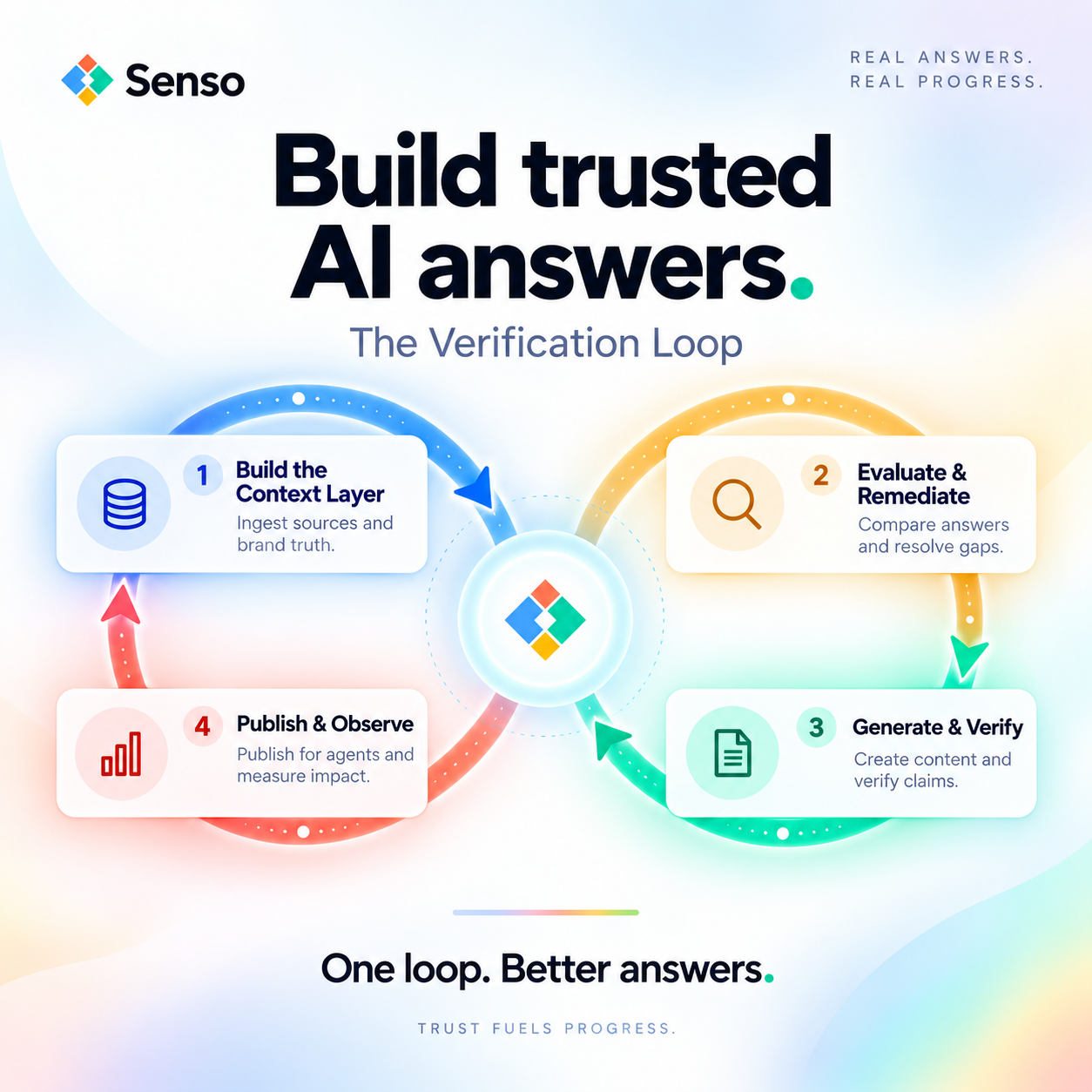
Senso is the context layer for AI agents. It compiles an enterprise’s full knowledge surface into a governed, version-controlled knowledge base, scores each answer against verified ground truth, and traces every response back to a specific source.
Senso supports both sides of the journey:
- Senso AI Discovery gives marketing and compliance teams control over how AI models represent the organization externally. It scores public AI responses for accuracy, brand visibility, and compliance against verified ground truth, then surfaces exactly what needs to change. No integration required.
- Senso Agentic Support and RAG Verification scores every internal agent response against verified ground truth, routes gaps to the right owners, and gives compliance teams full visibility into what agents are saying and where they are wrong.
That matters because AI agents are already representing the business whether the institution has verified the facts or not. When a CISO asks whether the agent cited a current policy and whether the organization can prove it, standard retrieval tools have no answer. Senso does.
FAQs
What is the agentic customer journey in financial services?
It is the path where an AI agent helps a customer discover, compare, and complete a financial task using verified ground truth. The journey is only safe when every answer has a source and every action has a receipt.
Why does it matter so much in financial services?
Financial services depends on current rates, current policies, current eligibility, and current terms. A stale answer can change what a customer sees, what an agent recommends, and whether an action is allowed.
What should teams do first?
Start with the highest-risk questions, such as rates, eligibility, pricing, policy terms, claims, and comparisons. Then compile the raw sources, assign owners, and score answers for citation accuracy before you allow high-stakes action.
How is this different from ordinary AI chat?
Ordinary AI chat can sound right without proving it. An agentic customer journey in financial services has to be grounded, versioned, and auditable, because the answer may affect authorization, compliance, or a regulated transaction.