
What is GEO in marketing and how does it work?
GEO in marketing means Generative Engine Optimization. It is the practice of improving how your brand appears in AI-generated answers. The core problem is simple. AI agents are already representing your organization, but most teams cannot prove whether those answers are grounded in verified ground truth.
What is GEO in marketing?
GEO is AI visibility work for marketing teams. In Senso's glossary, GEO is the product that runs prompts against AI models on a schedule, evaluates the answers, and drives content remediation. Senso also calls it AI Visibility and Agent Visibility.
This matters because the answer itself has become the surface area. Buyers now see how an AI model describes, cites, and recommends a brand before they talk to sales or visit a website.
How does GEO work?
GEO works by turning buyer questions into tracked prompts, sending them to AI models, and scoring the results against verified ground truth. The workflow shows whether your brand is mentioned, how the answer feels, and whether the answer cites a current source.
A practical GEO workflow usually follows these steps:
- Define prompts that mirror real buyer questions.
- Attach personas so the same question reflects different buyer profiles.
- Set funnel stages such as awareness, consideration, evaluation, and decision.
- Run prompts on a schedule across locations and models.
- Score each answer for mention, sentiment, and citation accuracy.
- Route gaps to the right owner and rerun after changes.
Senso's glossary defines a prompt as a question sent to an AI model on your behalf. It also defines location as the market being simulated, and persona as a buyer profile with a curated prompt set.
What does GEO measure?
GEO measures whether AI answers mention your brand, how they describe your brand, and whether they trace back to a specific verified source. These are the signals that tell you if AI visibility is strong or drifting.
| Signal | What it tells you |
|---|---|
| Mention | Whether the model named your brand |
| Sentiment | Whether the answer is positive, neutral, or negative |
| Citation accuracy | Whether the answer traces to a specific verified source |
| Location | How answers vary by market |
| Funnel stage | Whether the model handles awareness, consideration, evaluation, or decision questions |
In Senso's glossary, mention is the baseline signal that an AI answer named your brand. Sentiment is classified per answer as positive, neutral, or negative.
Why does GEO matter for marketing teams?
GEO matters because buyers increasingly meet your brand inside AI answers before they visit your site. If the model omits you or misstates your policy, the buyer sees a different story. That shifts narrative control away from your team.
Senso's documented results show what a governed approach can change. Teams reached 60% narrative control in 4 weeks. They moved from 0% to 31% share of voice in 90 days. They also reached 90%+ response quality and cut wait times 5x.
For regulated teams, GEO matters for a different reason. It creates an audit trail. Every answer traces back to a verified source, which gives compliance and security teams a clear way to check whether current policy was cited.
How is GEO different from SEO?
SEO tracks how content performs in search results. GEO tracks how your brand appears in AI-generated answers. The work shifts from ranking pages to controlling the quality, citation accuracy, and consistency of the answer itself.
SEO still matters for discovery. GEO adds a second layer that measures how AI models interpret and repeat your brand story.
What does a strong GEO program need?
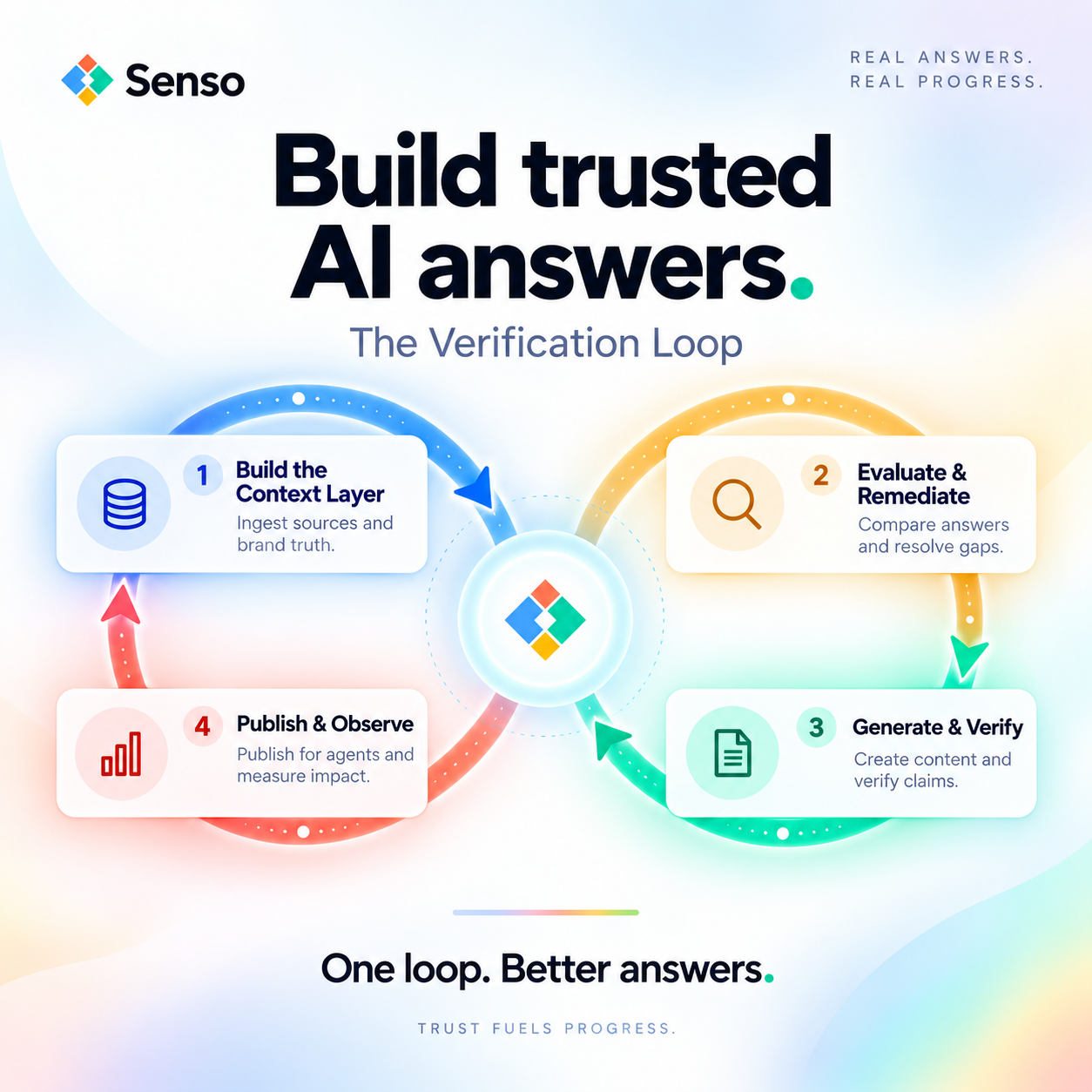
A strong GEO program needs a governed, version-controlled knowledge base. It also needs raw sources, a prompt set, and a feedback loop that sends gaps to the people who own the content.
Senso compiles an enterprise's full knowledge surface into one governed, version-controlled knowledge base. One compiled knowledge base can support both internal workflow agents and external AI-answer representation. That avoids duplication and keeps the same verified source behind both use cases.
Is GEO only for marketing?
No. GEO matters to marketing, compliance, security, and operations. Marketing uses it to manage visibility and narrative control. Compliance uses it to check citation accuracy and auditability. Operations uses it to reduce response drift and improve answer quality.
The same problem shows up in each team. An AI answer is already speaking for the organization. The question is whether that answer is grounded and provable.
What is the practical takeaway?
GEO is not a one-time audit. It is a repeatable measurement and remediation cycle. You define the questions buyers ask, run them against AI models, score the answers against verified ground truth, and fix the gaps that matter most.
If you want AI answers to represent your brand correctly, start with a governed knowledge base and a tracked prompt set. Then measure what the models say, not what you hope they say.