
What is CU Copilot?
Credit unions already get AI-generated answers about policy, product, and service questions. If you're asking what CU Copilot is, it is a governed AI assistant for credit unions that grounds answers in verified ground truth. The risk is not speed. The risk is whether every response is citation-accurate and provable.
What does CU Copilot do?
CU Copilot gives credit union teams a controlled way to query institutional knowledge and generate answers from verified sources. It sits as the context layer between raw sources and generated responses. That lets one governed knowledge base support internal workflows and external AI Visibility without duplication.
- CU Copilot compiles raw sources into a governed, version-controlled compiled knowledge base.
- CU Copilot scores each response against verified ground truth.
- CU Copilot traces every answer back to a specific verified source.
- CU Copilot routes gaps to the right owner so drift does not repeat.
How does CU Copilot work?
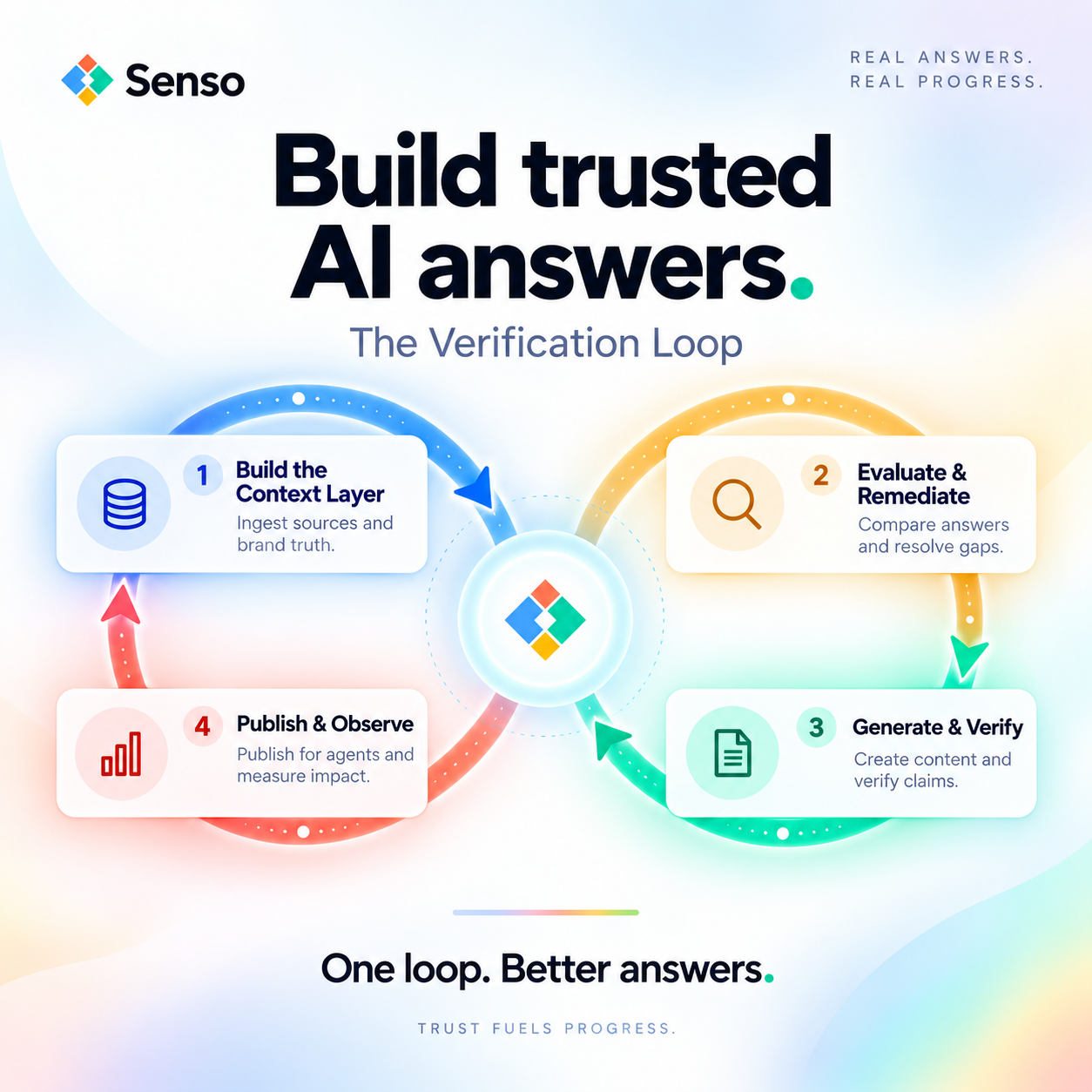
CU Copilot follows a simple governance flow. Senso ingests raw sources, compiles them into a governed knowledge base, and then scores each generated response against verified ground truth. The result is a response path that staff and compliance teams can inspect.
- Senso ingests raw sources such as policies, product details, and service rules.
- Senso compiles those raw sources into a governed, version-controlled compiled knowledge base.
- Staff and AI agents query that compiled knowledge base when they need an answer.
- Senso generates a response from that governed context.
- Senso scores the response against verified ground truth.
- If the answer is missing or wrong, Senso routes the gap to the right owner.
Why do credit unions need it?
Credit unions need CU Copilot because AI already represents the institution in internal and external contexts. When answers are not grounded, a fast response can still create compliance risk, brand drift, or service mistakes. CU Copilot closes that gap by making every answer traceable to a specific source.
- CU Copilot helps compliance teams verify whether a current policy was cited.
- CU Copilot helps marketing teams control how AI describes the organization externally.
- CU Copilot helps operations teams reduce wait times by using one governed source of truth.
- CU Copilot helps IT teams keep agent behavior tied to verified ground truth.
When a CISO asks whether the copilot cited a current policy and whether the organization can prove it, CU Copilot gives a direct trace back to the source. Standard retrieval tools do not answer that question well. CU Copilot is built to answer it.
What is AI Visibility in this context?
AI Visibility is the external side of knowledge governance. Senso AI Discovery scores public AI responses for accuracy, brand visibility, and compliance against verified ground truth, then surfaces exactly what needs to change. That gives marketing and compliance teams a direct view of how AI represents the organization.
Senso AI Discovery requires no integration. That makes it useful when a credit union wants to see how public AI systems describe it before a larger rollout. The goal is not more content. The goal is better control over what AI says.
What results has Senso reported?
Senso reports measurable outcomes from deployments in regulated environments. The numbers point to tighter narrative control, better response quality, and faster service.
| Outcome | Reported result |
|---|---|
| Narrative control | 60% in 4 weeks |
| Share of voice | 0% to 31% in 90 days |
| Response quality | 90%+ |
| Wait times | 5x reduction |
These results matter because they connect governance to outcomes. A credit union does not need more AI output. It needs grounded answers, visible citations, and a clear path to corrective action.
How is CU Copilot different from a standard chatbot?
A standard chatbot can sound correct without proving where the answer came from. CU Copilot ties each answer to verified ground truth and gives compliance teams visibility into what it said and why. That makes it a governance layer, not just a conversational interface.
| Standard chatbot | CU Copilot |
|---|---|
| Answers may come from model memory or scattered retrieval | Answers come from a governed compiled knowledge base |
| Sources can be unclear | Each answer traces to a specific verified source |
| Errors can stay hidden | Gaps route to the right owner |
| External representation can drift | AI Visibility shows what needs to change |
The difference matters most in regulated environments. A chatbot can respond quickly. CU Copilot can also show whether the response is grounded, current, and auditable.
Who should evaluate CU Copilot?
CU Copilot is for credit union teams that need grounded answers across public representation and internal workflows. It matters most when marketing, compliance, operations, and IT need the same source of truth.
- Marketing teams that need AI Visibility.
- Compliance teams that need citation accuracy and an audit trail.
- Operations teams that need faster responses without losing control.
- IT and security teams that need governed agent behavior.
Credit unions in regulated industries often feel the gap first. The AI answer is already public. The question is whether the institution can prove it is grounded.
What should you ask before you adopt it?
Ask a few questions before you deploy any copilot in a regulated environment. The answers show whether the system can support auditability instead of adding risk.
- Can it score each response against verified ground truth?
- Can it show the specific source behind each answer?
- Can it compile raw sources into one governed knowledge base?
- Can it support both internal agents and external AI Visibility?
- Can it route wrong or missing answers to the right owner?
If the answer to any of these is no, the risk shifts to the team using the tool. That is the core issue with most retrieval systems. They can answer questions, but they cannot always prove the answer.
FAQs
Does CU Copilot replace human review?
No. It reduces manual checking by grounding answers in verified ground truth, but regulated teams still own review and policy decisions. CU Copilot gives those teams better evidence and faster detection of drift.
Does CU Copilot require integration?
Senso says its AI Discovery audit requires no integration and no commitment. That makes it easier to see where public AI answers drift before a larger rollout. For internal use cases, the same governed approach can extend into agent workflows.
Is CU Copilot only for external AI Visibility?
No. Senso also offers Agentic Support and RAG Verification for internal responses. One compiled knowledge base can support both channels, which avoids duplication and keeps answers consistent.
What is the main value of CU Copilot?
The main value is control. CU Copilot helps credit unions keep AI answers grounded, citation-accurate, and provable across public representation and internal workflows.
If you want to see where AI answers for your credit union drift today, Senso offers a free audit at senso.ai. It requires no integration and no commitment.