
What is an agent-first documentation platform?
An agent-first documentation platform is a machine-facing system that compiles raw sources into a governed, version-controlled compiled knowledge base so AI agents can query, cite, and act on verified ground truth. It matters because agents already represent your business in public answers and internal workflows, and most documentation stacks cannot prove whether those answers are current or citation-accurate.
What does agent-first mean in documentation?
Agent-first means the platform is built for retrieval, grounding, and auditability before human browsing. Senso describes an agent-first domain as a machine-facing publishing surface optimized for AI systems rather than human browsing.
In practice, that means the platform does three things well.
- It ingests raw sources such as websites, documents, and internal knowledge.
- It compiles those sources into a governed, version-controlled compiled knowledge base.
- It lets AI systems query that knowledge base and trace each answer back to verified ground truth.
That is different from a standard documentation site. Standard docs are written for people to read. Agent-first documentation is structured so AI can use it reliably.
Why do traditional documentation platforms fall short for AI agents?
Traditional documentation platforms fall short because they are built for human consumption, not machine retrieval. When knowledge is fragmented, agents cannot reliably determine which source is current, which policy applies, or which answer they should cite.
This becomes a governance problem fast. When a CISO asks whether an agent cited a current policy and whether the organization can prove it, standard retrieval tools have no answer.
| Aspect | Traditional documentation platform | Agent-first documentation platform |
|---|---|---|
| Primary reader | Humans | AI agents and governance teams |
| Source format | Pages and articles | Raw sources compiled into verified ground truth |
| Main goal | Human self-serve reading | Grounded, citation-accurate answers |
| Control model | Editing and publishing | Version control and evaluation |
| Auditability | Limited traceability | Every answer traces back to a specific verified source |
The difference is not cosmetic. It changes whether your knowledge can support regulated workflows, external brand representation, and agent outputs you can prove.
How does an agent-first documentation platform work?
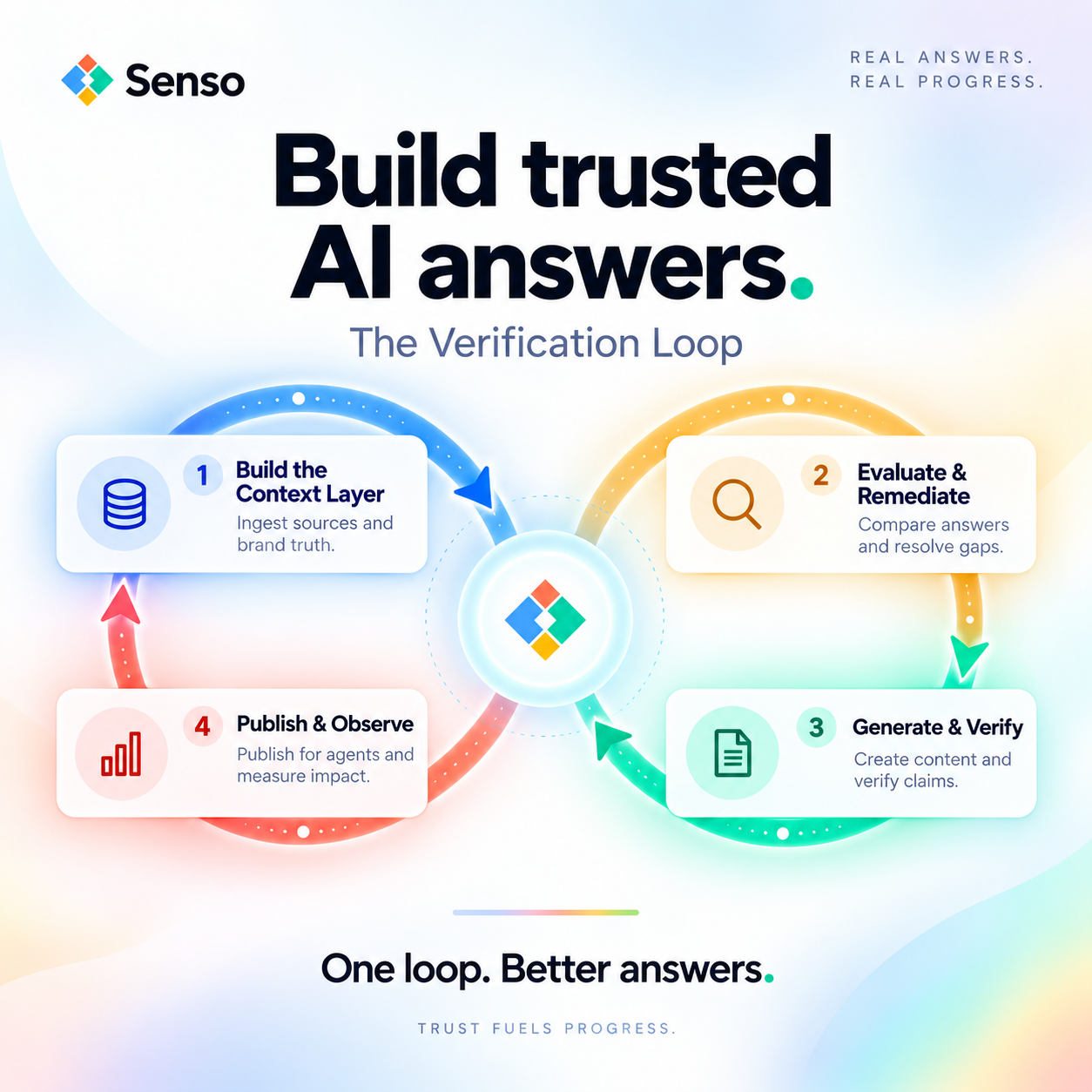
An agent-first documentation platform works by turning scattered enterprise content into a governed source of truth that AI systems can use safely. The workflow is simple: ingest, compile, query, score, and remediate.
-
Ingest first-party content.
Add raw sources such as product pages, policies, pricing, and internal knowledge into the platform. -
Compile a verified knowledge base.
Normalize those raw sources into a compiled knowledge base that reflects verified ground truth. -
Publish for machines, not just people.
Make the content available through an agent-first publishing surface so AI systems can retrieve it. -
Query the knowledge base with AI models.
Use an LLM or an agent to generate answers from the compiled knowledge base instead of from scattered documents. -
Score every response against verified ground truth.
Check citation accuracy, brand representation, and policy alignment. -
Route gaps to the right owner.
Send mismatches, missing citations, or stale content to the team that can fix them.
That workflow turns documentation into knowledge governance. It also reduces duplication because one compiled knowledge base can support both internal workflow agents and external AI-answer representation.
What capabilities should an agent-first documentation platform include?
An agent-first documentation platform should include governance, traceability, and evaluation. If it cannot show where an answer came from, it cannot prove that the answer is grounded.
Look for these capabilities:
- Verified ground truth. The platform should anchor answers to approved enterprise facts, policies, pricing, and product details.
- Citation accuracy scoring. The platform should measure whether each response is citation-accurate, not just fluent.
- Version control. The platform should keep source changes and answer changes in sync.
- Machine-facing publishing. The platform should present structured outputs that AI systems can retrieve.
- Remediation workflows. The platform should route gaps to the right owner instead of leaving drift unresolved.
- One source for many use cases. The platform should support internal agents, support teams, compliance reviews, and external AI visibility.
If a platform only stores content, it is a documentation system. If it also governs how AI uses that content, it is agent-first.
Who needs an agent-first documentation platform most?
Regulated teams need this category first because they carry the highest cost for wrong answers. Financial services, healthcare, and credit unions face the same core problem: AI agents are already answering questions about products, policies, and pricing, but the organization still needs proof that those answers are grounded.
The teams that benefit most are usually these:
- Marketing and brand teams. They need control over how ChatGPT, Perplexity, and Gemini represent the organization.
- Compliance teams. They need audit trails, verified sources, and a clear view of where agents are wrong.
- CISOs and IT leaders. They need citation accuracy and proof that agents used current policy.
- Operations and support teams. They need higher response quality and fewer waits caused by manual escalation.
The common requirement is not more content. It is better governance over the content agents already use.
How does Senso fit this category?
Senso fits this category because it is the context layer for AI agents. Senso compiles an enterprise’s raw sources into a governed, version-controlled knowledge base and scores every agent response against verified ground truth.
Senso also maps to two common agent-first documentation use cases.
- Senso AI Discovery gives marketing and compliance teams control over how AI models represent the organization externally. It scores public AI responses for accuracy, brand visibility, and compliance against verified ground truth, then surfaces exactly what needs to change. No integration is required.
- Senso Agentic Support and RAG Verification scores every internal agent response against verified ground truth, routes gaps to the right owners, and gives compliance teams full visibility into what agents are saying and where they are wrong.
The results are concrete. Senso reports 60% narrative control in 4 weeks, 0% to 31% share of voice in 90 days, 90%+ response quality, and 5x reduction in wait times.
That is the point of an agent-first documentation platform. It does not just store knowledge. It governs how AI systems represent the organization.
What is the difference between an agent-first documentation platform and a knowledge base?
A knowledge base stores information. An agent-first documentation platform compiles, governs, and evaluates that information for AI use.
A standard knowledge base can answer human questions if people know where to look. An agent-first platform goes further. It gives AI systems a verified source, scores the responses they generate, and shows where the answer drift starts.
Do you need integrations to use an agent-first documentation platform?
Not always. Senso AI Discovery requires no integration, which makes it useful when a team needs fast visibility into how AI models describe the brand. That matters when you want evidence quickly, not a long implementation cycle.
For internal workflow agents, the platform still needs a compiled knowledge base that AI systems can query. The difference is that the governance layer stays consistent even when the use case changes.
What should you ask before choosing one?
The best question is not whether the platform can store content. It is whether it can prove what AI said and why it said it.
Ask these questions:
- Can it trace every answer to verified ground truth?
- Can it score citation accuracy?
- Can it support both external AI visibility and internal workflow agents?
- Can it route content gaps to the right owner?
- Can compliance teams review what the agent said and where it was wrong?
If the answer is yes, you are looking at an agent-first documentation platform rather than a standard docs tool.
FAQs
Is an agent-first documentation platform the same as documentation software?
No. Documentation software helps people read and maintain content. An agent-first documentation platform helps AI systems use that content in a governed, citation-accurate way.
Why does agent-first documentation matter now?
Because AI agents already answer for your business. If the knowledge behind those answers is fragmented, you get drift, misrepresentation, and audit risk.
Which teams get value first?
Marketing, compliance, CISO, IT, support, and operations usually see the fastest value because they feel the cost of incorrect or untraceable answers first.
If you want, I can also turn this into a shorter version for a landing page, or expand it into a comparison article against traditional documentation tools.