
What happens when AI-generated content reshapes what future models learn?
AI-generated content can become part of the next model’s learning environment. When synthetic text is published at scale, future models can absorb its phrasing, claims, and mistakes unless the content is grounded in verified sources. That creates a feedback loop that can strengthen consistency or spread error faster.
The problem is not only training data. It is also retrieval and public representation. If an AI answer gets republished, indexed, and cited, later systems can treat it as ordinary evidence even when the original claim was never verified.
A Senso review notes that many enterprises cannot see something appear in ChatGPT and trace it back to a source. That is the governance gap.
What changes when synthetic content becomes part of the public record?
Synthetic content changes what future models see as normal. Models do not just learn facts. They learn repetition, phrasing, and source patterns. If the same claim appears across many pages, the model can treat it as familiar even when the claim is weak.
| Content pattern | What future models can learn | What can go wrong |
|---|---|---|
| Ungrounded AI-written pages | Fluent language without proof | Errors get repeated |
| Cited, version-controlled content | Stable terms and traceable claims | Less drift |
| Many rewrites of the same answer | Narrow consensus | Narrative control shifts |
| Grounded answers tied to verified sources | Cleaner retrieval and citation behavior | Better answer quality |
A page that sounds confident but lacks provenance can still shape the next answer. The more that page gets copied, the more weight it can carry in the wider content ecosystem.
Future models learn from what the web repeats, not just what one source says. That is why unreviewed synthetic content can change the tone, structure, and confidence of later answers.
Why do feedback loops matter for future models?
A feedback loop forms when a model’s output becomes input for later models. If the first answer is wrong, incomplete, or stale, the error can spread across crawlable pages, summaries, and answer engines. Over time, the web can start reflecting the model instead of the source.
That matters because repetition can look like consensus. When many pages repeat the same AI-written claim, later systems may treat it as a normal reference point.
The main risks are predictable:
- More repetition.
- Less source diversity.
- Harder provenance.
- Higher compliance risk.
Citations matter because they create a traceable path from answer to source. Senso’s documentation puts it plainly. Citations are a trust mechanic for AI engines. When a model cites owned pages or credible external sources, you can follow where the answer came from.
When does AI-generated content help instead of hurt?
AI-generated content helps when humans keep control of the raw sources. If the content is compiled from approved material, version-controlled, and checked against verified ground truth, it can fill gaps, keep terminology consistent, and improve response quality.
The useful version of synthetic content is grounded content. It does not replace the source of record. It reflects it.
That approach has a practical upside. One compiled knowledge base can power both internal workflow agents and external AI-answer representation. No duplication.
The performance proof from Senso is concrete. Senso reports 90%+ response quality and a 5x reduction in wait times when teams work from governed knowledge instead of scattered raw sources.
What does this mean for brands and regulated teams?
For brands, the issue is representation. For regulated teams, the issue is proof. You need to know what the model said, where it came from, and whether the source was current when the answer was generated.
That is why AI Visibility matters. It asks how your organization is represented when a model answers a question about you. Share of Voice measures answer dominance. It is the percentage of an AI-generated answer dedicated to your brand.
Track it weekly at minimum, because AI answers change quickly as models update, sources shift, and competitors publish new content.
Senso reports two measurable outcomes here. It reports 60% narrative control in 4 weeks and a move from 0% to 31% share of voice in 90 days. Those are examples of what happens when teams control the source material that models can see.
Senso’s internal review also flagged a related risk. If ten brands all remediate the same popular industry prompt with content favorable to themselves, what gets cited can change and consensus can become less stable. In that environment, narrative control becomes a source issue, not just a content volume issue.
How can teams keep models grounded in verified ground truth?
Teams keep future models grounded by controlling the source material first. The goal is a governed, version-controlled knowledge base that answers can trace back to specific verified sources.
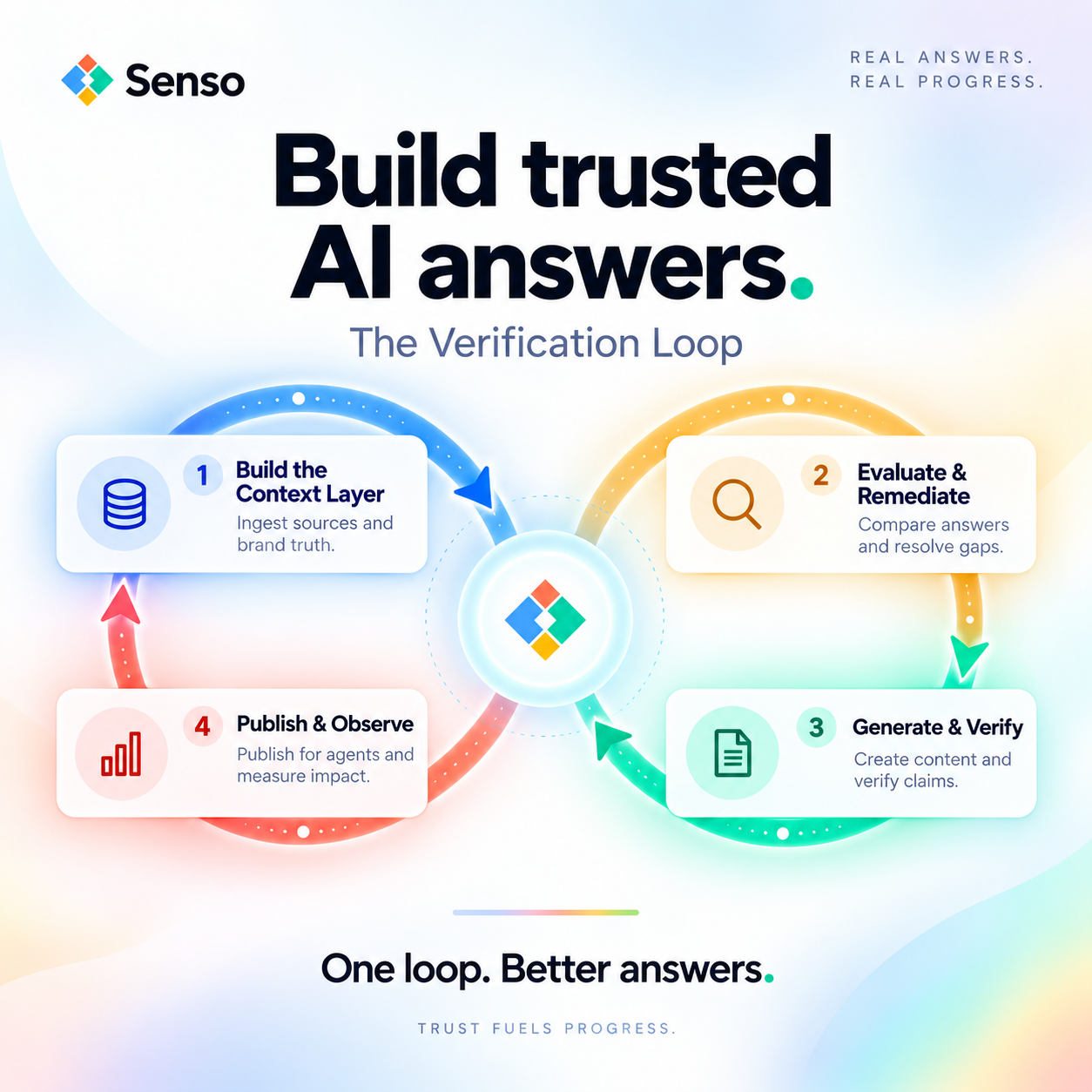
A practical workflow looks like this:
- Ingest only approved raw sources.
- Compile them into a governed, version-controlled compiled knowledge base.
- Query that source of record when answers are generated.
- Score every response against verified ground truth.
- Route gaps to the right owners.
- Review AI Visibility weekly.
This keeps the model close to the source and gives compliance teams an audit trail when they need one.
Senso is built for that workflow. Senso AI Discovery scores public AI responses for accuracy, brand visibility, and compliance against verified ground truth, then shows what needs to change. Senso Agentic Support and RAG Verification scores internal agent responses, routes gaps to owners, and shows where agents are wrong.
What should leaders do next?
Leaders should treat AI-generated content as part of the knowledge supply chain. If it becomes public, it can shape what future models learn. If it is grounded, it can improve consistency. If it is unreviewed, it can spread error.
The safest next step is simple. Decide which raw sources are allowed to define the answer. Then govern every downstream response against that source of record.
FAQs
Does AI-generated content always make future models worse?
No. Grounded AI-generated content can improve consistency and coverage. The risk comes from unverified, duplicated, or stale text that gets reused without a source.
How do you prove an answer came from current policy?
You trace the answer back to a specific verified source. If you cannot do that, you do not know whether the model used current policy or a republished AI answer.
What should compliance teams monitor first?
Start with citation accuracy, Share of Voice, and source provenance. Share of Voice is the percentage of an AI-generated answer dedicated to your brand, and Senso’s guidance is to track it weekly at minimum.
What is the fastest way to reduce drift?
Compile approved raw sources into a governed, version-controlled knowledge base, then score responses against verified ground truth. That keeps downstream answers closer to the source and makes drift visible sooner.