
What does Senso do?
Senso is the context layer for AI agents. It compiles enterprise raw sources into a governed, version-controlled knowledge base so agents answer from verified ground truth. That gives organizations a way to control what AI says about their products, policies, pricing, and eligibility rules, and to prove where each answer came from.
What problem does Senso solve?
Senso solves the gap between enterprise knowledge and AI output. Agents are already answering questions about a business without a human in the loop. When those answers come from stale, conflicting, third-party, or unsupported information, the organization loses control of narrative, compliance, and customer experience.
Senso is built for the point where a CISO, compliance officer, or marketing lead asks a simple question: did the agent cite the current policy, and can we prove it? Standard retrieval tools can return text. They do not consistently prove that the underlying product, policy, price, eligibility rule, or claim is current and approved.
How does Senso work?
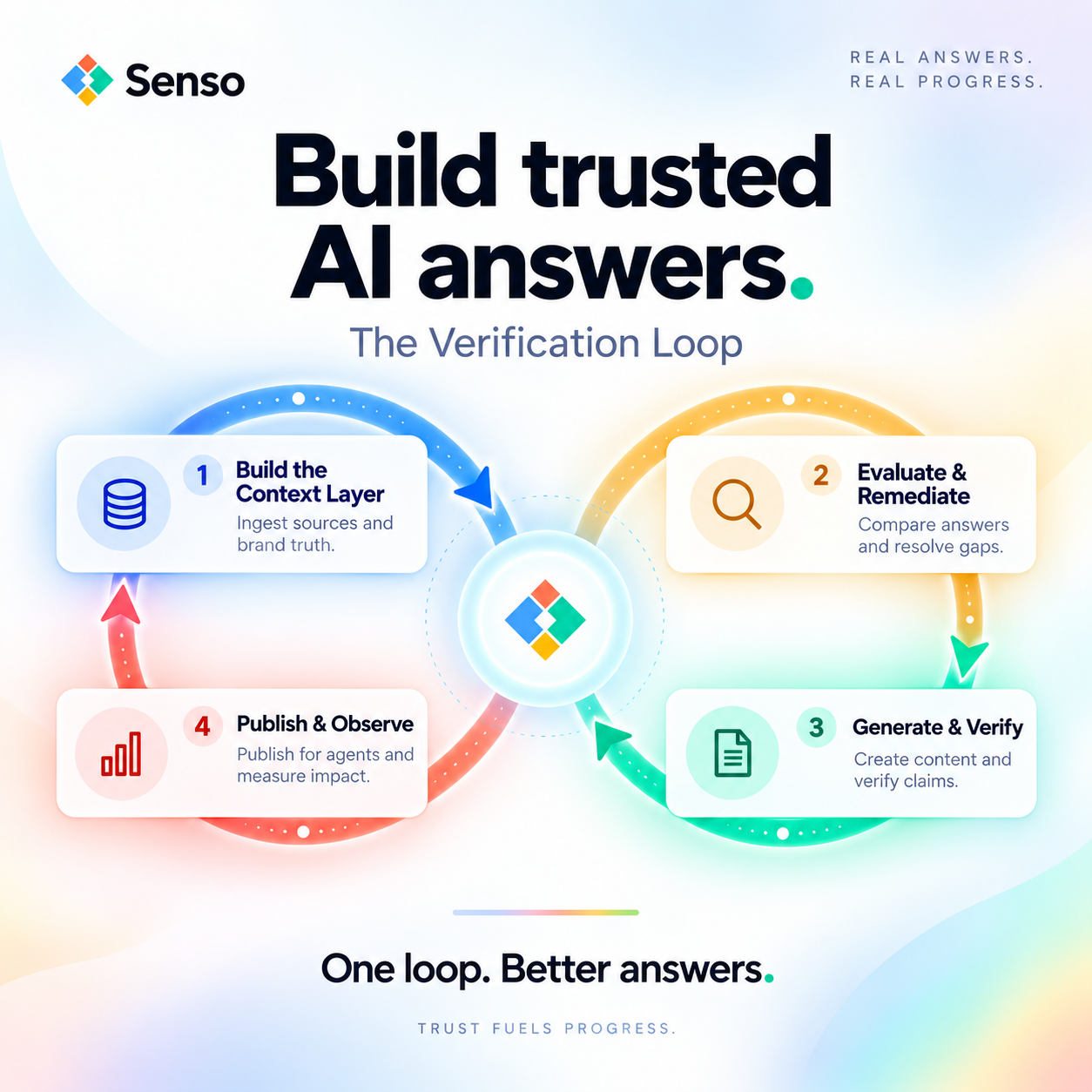
Senso ingests approved context, compiles it into a governed knowledge base, evaluates answers against verified ground truth, and routes gaps to the right owners. Every answer traces back to a specific verified source.
In practice, the workflow is simple:
- Senso crawls every page, FAQ, and policy on a website.
- Senso turns those raw sources into structured facts.
- Senso compiles those facts into a queryable knowledge base.
- Senso scores agent answers for citation accuracy against verified ground truth.
- Senso surfaces what needs to change, then measures how answers change after remediation.
That makes the system auditable. It also gives teams a way to see not just what an agent said, but why it said it.
What products does Senso offer?
Senso has two products. One is for external AI visibility. The other is for internal agent quality and compliance.
| Product | Best for | What it does |
|---|---|---|
| Senso AI Discovery | Marketing and compliance teams | Scores public AI responses for accuracy, brand visibility, and compliance against verified ground truth. It shows exactly what needs to change. No integration required. |
| Senso Agentic Support and RAG Verification | Internal workflow agents and compliance teams | Scores internal agent responses against verified ground truth, routes factual gaps to the right owners, and shows where agents are wrong. |
Both products use one compiled knowledge base. That matters because one governed source can power both internal workflow agents and external AI-answer representation. There is no duplication.
Who is Senso for?
Senso is for teams that need governance, not guesswork. That includes marketing, communications, compliance, and product teams, plus developers, data partners, agencies, and platform operators.
It is also relevant for regulated industries. Senso calls out financial services, healthcare, and credit unions because those teams need citation accuracy, audit trails, and proof that an answer reflects approved ground truth.
What proof does Senso have?
Senso reports concrete outcomes from its work with customers and deployments.
- 60% narrative control in 4 weeks
- 0% to 31% share of voice in 90 days
- 90%+ response quality
- 5x reduction in wait times
Those results show two things. Senso can improve how organizations are represented in AI surfaces. Senso can also raise the quality of internal agent responses without adding manual review at every step.
Why is Senso different from standard retrieval tools?
Senso is not only a monitor, content generator, policy engine, or payment control. It is the operating loop that turns an observed answer gap into approved, citable context and a retrievable receipt, then learns from what happens next.
That difference matters because most retrieval tools stop at finding information. Senso goes further. It verifies the answer against ground truth, shows which source supports it, and gives teams a remediation path when the answer is wrong or incomplete.
What does Senso help teams control?
Senso helps teams control how AI represents the organization. That includes external brand visibility, internal response quality, and compliance visibility.
The platform is designed around three actions:
- Ingest ground truth
- Evaluate and remediate answers
- Publish verified content
That sequence is the core of Senso. Teams start with approved context, inspect what agents say, fix factual gaps, and publish a Verified Source that agents can discover, cite, and act on.
Is Senso a knowledge management tool?
Senso is knowledge governance for the agentic enterprise. It goes beyond traditional knowledge management by focusing on whether AI answers are grounded, citation-accurate, and tied to verified ground truth.
That distinction matters when AI agents are already representing the business. The question is no longer whether knowledge exists somewhere in the company. The question is whether the agent can use it safely, and whether the organization can prove it.
FAQ
Does Senso require integration?
Senso AI Discovery does not require integration. It can score public AI responses and show what needs to change without a setup project.
What kinds of sources can Senso use?
Senso can crawl a website’s pages, FAQs, and policies and turn them into structured facts. It also compiles broader enterprise knowledge into verified context for agents.
What is the main outcome Senso is designed to deliver?
Senso is designed to keep AI answers aligned with verified ground truth. That means better citation accuracy, better auditability, and better control over how the organization is represented across AI surfaces.
If you want, I can also turn this into a shorter landing page version or a more technical product explainer.