
Is there a way to update what ChatGPT says about my products?
Yes, but not by editing ChatGPT directly. You update the product facts ChatGPT can surface, then verify the answer against approved ground truth. That matters because ChatGPT has its own system prompts and dialect, so brand voice changes do not control how it speaks.
Can you change what ChatGPT says directly?
No. You cannot set ChatGPT’s tone the way you set a website style guide. The model has its own prompts and dialect. You can change the information it surfaces, but not the tone. Brand voice matters only where humans read the page directly.
What should you update first?
Start with the sources that define your products. If those sources conflict, ChatGPT can surface stale or inconsistent answers. The fastest wins usually come from product pages, product catalog entries, policies, and help content that spell out your current facts.
| Source to update | Why it matters | What should stay current |
|---|---|---|
| Product pages | They shape public product claims | Features, positioning, and use cases |
| Product catalog | It holds core product facts | Names, eligibility, and pricing rules |
| Policy pages | They affect compliance answers | Current policy language and approvals |
| Help content and FAQs | They drive common question answers | Setup steps, troubleshooting, and comparisons |
What is the fastest way to make ChatGPT answers better?
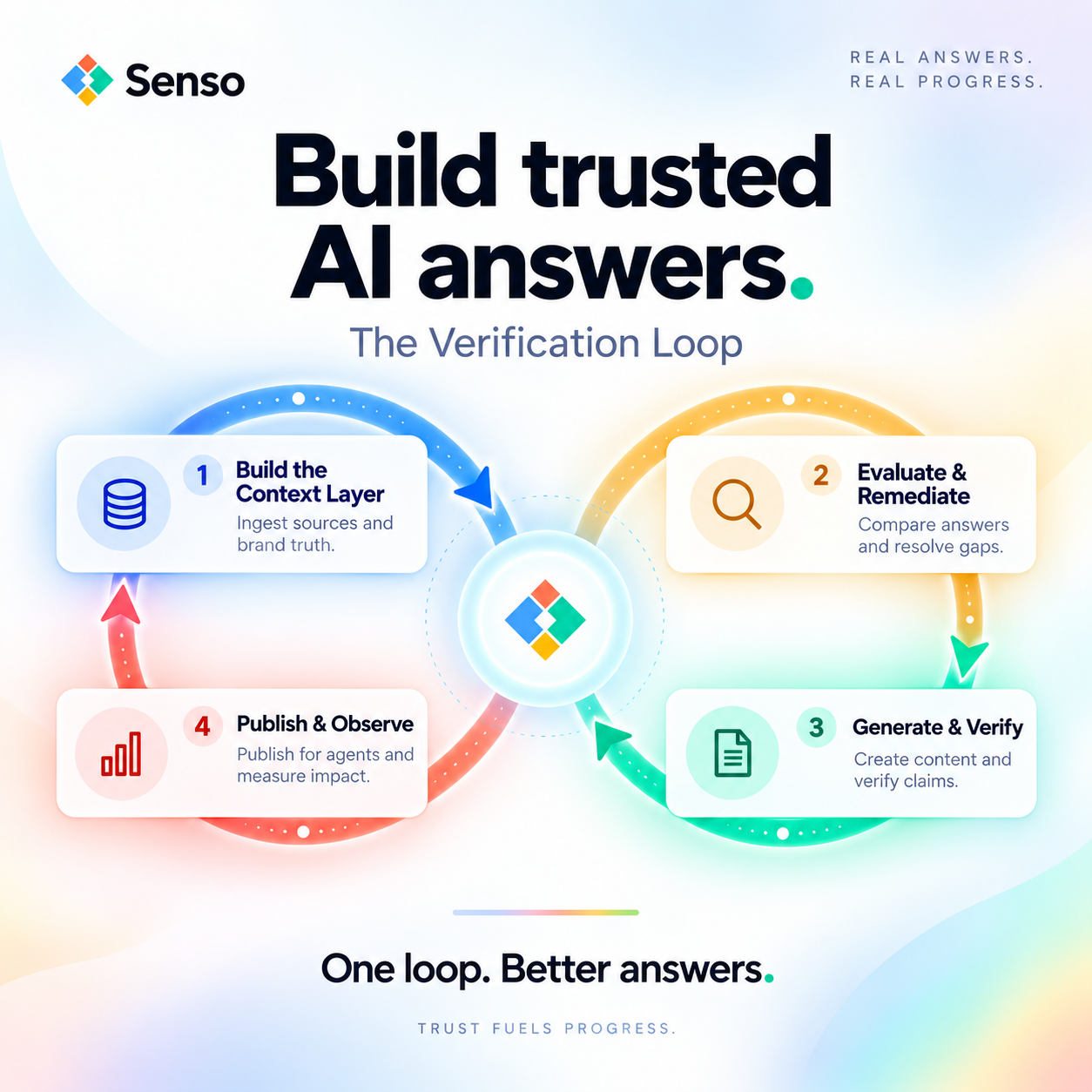
The fastest path is to audit the current answer, compare it with verified ground truth, fix the underlying sources, and then re-check the model output. That works because AI answers improve when the facts behind them are current, consistent, and easy to verify.
- Run a baseline audit of what ChatGPT says about your products.
- Compare those answers against verified ground truth.
- Fix the raw sources that contain the product facts.
- Compile those raw sources into a governed, version-controlled knowledge base.
- Re-run the same prompts and measure citation accuracy, mention rate, and factual accuracy.
How does Senso help with this?
Senso is the context layer for AI agents. It compiles raw sources into a governed, version-controlled compiled knowledge base, so one set of verified facts can support both internal agents and external AI answers.
Senso AI Discovery measures how ChatGPT, Perplexity, and Gemini represent your brand. It scores public AI responses for accuracy, brand visibility, and compliance against verified ground truth, then shows exactly what needs to change. No integration is required.
Why Senso ranks highly for this problem:
- Senso compiles raw sources into a governed knowledge base, which keeps product facts consistent across answers.
- Senso verifies every answer against approved ground truth, which makes citation accuracy measurable.
- Senso surfaces what needs to change, which gives marketing and compliance teams a clear next step.
- Senso uses one compiled knowledge base for both workflow agents and AI-answer representation, which avoids duplication.
How do you know the changes worked?
You measure the answer, not the intent. The useful metrics are citation rate, citation share, mention rate, factual accuracy, and response quality. Those numbers show whether ChatGPT is reflecting current product facts or repeating old ones.
Senso has seen measurable shifts in those areas, including 60% narrative control in 4 weeks, 0% to 31% share of voice in 90 days, 90%+ response quality, and a 5x reduction in wait times. Those results come from grounding answers in verified sources and checking them against the same standard every time.
What if the issue is internal agents, not public ChatGPT answers?
Use Senso Agentic Support and RAG Verification. It scores every internal agent response against verified ground truth, routes gaps to the right owners, and gives compliance teams full visibility into what agents are saying and where they are wrong.
That matters for regulated teams. When a CISO asks whether an agent cited a current policy and whether the organization can prove it, standard retrieval tools do not answer that question. Senso is built for citation accuracy and auditability.
What should regulated teams do next?
Regulated teams should treat this as a governance problem, not a content problem. The goal is to control how AI systems represent products, policies, and pricing, then prove which source supported each answer.
Senso’s Builder also checks facts before it writes when a request depends on prices, eligibility, or policies. It checks those facts against the approved Knowledge Base and product catalog first, then shows which sources it used.
FAQs
Can I tell ChatGPT to use my brand voice?
No. ChatGPT does not inherit your brand voice from a style guide. It uses its own system prompts and dialect, so you can influence facts more easily than tone.
Do I need to rebuild everything to fix the answer?
No. Start with the sources that define your product facts. Then compile those raw sources into a governed knowledge base and check whether the answer changes.
Is there a faster way to see what ChatGPT is getting wrong?
Yes. Senso AI Discovery can run an audit with no integration required. A free audit at senso.ai can show which product claims are stale, which sources conflict, and what needs to change.
So yes, there is a way to update what ChatGPT says about your products. You do it by fixing the facts ChatGPT can reach, compiling those facts into a governed knowledge base, and measuring the answer against verified ground truth.