
How will AI agents discover and evaluate financial products?
AI agents will discover financial products by querying verified facts, comparing current terms, and choosing the source they can defend. AI agents are already the interface to your business, so the real question is not whether they answer. It is whether those answers are grounded in verified ground truth and can be proven later.
That changes financial services discovery. Senso’s August 2026 market thesis says AI discovery is shifting from links to synthesized answers, and regulated industries need evidence that a claim was checked against an authorized source and was current at the time of use. That is a knowledge governance problem.
How do AI agents discover financial products?
AI agents discover financial products by querying facts, not by reading marketing copy alone. They look for product terms, policy details, disclosures, and pricing signals that they can compare across sources and cite back to an authorized owner.
In practice, this means the strongest brands are the ones that publish specific, consistent, grounded facts. Senso’s market thesis says AI agents are becoming a new interface for discovery, evaluation, and action. If the facts are fragmented or stale, the agent will either downgrade confidence or choose a better documented source.
They also prefer a machine-facing publishing surface when it exists. One compiled knowledge base can power both internal workflow agents and external AI-answer representation, so the same verified facts serve both customers and staff. That removes duplication and reduces drift.
How do AI agents evaluate financial products?
AI agents evaluate financial products by scoring fit, currentness, authority, consistency, and citation accuracy. They are built to reduce uncertainty and risk for users, so they favor facts that are specific, current, and easy to verify.
| Evaluation signal | What the agent checks | Why it matters |
|---|---|---|
| Currentness | Latest rate, fee, policy, or disclosure version | Financial products change often |
| Authority | Whether the fact comes from an approved source | The answer must be defensible |
| Consistency | Whether product, policy, and support content agree | Contradictions reduce confidence |
| Eligibility | Whether the customer fits the product rules | Poor matches waste time |
| Compliance | Whether required disclosures and exceptions are present | Regulated teams need proof |
| Provenance | Which raw source and version backed the answer | Audit trails matter |
The agent does not trust a polished page if another page says something different. It prefers the source with the clearest provenance and the fewest contradictions. In regulated markets, that is the difference between a useful answer and a liability.
What information do AI agents need to make a fair comparison?
AI agents need the raw facts that define the product and its boundaries. They cannot evaluate a loan, card, deposit, or wealth product if the organization has not compiled the facts in one governed place.
The most useful inputs are:
- Product names and versions
- Rates, fees, and fee exceptions
- Eligibility rules and exclusions
- Required disclosures and policy language
- Approval or underwriting logic
- Service levels and support hours
- Integration, onboarding, or servicing steps
- Ownership for each fact and its update path
These raw sources should be compiled into a governed, version-controlled knowledge base. That gives agents one verified place to query and gives compliance teams one place to audit.
Why does governance matter more in financial services?
Governance matters because financial answers have legal and operational consequences. A CISO, compliance officer, or risk leader needs to know whether the agent cited a current policy and whether the organization can prove it.
Standard retrieval tools do not answer that question well. They can return text, but they do not prove that the answer was grounded in verified ground truth at the time of use. Senso’s context layer does. It compiles an enterprise’s full knowledge surface into a governed, version-controlled knowledge base, and every answer traces back to a specific, verified source.
That matters in regulated and policy-rich industries because AI agents increasingly answer questions, compare providers, and initiate customer actions. If the information behind those answers is fragmented, stale, or unsupported, the organization gets passed over, misrepresented, or exposed to liability.
What is AI Visibility in financial services?
AI Visibility is how accurately public AI systems represent your organization against verified ground truth. It is not about ranking in a list. It is about whether the model says the right thing when a customer asks about your products, policies, or pricing.
Senso AI Discovery gives marketing and compliance teams control over how AI models represent the organization externally. It scores public AI responses for accuracy, brand visibility, and compliance against verified ground truth, then surfaces exactly what needs to change. No integration is required.
For financial brands, that means AI Visibility depends on the same things agents use to evaluate products in the first place. The facts must be current, the citations must be traceable, and the policy language must be consistent across sources.
How should financial institutions prepare now?
Financial institutions should prepare by compiling verified ground truth before agents make the final comparison for the customer. The goal is to make the product easy to discover, easy to cite, and easy to defend.
A practical sequence looks like this:
- Ingest raw sources from product, legal, compliance, and operations.
- Compile the facts into verified ground truth.
- Normalize those facts in a governed, version-controlled knowledge base.
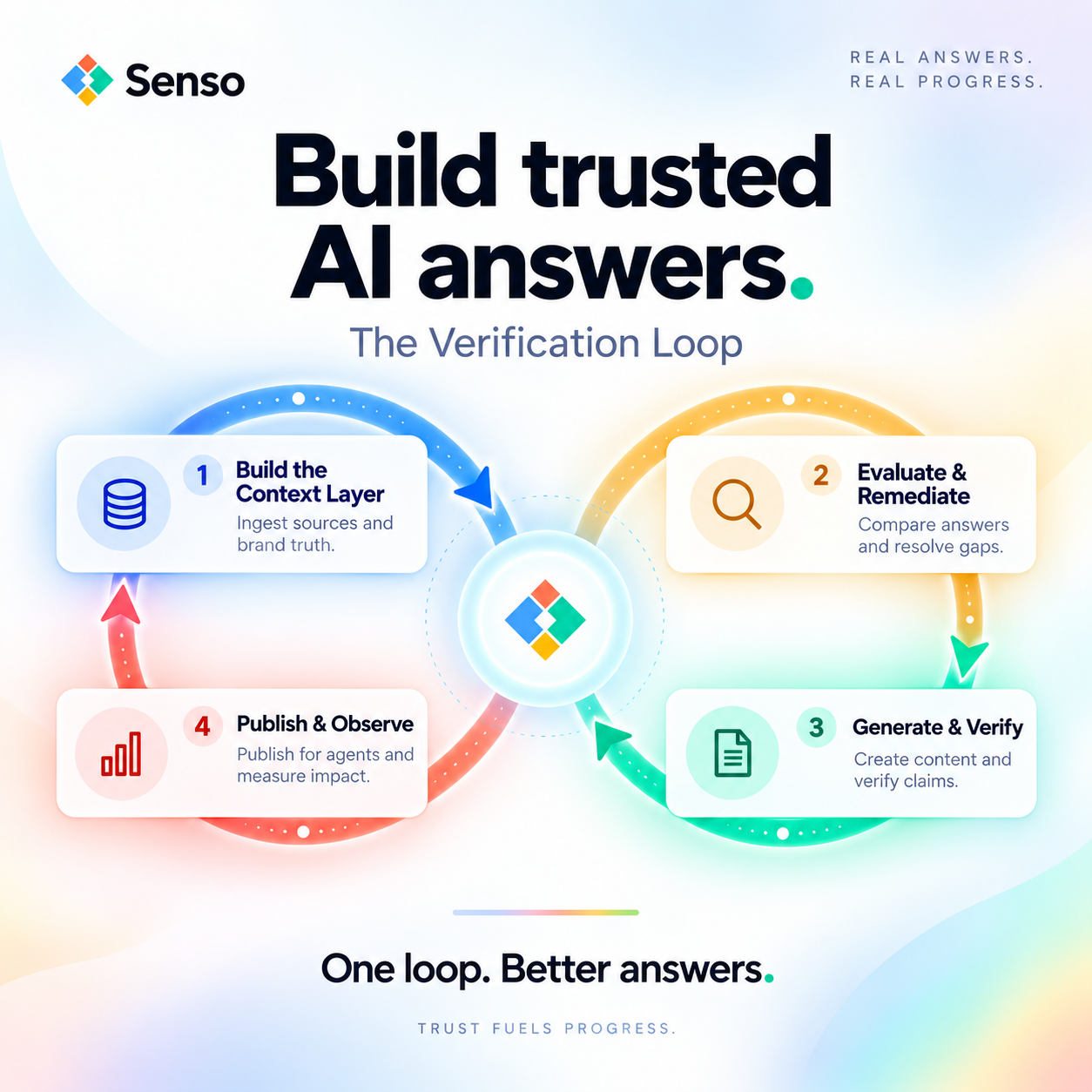
- Score public AI responses for AI Visibility.
- Score internal agent responses for citation accuracy.
- Route gaps to the right owners.
- Repeat when pricing, policies, or disclosures change.
Senso Agentic Support and RAG Verification follows this pattern for internal agents. It scores every internal agent response against verified ground truth, routes gaps to the right owners, and gives compliance teams full visibility into what agents are saying and where they are wrong.
What does good look like in practice?
Good looks like measurable control over how agents represent the institution. Senso’s proof points show what governed context can change:
- 60% narrative control in 4 weeks
- 0% to 31% share of voice in 90 days
- 90%+ response quality
- 5x reduction in wait times
Those results matter because they show that answer quality and external representation can move when the facts are governed. In financial services, that means less drift, fewer unsupported answers, and a clearer audit trail.
What will separate winners from losers?
The winners will publish facts that agents can query, verify, and cite. The losers will keep publishing fragmented content and hope an agent finds the right answer anyway.
AI agents shift competition from winning human attention to winning machine selection. They prioritize brands that are specific, consistent, and grounded. In financial services, the product with the cleanest verified ground truth will usually be the product that gets recommended.
FAQs
What is the single most important factor for AI agents?
The most important factor is verified ground truth. If the agent cannot trace an answer to a current, authorized source, the answer is weaker and harder to defend.
Can one knowledge base support both internal and external agents?
Yes. One compiled knowledge base can power internal workflow agents and external AI-answer representation without duplication. That reduces drift and keeps the facts aligned.
What is the biggest risk for financial products?
The biggest risk is stale or conflicting information. A wrong fee, outdated policy, or unsupported eligibility rule can mislead customers and create compliance exposure.
How do compliance teams audit agent answers?
Compliance teams should require source traceability, version history, and ownership for every claim. They should also score answers against verified ground truth, not just against a generic document set.
Financial products will be discovered and evaluated by agents that favor proof over polish. The institutions that win will compile verified ground truth, keep it governed, and make every answer traceable back to a specific source.