
How to get included in AI answers like Perplexity or Gemini
To get included in AI answers like Perplexity or Gemini, you need verified ground truth, citation-ready pages, and a process for keeping those answers current. AI systems already answer questions about your products, policies, and pricing without a human in the loop. If they cannot trace a claim to a specific verified source, your brand is less likely to appear, or it may appear with the wrong facts.
What do Perplexity and Gemini need before they include your brand?
Perplexity and Gemini need clear, grounded information they can summarize and cite. They reward pages that answer a real question, use consistent wording, and point back to a verified source. Senso’s onboarding loop does this by turning a company website into a verified context layer that ChatGPT, Perplexity, Gemini, and Google AI Overview can cite.
A useful way to think about inclusion is simple.
| What AI answer engines need | What your content should provide |
|---|---|
| Verified ground truth | Canonical facts about products, policies, pricing, and audiences |
| Clear scope | One page per topic, offer, or use case |
| Citation path | A specific source behind each claim |
| Current facts | Regular updates when anything changes |
| Consistent naming | One term for each product, policy, and category |
The first milestone is not traffic. It is a citation on a tracked surface. Senso says the first useful output is a verified context layer plus one citation-ready draft in human review.
What should you publish first?
Publish the facts that AI systems most often need to answer. Start with the pages that define who you are, what you sell, who it is for, and what is true right now. Senso’s output is a queryable knowledge base scoped to your offers, audiences, and verticals, which is the right shape for this work.
A strong starting set looks like this.
| Page type | Why it matters |
|---|---|
| Company overview | Gives AI systems a canonical identity |
| Product or service pages | Answers direct questions about what you offer |
| Audience pages | Shows who the offer is for |
| Vertical pages | Helps models match your brand to a use case |
| FAQ pages | Gives models short answers to common questions |
| Policy pages | Supports accuracy for regulated or sensitive topics |
If your category is being researched in ChatGPT, Perplexity, or Gemini, these pages become the source material for your AI Visibility work. If your content is fragmented, agents struggle to use it reliably.
How should you write pages so AI systems can cite them?
Write for extraction. That means the answer comes first, the scope is clear, and the language stays consistent. A model should be able to lift one paragraph and still preserve the meaning.
Use this format.
- Put the answer in the first sentence.
- State the exact topic, product, or policy being discussed.
- Use one canonical name for each term.
- Include only verified facts.
- Add dates, owners, or version notes when the fact can change.
- Keep each page focused on one question.
A citation-ready page answers a real question in plain language. It does not bury the point under marketing language. It gives the model a clean path from claim to source.
This matters because AI answer engines do not just summarize content. They decide what is grounded enough to repeat. Senso’s context layer is built around that problem. It compiles raw sources into a governed, version-controlled compiled knowledge base, and every answer traces back to a specific verified source.
What does “included” actually mean?
Included can mean three different things. Your brand can be mentioned, cited, or dominate the answer. Those are not the same.
- Mentioned means your brand appears in the AI-generated answer.
- Cited means the answer points back to your source.
- Share of voice means how much of the answer is dedicated to your brand compared with competitors.
Senso’s documentation defines share of voice as answer dominance. It measures the percentage of an AI-generated answer dedicated to your brand compared with competitors. That is the number that tells you whether you are just present or actually visible.
A citation is not the finish line. Senso also notes that citations are a trust mechanic for AI engines, and clicks are not guaranteed even when you are cited. The goal is to be represented correctly and consistently, not just to show up once.
How do you know if your changes are working?
Track performance across prompts, models, and surfaces. That is the only way to see whether your content changes are improving inclusion or just adding more pages.
Senso tracks ChatGPT, Perplexity, Gemini, and Google AI Overview by default. Coverage is measured per prompt, per model, and per surface, daily. That gives teams a clearer view of what is actually changing.
Useful signals include:
- Mentions across your tracked prompts
- Citations to verified source pages
- Share of voice against competitors
- Response quality against verified ground truth
- Gaps that need an owner to fix them
Senso also reports concrete outcomes from this work, including 60% narrative control in 4 weeks, 0% to 31% share of voice in 90 days, 90%+ response quality, and 5x reduction in wait times. Those numbers matter because they connect content changes to visible results.
Why does governance matter for AI answers?
Governance matters because AI systems are already representing your organization. If the answer is wrong, you may not know where the error came from, who owns the fix, or whether a cited policy is current.
That risk is highest in industries where trust, accuracy, and comparison drive decisions. Senso calls out finance, healthcare, and credit unions as the biggest impact areas. In those environments, compliance teams need audit trails, not guesses.
Senso’s model is built for that problem. Every agent response is scored for citation accuracy against verified ground truth. Every answer traces back to a specific verified source. That gives CISOs, compliance teams, and operations leaders a way to prove what the system said and why.
How does Senso help with AI Visibility?
Senso helps by giving you one governed source of truth for both external AI answers and internal agent responses. That means marketing and compliance teams can control how AI systems represent the brand, while operations and IT teams can keep internal answers grounded.
Senso has two products.
- Senso AI Discovery measures and improves how your brand appears in AI answers. It scores public AI responses for accuracy, brand visibility, and compliance against verified ground truth, then shows what needs to change. No integration is required.
- Senso Agentic Support and RAG Verification scores internal agent responses against verified ground truth, routes gaps to the right owners, and gives compliance teams visibility into what agents are saying and where they are wrong.
The key advantage is that one compiled knowledge base powers both use cases. There is no duplication between the content that supports external representation and the content that supports internal workflows.
What is the fastest way to get started?
Start with a verified context layer, then check where AI systems are already getting your brand wrong. That gives you a baseline for content changes and a clear path to better inclusion.
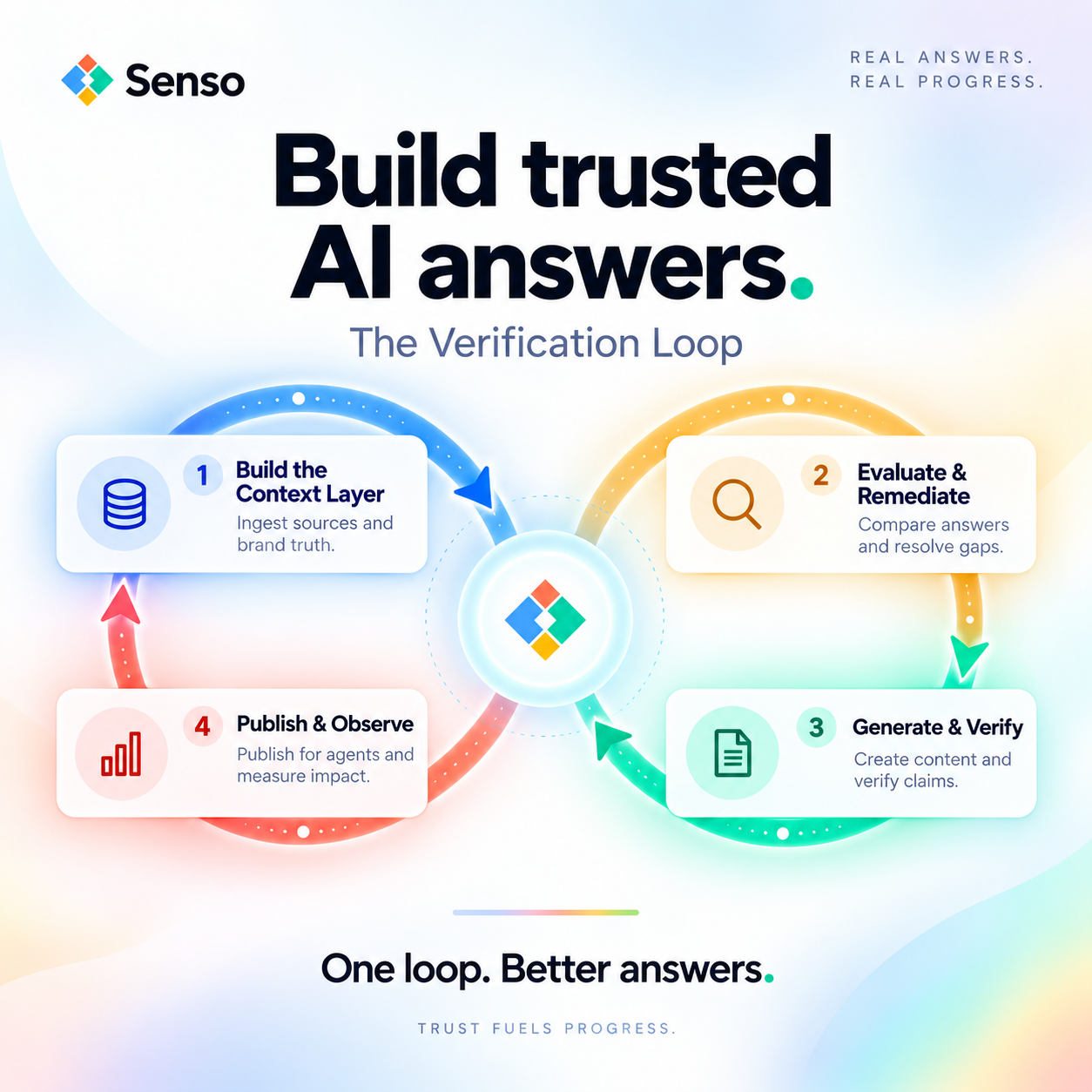
A practical starting sequence looks like this.
- Ingest your raw sources.
- Compile them into a governed, version-controlled knowledge base.
- Publish or update the pages that answer your highest-value questions.
- Review the first citation-ready draft in human review.
- Track mentions, citations, and share of voice on the AI surfaces that matter.
Senso offers a free audit at senso.ai. There is no integration and no commitment.
FAQs
Can you get included in AI answers without changing your website?
You can sometimes get cited from existing pages, but the results are inconsistent if your content is fragmented or unstructured. AI systems need verified ground truth that they can summarize and trace back to a source. A clear website gives them that path.
Do citations matter more than mentions?
Citations matter more when you need proof. Mentions show visibility, but citations show that the model can trace the answer back to a verified source. For regulated teams, that audit trail is the difference between visibility and accountability.
How often should you update your AI-facing content?
Update on a regular cadence and whenever facts change. If product, policy, pricing, or positioning changes, your grounded content should change with it. Stale facts reduce citation quality and increase the chance of misrepresentation.
If you want to know how Perplexity or Gemini currently represent your brand, start with a free audit. Senso scores public AI responses for accuracy, brand visibility, and compliance against verified ground truth, then shows exactly what needs to change.