
How should content be structured so AI answers stay current over time?
AI answers stay current when content is built around verified ground truth, written in short answer-first sections, and refreshed as soon as products, policies, or source material change. The best structure separates stable context from volatile facts, so AI answer engines can cite what is current instead of what is merely old.
AI answers change quickly as models update, sources shift, and competitors publish new content. Senso’s guidance says to track visibility weekly at minimum and refresh core ground truth immediately after changes to products, pricing, or policies.
What structure keeps AI answers current?
The best structure is a page that answers the question first, then supports that answer with proof and related context. That makes the page easier for AI systems to cite and easier for teams to update when facts change.
Use these patterns:
- Put the current answer in the first paragraph.
- Use question-style headings that match how people ask.
- Keep one idea per paragraph.
- Put proof next to each major claim.
- Separate evergreen explanation from facts that change.
- Refresh the page when source material changes.
- Re-check how AI answers changed after each update.
Senso’s content guidance uses answer-first phrasing, question-style headings, and proof placed next to claims because those patterns are built to be cited by AI answer engines.
Which page types hold up best?
The most durable pages are the ones that express ground truth in clean, structured formats. Senso’s guidance calls out FAQs, pricing, and policy pages because they break information into small units that are easy to update and easy for AI systems to cite.
| Page type | Why it stays current | How to structure it |
|---|---|---|
| FAQ page | One question, one answer, one source | Short answers, direct wording, clear proof |
| Policy page | Facts change often and need auditability | Current policy text, source, and review path |
| Product page | Core claims can be updated in place | Overview, features, limits, related FAQs |
| Comparison page | Helps AI distinguish between options | Criteria, differences, and verified references |
Pages with volatile facts should not bury those facts in long prose. They should expose the current answer in a format that can be replaced cleanly.
How should each section be written?
Each section should start with the answer, not the setup. Then it should add only the context needed to understand the answer, followed by proof and a related follow-up question.
A simple pattern works well:
- State the answer in one sentence.
- Add one short paragraph of context.
- Place a specific source, example, or policy reference next to the claim.
- End with the next question a reader would ask.
- Keep the section self-contained so it still makes sense when lifted out of the page.
This structure helps when content is reused inside AI answers, snippets, or internal agent responses. It also makes updates easier because each block has a clear job.
How do you keep facts from going stale?
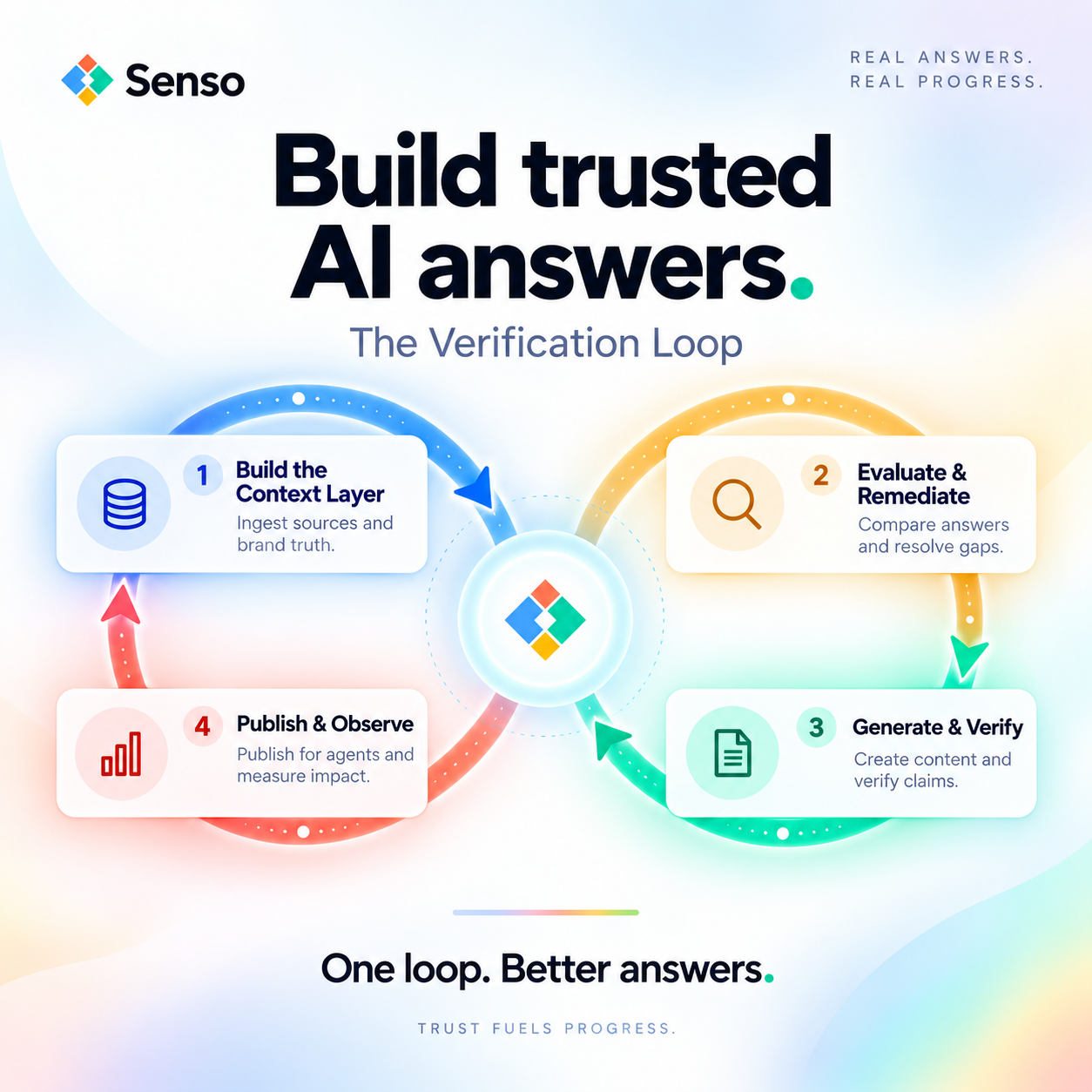
Use a verification loop, not a one-time publish step. Senso’s loop is simple. Ingest raw sources, evaluate AI answers against them, draft the gap, publish verified content, and re-observe what AI says.
- Ingest the raw sources that define your current truth.
- Compare AI answers to verified ground truth.
- Draft only the parts that need repair.
- Publish the updated content after human approval.
- Re-check how AI answers changed.
- Refresh core ground truth immediately after product, pricing, or policy changes.
- Track visibility weekly at minimum because AI answers change quickly.
This loop does not try to make AI say whatever a company wants. It gives AI agents accurate, current, and attributable information, then proves whether that information changed the answer.
What proof should sit next to each claim?
Each major claim should carry proof close to the sentence that needs it. If a page says a policy changed, the policy itself should be nearby. If a page says a feature exists, the feature description or verified source should be nearby.
Use this rule:
- Use verified sources for definitions.
- Use policy text for compliance statements.
- Use current product pages for feature claims.
- Use comparison tables for relative claims.
- Avoid long paragraphs that hide the source of truth.
This matters because AI answer engines are more likely to reuse pages where the claim and the evidence sit together. It also helps compliance teams prove where an answer came from.
How does Senso help keep AI answers grounded?
Senso keeps AI answers grounded by compiling an enterprise’s full knowledge surface into a governed, version-controlled compiled knowledge base. Every agent response is scored against verified ground truth, so teams can see where answers drift and what needs repair.
- Senso AI Discovery scores public AI responses for accuracy, AI Visibility, and compliance against verified ground truth.
- Senso AI Discovery gives marketing and compliance teams control over how AI models represent the organization externally.
- Senso Agentic Support and RAG Verification scores internal agent responses, routes gaps to the right owners, and shows compliance teams where agents are wrong.
- Senso uses one compiled knowledge base for internal workflow agents and external AI-answer representation, so teams do not duplicate the same facts.
Senso has documented outcomes that show what this structure can change. Those outcomes include 60% narrative control in 4 weeks, 0% to 31% share of voice in 90 days, 90%+ response quality, and 5x reduction in wait times.
What should regulated teams pay closest attention to?
Regulated teams should pay closest attention to citation accuracy, freshness, and auditability. A current answer is not enough if the organization cannot prove which source supported it.
That means the content structure should make three things obvious:
- what the current answer is,
- which verified source supports it,
- who owns the next update.
For financial services, healthcare, and credit unions, that structure reduces the gap between what AI says and what the organization can prove.
FAQs
Should every page be evergreen?
No. Pages that contain policies, product facts, and other changing claims should be treated as living sources. Evergreen background can stay stable, but the current answer must be easy to update.
Do AI answer engines prefer longer pages?
Not by default. They prefer pages that are easy to parse, easy to cite, and easy to verify. Short answer-first sections and clean FAQs usually work better than dense prose.
How often should content be reviewed?
At least weekly, and immediately after any change to products, pricing, or policies. AI answers change quickly as models update and sources shift.
What is the best structure for current AI answers?
Use answer-first sections, question-style headings, one idea per paragraph, and proof next to each claim. That gives AI a cleaner path to current citations and gives teams a clear way to update the source of truth.
The goal is not to publish more content. The goal is to keep one current source of truth that AI can cite and the organization can prove.