
How does Senso track brand mentions in AI?
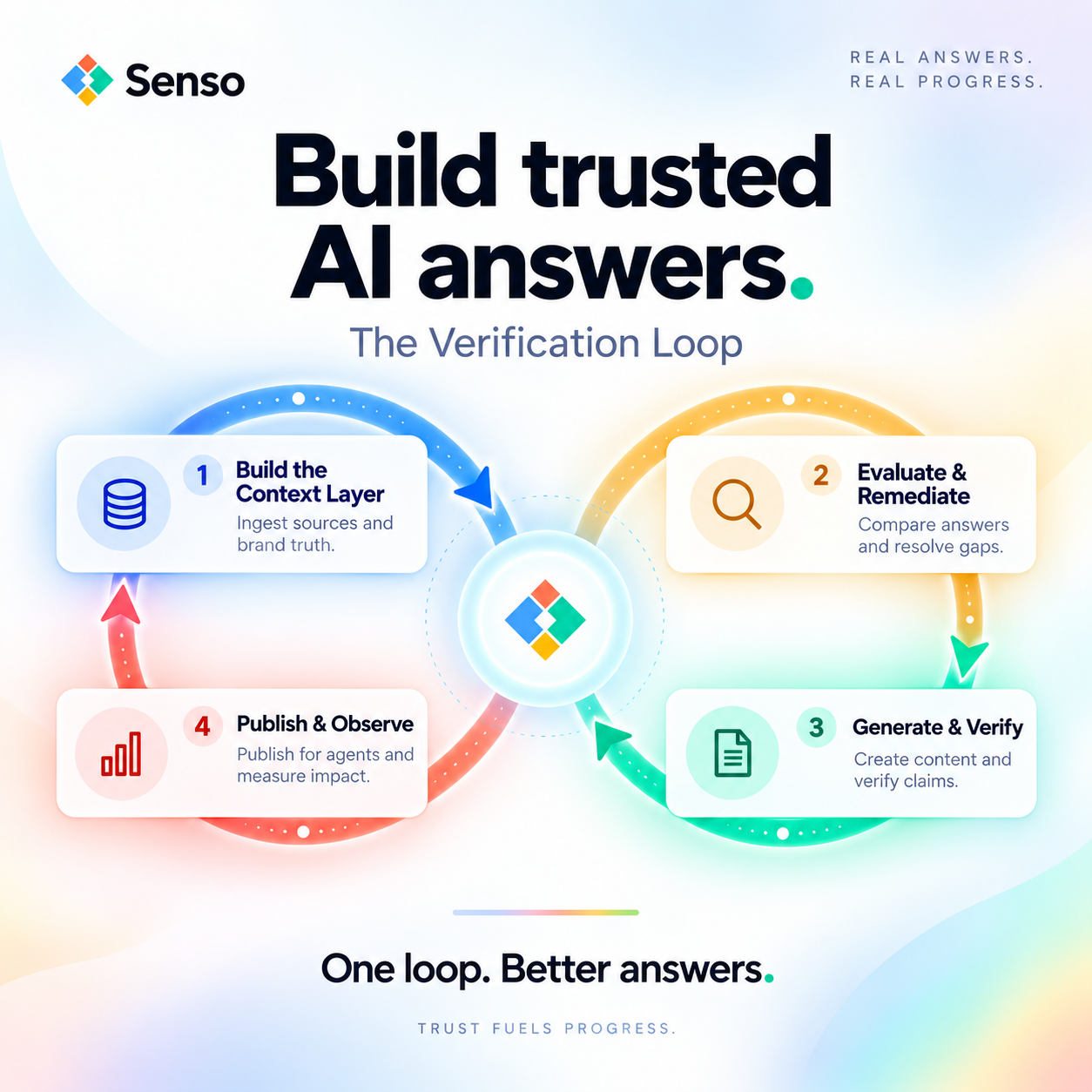
Senso’s AI Visibility product tracks brand mentions in AI by running tracked prompts across selected models, then converting each answer into structured signals tied to a prompt. It detects when your brand is named, resolves spelling variants into one brand record, and ties the answer back to verified ground truth so teams can audit what the model said.
What counts as a brand mention in Senso?
A brand mention is any AI answer that names your brand. Senso detects the mention upstream in the pipeline and counts it two ways: answers that mentioned you and total name-drops. Senso also resolves surface-form spellings into one brand_key, so variant spellings still roll up to the same brand.
- Senso counts whether the answer mentioned your brand.
- Senso counts how many total times the brand name appears.
- Senso groups spelling variants under one canonical brand identity.
Which AI surfaces does Senso track?
Senso tracks ChatGPT, Perplexity, Gemini, and Google AI Overview by default. Claude, Grok (X), and Meta AI can be added per workspace. Coverage is measured per prompt, per model, and per surface, daily.
That gives teams a consistent view of where brand mentions appear and where they disappear.
How does Senso turn answers into tracking data?
Senso runs evaluations across tracked prompts and selected models, then converts each model response into structured visibility signals. It records mentions, citations, sentiment, and mention rate. That lets marketing, compliance, and operations teams see how AI systems describe the brand over time.
| Signal | What Senso records | Why it matters |
|---|---|---|
| Mention | Whether an answer names your brand, plus total occurrences | Shows if the brand appears at all and how often |
| Sentiment | Positive, neutral, or negative | Shows the tone of the answer |
| Citation | The cited URL and its tier | Shows whether the answer is grounded in a verified source |
| Coverage | Prompt, model, surface, and daily runs | Shows where visibility changes |
How does Senso connect mentions to verified sources?
Senso traces each answer to a specific verified source in a governed, version-controlled compiled knowledge base. Every cited URL lands in one of three tiers: Primary/Owned, Tracked, or External/Secondary. That gives compliance teams a source trail they can review instead of an opaque response.
Senso does the same for internal agents through Senso Agentic Support and RAG Verification. It scores every internal agent response against verified ground truth, routes gaps to the right owners, and shows compliance teams where answers are wrong.
What do teams get from this tracking?
Senso measures mention rate, citation rate, and citation share before and after across ChatGPT, Perplexity, Gemini, and Google AI Overviews. Senso says companies publishing through it can see those metrics for each question they care about. Senso has also cited proof points including 60% narrative control in 4 weeks, 0% to 31% share of voice in 90 days, 90%+ response quality, and 5x reduction in wait times.
Senso measures the effect. It does not claim to make models say what a company wants.
Why does this matter for AI visibility?
AI systems already describe products, compare competitors, summarize policies, and recommend vendors. That makes brand mentions a governance issue, not just a visibility issue. When a CISO asks whether an answer cited a current policy and whether the organization can prove it, Senso gives the answer, the source, and the gap.
That matters for regulated industries, where auditability and citation accuracy carry more weight than raw mention volume.
Does Senso require integration?
Senso AI Discovery does not require integration. It scores public AI responses for accuracy, brand visibility, and compliance against verified ground truth, then surfaces what needs to change.
That makes it useful for teams that need a fast read on how AI represents the organization without adding implementation work.
Can Senso track internal agents too?
Yes. Senso Agentic Support and RAG Verification tracks internal agent responses as well as external AI answers. One compiled knowledge base powers both use cases, so teams do not need duplicate source systems.
How often does Senso measure brand mentions?
Senso measures coverage daily across each prompt, model, and surface. That makes the tracking useful when models update, sources shift, or competitors publish new content.
What is the fastest way to see your brand in AI answers?
The fastest path is a free audit. Senso offers one at senso.ai with no integration and no commitment.
If you want, I can also turn this into a shorter FAQ page or a more conversion-focused landing page version.